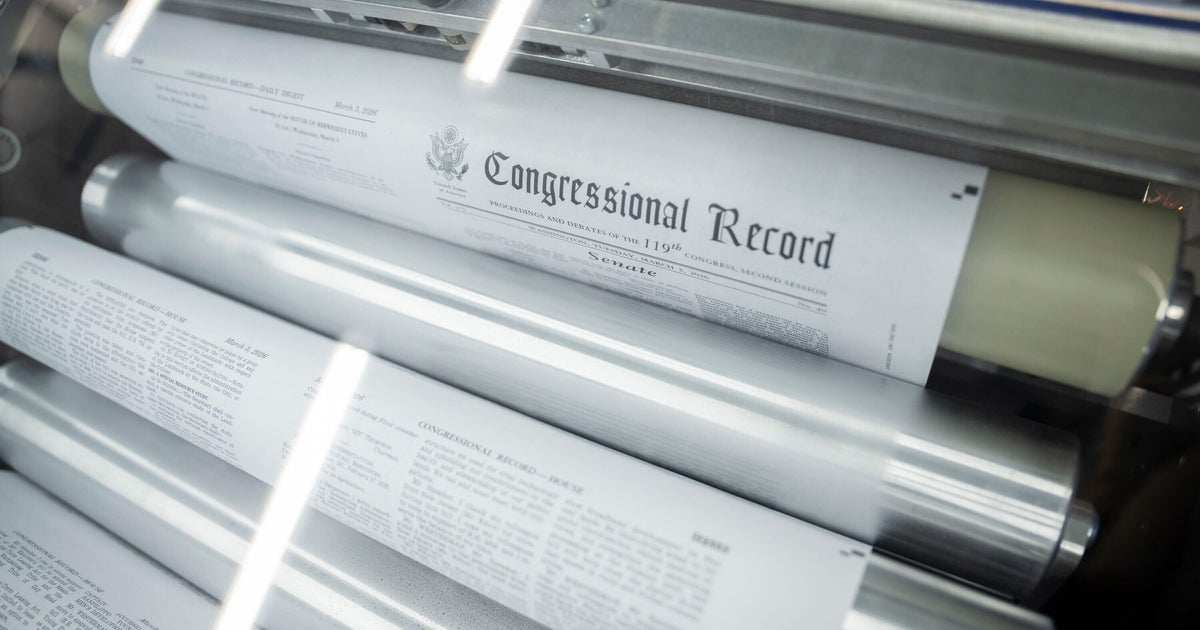
In the heart of Washington, D.C., just a few blocks away from the U.S. Capitol, stands a large, imposing red-brick building. This is the headquarters of the Government Publishing Office (GPO), the agency responsible for producing the Congressional Record. Every night, while most of Washington sleeps, dozens of workers inside this building perform an unheralded task that is crucial to the functioning of Congress and the preservation of the country’s democratic processes. They compile, edit, and print the first draft of the history of Congress.
The Congressional Record is a complete daily account of the proceedings of the U.S. Congress. It chronicles everything that happens on the floor of the House and Senate, from the speeches and debates to the votes and legislative actions. It is a meticulous record of the work of the people’s representatives, capturing not just the momentous decisions but also the mundane details of the legislative process. In short, it encapsulates the essence of democracy in action.
The production of the Congressional Record is one of the unseen cogs in the congressional machine. Known by few but relied upon by many, it is a vital part of the democratic process. This article will explore the history of the Congressional Record, how it is created, and the invaluable role it plays in the functioning of the U.S. Congress.
## A “Substantially Verbatim” Account of Congress
The first Congress convened in 1789, but it was not until nearly a century later, in 1873, that the Congressional Record was first published. Before its inception, information about the internal workings of the legislative branch was sparse and fragmented. Newspaper reporters provided coverage of the floor proceedings, but their accounts were often incomplete and biased.
“There was definitely a demand for what was going on on the floor of Congress,” said Daniel Holt, an associate Senate historian. “The problem was that there wasn’t a mechanism in place to systematically record and publish this information.”
To fill this gap, a number of publications sprang up, though their relationship with lawmakers was notably different from the dynamic that exists today between reporters and politicians. For example, one well-known newsman was known to share a snuff box with the vice president while on the Senate floor.
However, the demand for a more formal and impartial record of congressional proceedings continued to grow. In response, the Government Publishing Office produced the first copy of the Congressional Record on March 5, 1873. The publication was dedicated to chronicling everything that happened in the House and Senate, offering a “substantially verbatim” account of the proceedings.
There are “few documents more important than the Congressional Record,” said Lyndon B. Johnson, who was the Senate majority leader in 1956. “Locked in its pages are the debate, the resolutions, the bills, the memorials, the petitions, and the legislative actions that are the reason for the existence of the Senate [and the House]. It is a document that affects our laws, our precedents, and our judicial decisions.”
The Congressional Record is not designed to be read cover to cover, like a novel or a newspaper. It is printed on 11 x 8.5-inch paper, and its thickness varies depending on the activity of Congress on the previous day. For example, on April 29, when both chambers were in session, the Record ran for 233 pages. On May 4, when both chambers were on recess, the Record was just 22 pages.
Across its four sections, the Congressional Record provides a “substantially verbatim” account of the happenings on Capitol Hill. Everything that is said and done on the floor of each chamber is transcribed and divided into three columns per page. It also includes a “Daily Digest” of chamber action and committee meetings, and a section for extensions of remarks, which allows House members to submit words they never spoke aloud on the floor.
Interestingly, the inclusion of remarks that were not actually spoken on the floor has been a source of controversy for decades. It highlights the importance of what gets included in the Record and what does not. For example, in 1972, a speech attributed to Rep. Hale Boggs of Louisiana appeared in the Record two days after he died in a plane crash.
“He obviously didn’t do that two days after he had passed. He did the arrangements before he was leaving town,” Holt explained. “But this led to that question of, ‘OK, what is in the Record, and how is it related to what is actually said on the floor of Congress?'”
In response to this and similar incidents, the rules were changed to indicate when a speech had been added to the Record. However, lawmakers could bypass these changes by delivering the beginning of their remarks on the floor and submitting the rest for inclusion later. Additional reforms were implemented in the 1980s.
“The rules were essentially put in place that said speeches can still be edited for clarity and things of that sort, but they ought not to be edited for substance,” Holt said.
With the advent of video cameras in the House in 1979 and in the Senate in 1986, the Congressional Record was no longer the sole account of congressional proceedings. However, it continued to provide a more comprehensive picture of what was happening on Capitol Hill.
“Ultimately, the point of it is still what it’s always been, which is to provide readers with as comprehensive a record as possible of the issues and debates about them and the different viewpoints that go into the lawmaking process,” Holt said.
## The Making of the Congressional Record
The process of creating the Congressional Record begins in the Capitol, where every speech and action on the floor of each chamber is logged from gavel to gavel. When a lawmaker speaks, a team of floor reporters takes down every word in shorthand using stenotype machines. Working in 15-minute shifts, they can capture up to 225 words per minute.
Off the floor, the reporters work with editors to convert their shorthand notes into polished documents. This process takes about an hour and a half for every 15 minutes of floor time in the House, and between two and three hours in the Senate. After several rounds of editing, the transcripts are compiled with vote tallies, committee reports, and other materials.
The process then moves to the headquarters of the Government Publishing Office, located on North Capitol Street. Once the world’s largest printing plant, the GPO is housed in a seven-story, red-brick Romanesque Revival building that was constructed in 1903. The building sits on the same spot that housed the GPO when it was established on the day of Abraham Lincoln’s inauguration in 1861.
Once the editing is completed on Capitol Hill, the documents are sent to