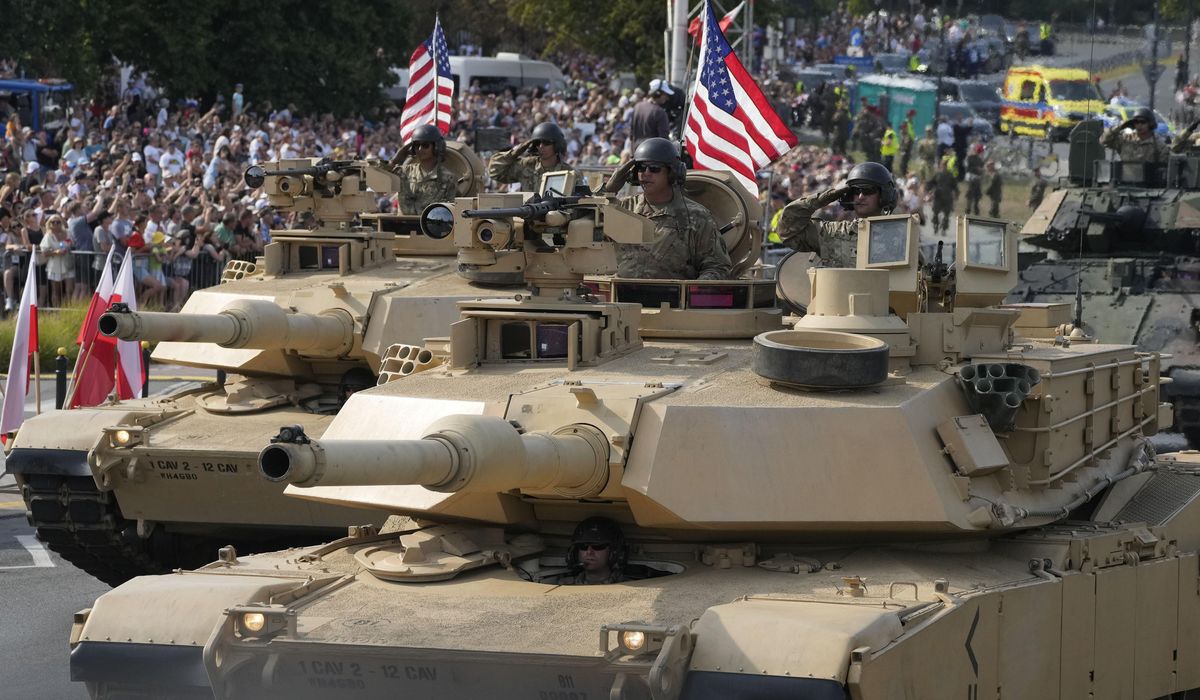
In a significant announcement made on Thursday, President Donald Trump unveiled his decision to deploy an additional 5,000 U.S. troops to Poland. This decision marks a stark reversal of an earlier resolve to cease certain deployments to Europe. The announcement, which was made public on Truth Social, has been linked directly to President Trump’s rapport with the recently elected Polish President, Karol Tadeusz Nawrocki.
Karol Tadeusz Nawrocki, a conservative and nationalist leader, assumed the mantle of the Polish presidency in August 2025. His political ideology and beliefs resonate with those of President Trump, making him a natural ally. This alignment of political ideals, coupled with the endorsement from President Trump in the recent elections, has played a crucial role in shaping the decision to increase U.S. military presence in Poland.
The 45th President of the United States stated, “Based on the successful Election of the now President of Poland, Karol Nawrocki, who I was proud to Endorse, and our relationship with him, I am pleased to announce that the United States will be sending an additional 5,000 Troops to Poland.” This statement not only reaffirms President Trump’s support for Nawrocki but also underlines his commitment to strengthening ties with Poland.
However, this resolution comes on the heels of a series of fluctuating decisions made by the U.S. administration. In recent days, President Trump made headlines when he announced the withdrawal of thousands of American troops from Germany. The decision was seen as a response to the contentious exchanges between President Trump and German Chancellor Friedrich Merz, particularly concerning the U.S. approach to negotiations with Iran.
The oscillating decisions sparked widespread speculation and anticipation of similar troop withdrawals from Poland. The mere thought of such a move elicited significant concern, both domestically and internationally. The concern stemmed from the belief that a reduction in American military presence could potentially destabilize the region and invite unwelcome advances from adversarial nations. Hence, the announcement of an increase in troop deployment has been received with relief and approval by many.
Polish President Karol Nawrocki, known for his conservative and nationalist views, has been somewhat reticent in his approach towards the European Union. This reluctance to align too closely with the EU has been interpreted as a strategic move to foster stronger relations with the United States and other non-EU nations. The decision by President Trump to increase troop deployment in Poland is viewed as a testament to the success of President Nawrocki’s strategy.
In reaction to the news of the additional troop deployment, Piotr Müller, a member of the European Parliament, expressed his approval. He lauded the decision as advantageous for the security of Poland and issued a warning to Brussels-aligned politicians in Poland. He urged them not to squander this opportunity and to recognize the importance of the U.S. troops for the security and stability of the nation.
Müller stated, “This is how you ensure Poland’s security. Do not waste this opportunity that has just presented itself.” His statement underscores the strategic significance of the U.S. troop deployment to Poland. It serves as a reminder to the politicians in the country that their actions and decisions should be guided by the broader security interests of Poland, rather than by their political affiliations or individual agendas.
In conclusion, the decision by President Trump to deploy an additional 5,000 U.S. troops to Poland represents a significant shift in the U.S. military strategy in Europe. It underscores the strengthening ties between the United States and Poland, driven by the mutual respect and alignment of political ideologies between the leaders of the two nations. The move is also indicative of President Trump’s commitment to ensuring the security and stability of its allies, despite previous decisions to reduce military presence in other parts of Europe.