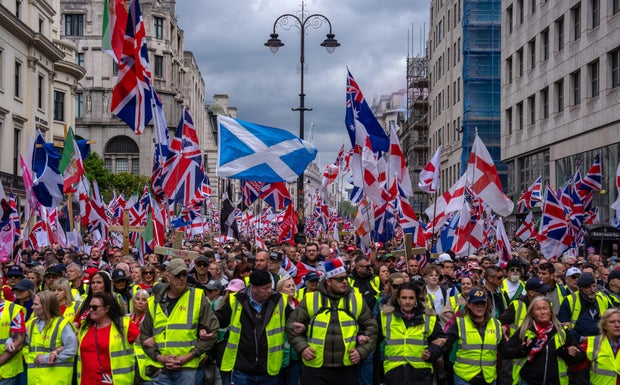
On a bustling Saturday in central London, scenes of a major rally cut across the heart of the city. Tens of thousands gathered for the “Unite the Kingdom” march spearheaded by far-right activist Tommy Robinson. With police estimates placing attendance around 60,000, it marked one of the largest right-wing mobilizations Britain has witnessed in recent years, although numbers fell short of a similar rally led by Robinson the previous September.
Tommy Robinson, former head of the nationalist and anti-Islamist English Defence League, stands as one of the most influential far-right voices in Britain. The demonstration highlighted a deep-seated angst among its participants—a fear of losing what they perceive as British identity.
The marchers—a sea of St. George’s Cross and Union flags—voiced their discontent loudly as chants of “we want Starmer out” and “Christ is King” resonated through the streets. The attire of many reflected international political influences, with several donning red “Make England Great Again” hats, clearly reminiscent of the former U.S. President Donald Trump’s campaign paraphernalia.
Attendees expressed a multitude of motivations for their presence. Many cited feelings of being sidelined by the government, unease about the country’s trajectory, and a particularly sharp pang over what they described as the diminishing place of Christianity in UK society. Among these demonstrators, Christian imagery was potent and pervasive; large wooden crosses were visible above the crowd, participants waved crucifixes, and some dressed as Knights Templar—a nod to historical Christian figures often romanticized by nationalist groups.
Chris Wickland, a self-proclaimed priest from the Confessing Anglican Church, captured this sentiment in his statement to the press, emphasizing a perceived erosion of Christian values in British society.
Diversity in representation included one man draped in an Israeli flag at the rally, who declared his reason for attending was to “bring back Judeo-Christian values to this nation.” Identifying as a British Protestant, he underlined the UK’s long-standing alliance with Israel.
Other protestors brought up issues related to national services and governance. Complaints ranged from the state of the National Health Service, with one wheelchair-bound woman highlighting the “silly” waiting times, to broader feelings of national decline voiced by a veteran who felt his service had become inconsequential.
The rally also featured international dimensions, with some participants representing the Iranian opposition, flaunting pre-revolutionary Iranian flags to signal their solidarity against authoritarian regimes.
At the helm, Tommy Robinson addressed the crowd from a stage in Parliament Square, harnessing the moment to urge political activism among his followers. With Britain’s next general elections in the offing, his call to action was unequivocal: engage, register to vote, become activists. During his speech, Robinson also extended gratitude to billionaire Elon Musk, crediting him for making the rally possible and instigating a surge of “Elon” chants among the participants. Musk previously made a virtual appearance at a Robinson-led rally, advocating for a political overturn in Britain.
Although Robinson did not explicitly endorse any political party, he nudged his supporters towards right-leaning and nationalist groups such as Reform UK.
Aside from the day’s charged speeches and chants, the demonstration was a massive operation for law enforcement. With London also hosting a large pro-Palestinian Nakba Day march the same day, the Metropolitan Police orchestrated one of their largest public order operations in recent years. About 4,000 officers were deployed, supported by mounted units, drones, helicopters, and advanced surveillance technology, including live facial recognition at key transit points, to prevent clashes between contrasting groups.
Prime Minister Keir Starmer critiqued the rally, labeling it a vessel for “hatred and division” and reflective of the challenges facing societal harmony in Britain. Amidst this political turmoil, Starmer faces his own battles, with internal pressures mounting within his Labour Party and calls for his resignation gaining momentum after disappointing local election results.
By late afternoon, the Metropolitan Police reported 31 arrests across both demonstrations, though noted that incidents were largely isolated with the wider proceedings largely passing without significant disruption. The cost of the policing operation was projected to hover around £4.5 million.
The rally, while a show of strength from Robinson’s faction, undoubtedly brought to the forefront deep national divisions, illustrating the growing polarization within British society. As tensions simmer in various facets of British politics and social life, the path ahead remains contentious, shadowed by the larger issues of identity, heritage, and the defining values of modern Britain.