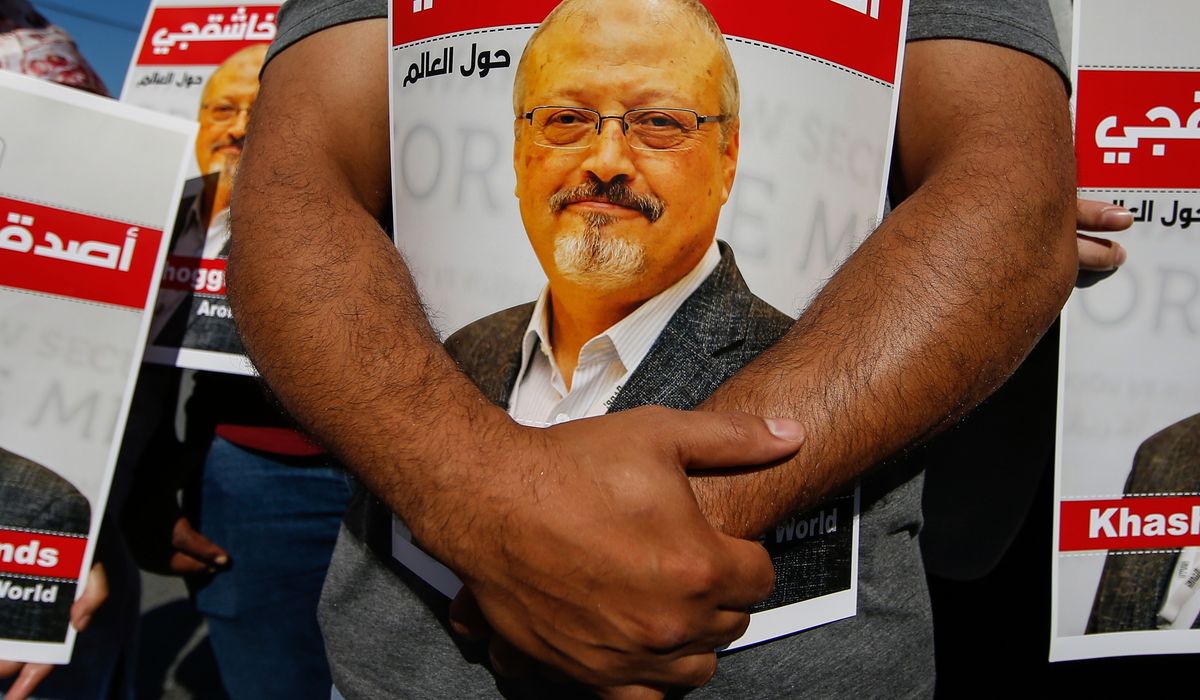
In a significant development, France’s national anti-terrorism prosecutor’s office, known as the PNAT, announced on Saturday that a French investigating judge will scrutinize a complaint filed by two human rights organizations implicating Saudi Crown Prince Mohammed bin Salman in the brutal murder of journalist Jamal Khashoggi in 2018. The case will now be taken up by an investigating judge from the crimes against humanity unit, following a ruling by the Paris Court of Appeal on May 11.
The complaint was lodged by two prominent rights groups, Trial International and Reporters Without Borders. These organizations accuse the Saudi crown prince of complicity in acts of torture and enforced disappearance in connection with the murder of Khashoggi, a Saudi dissident journalist, and columnist for the Washington Post, who met a gruesome end within the confines of the Saudi Consulate in Istanbul in October 2018.
Khashoggi was a known critic of the Saudi regime and had been living in self-imposed exile in the United States for about a year, writing articles critical of Crown Prince Mohammed bin Salman. On October 2, 2018, he entered the Saudi Consulate in Istanbul to obtain documents for his upcoming marriage to a Turkish woman, never to be seen alive again. His body was dismembered and disposed of in a manner that it has never been found.
The details of Khashoggi’s death sent shockwaves around the world, leading to a significant diplomatic crisis for Saudi Arabia. While the Saudi government initially denied any knowledge of Khashoggi’s fate, it later admitted that he was killed in a “rogue operation” that did not involve the crown prince.
The PNAT explained that the Paris Court of Appeal found the complaints lodged by the rights groups to be admissible because it could not be ruled out at this stage that the case might be classified as a crime against humanity. Such a classification could potentially encompass the underlying crimes of torture and enforced disappearance.
The prosecutor’s office noted the court’s decision but emphasized that the ruling did not undermine its own interpretation of the French criminal procedure rules that govern whether the groups were entitled to file the complaint as civil parties. This indicates that the legal process is complex and that the road to a potential trial may be long and fraught with legal detours.
The French complaint against Prince Mohammed was initially filed in 2022, during a visit to France by the crown prince. This was a time when the prince had been facing international isolation following the killing of Khashoggi but has since been welcomed once more by Western leaders and dignitaries.
The initiation of a French judicial inquiry does not imply that Prince Mohammed has been formally charged or that French judges have found him culpable. Instead, it signifies that an investigating judge will assess whether the complaint has enough merit to give rise to further proceedings.
Prince Mohammed has consistently denied ordering Khashoggi’s murder but has conceded that it transpired during his tenure as Saudi Arabia’s de facto ruler. This admission led to speculation about the extend of his involvement or knowledge of the operation.
Contradictorily, U.S. intelligence agencies had previously concluded that the crown prince approved the operation that led to Khashoggi’s killing. This further fueled the controversy and led to strained relations between the US and Saudi Arabia for a time.
Saudi Arabia conducted a closed-door trial over the killing and claimed to have penalized those responsible. However, the trial was criticized by rights groups as opaque and inadequate, with many believing that the true instigators and planners of the murder were not held accountable.
In conclusion, the decision by the French court to allow an investigative judge to examine the complaint against Saudi Crown Prince Mohammed bin Salman marks a significant step in the ongoing quest for justice for Jamal Khashoggi. While the process is expected to be lengthy and complex, it reinforces the importance of accountability and the rule of law. It remains to be seen how this development will impact the already complex diplomatic relations between Saudi Arabia and the West.