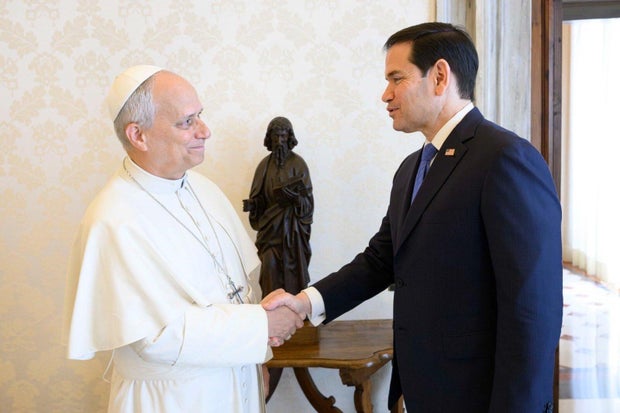
In a significant diplomatic endeavor bridging the realms of religion and politics, Secretary of State Marco Rubio engaged in substantive discussions with Pope Leo XIV at the Vatican, aiming to address the tumultuous situation in the Middle East and explore areas of mutual interest between the United States and the Holy See. This meeting, occurring against the backdrop of a recent spat between Pope Leo, the first American-born pontiff, and President Trump, was a crucial step toward re-fortifying the traditionally strong alliance between the U.S. and the Vatican.
During the encounter, which took place on a Thursday, both leaders deliberated over several pressing issues, particularly the ongoing conflicts and humanitarian crises in the Middle East. The discussion was part of a broader agenda to further peace initiatives and promote human dignity across the globe. According to State Department spokesperson Tommy Pigott, “The meeting underscored the strong relationship between the United States and the Holy See and their shared commitment to promoting peace and human dignity.”
The talks were not limited to the Pope and Rubio; the U.S. Secretary of State also met with Cardinal Pietro Parolin, the Vatican’s Secretary of State. Pigott elaborated on their dialogue, noting that Rubio and Cardinal Parolin discussed “mutual cooperation and pressing international issues” and “efforts to achieve a durable peace in the Middle East.” It’s clear that the discussions were comprehensive, covering a variety of topics that underscore the Vatican’s influence in international affairs and its potential role as a peacemaker.
The significance of these meetings was heightened by the recent public disagreements between Pope Leo XIV and President Trump. Relations were strained following the Pope’s comments on social media on Palm Sunday, where he emphasized the peaceful teachings of Jesus Christ and explicitly rejected war and the use of religious justification for it. His message, “This is our God: Jesus, King of Peace, who rejects war, whom no one can use to justify war. He does not listen to the prayers of those who wage war, but rejects them,” resonated as a firm theological stance against conflict, indirectly critiquing policies perceived as belligerent.
This indirect reproach appears to have incited President Trump’s ire, leading to a series of critical remarks against the Pontiff. The zenith of this conflict seemed to occur following a “60 Minutes” segment that broadcast cardinals discussing Pope Leo’s criticism of Trump’s foreign policy, particularly regarding Iran and immigration. Subsequently, Trump lambasted Pope Leo on social media, even going so far as to post an AI-generated image that depicted him in a Christ-like pose, which he later removed after wide criticism across the political spectrum.
Despite this recent volatility, by the time of Rubio’s visit, there appeared to be a cooling of direct confrontation. However, just prior to Rubio’s departure for the Vatican, President Trump made remarks on a radio show hosted by Hugh Hewitt, suggesting that the Pope’s approach could potentially endanger many people due to his stance on international conflicts and weapons proliferation.
Amidst these swirling controversies, both Rubio and Vice President JD Vance, also a Catholic, were put in the challenging position of having to navigate their faith with their political alignments, especially given the Pope’s clear and pointed messages on matters of war and peace. Vance himself noted the importance of caution when public figures discuss issues within their domains, be it public policy or theological matters.
This series of engagements at the Vatican, with both religious and political implications, vividly illustrates the complex interplay between leading global institutions and the significant figures at their helms. The dialogues between Secretary Rubio and the Vatican not only aimed to mediate existing tensions but also sought to solidify a collaborative approach towards peacebuilding and the promotion of human rights, marking a noteworthy moment in contemporary diplomatic history.
As the world grapples with complex international challenges, the outcomes of such high-level meetings could potentially pave the way for more coordinated and humanitarian responses to global crises, highlighting the enduring importance of dialogue and cooperation between nations and influential non-state actors like the Holy See. The meeting between Rubio and Pope Leo XIV thus stands as a poignant reminder of the potential for diplomatic engagements to foster peace and understanding on the global stage.