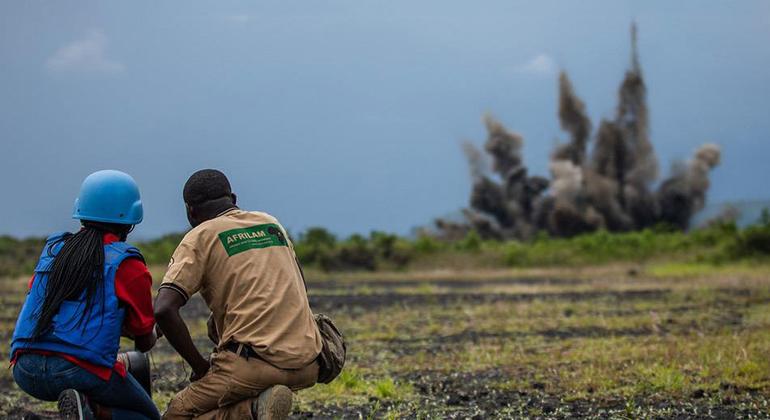
Landmine technology in the Ukraine conflict is paving the way for a new era of development, utilizing 3D printers to produce basic models of landmines that can be easily assembled, filled with explosives, and deployed by drones close to the battlefield. The majority of mines currently being laid in Ukraine are done remotely, whether through artillery, rockets, helicopters, or drones.
Paul Heslop, the Head of the UN Mine Action Service in Ukraine, highlighted the deployment of more high-tech mines in the conflict zone, making landmine detection a much more complex and dangerous task. These advanced mines are equipped with sensors that can detect the presence of deminers approaching, whether on foot or in a vehicle, and then detonate. Some mines even possess magnetic influence capabilities, causing them to explode when exposed to the magnetic field of a detector.
Mr. Heslop emphasized the challenges faced in the arms race of clearing mines faster than the technology to prevent their clearance is being developed. As the International Day for Mine Awareness and Assistance in Mine Action is commemorated on April 4th, the focus remains on finding new solutions to protect civilian lives and minimize the impact of landmine contamination on communities.
Deminers are actively seeking innovative ways to address the deployment of landmines, particularly those that do not penetrate the surface when laid remotely. This characteristic makes detection easier using drones and advanced sensor technology, as compared to traditional buried mines.
Efforts are being made to leverage technology, such as drones and robots, to neutralize the threat posed by landmines. However, despite these advancements, the pace of mine deployment globally continues to outstrip the rate of clearance. Since 2015, there has been a concerning trend of increasing contamination daily, surpassing the clearance efforts.
UNMAS estimates reveal the extensive scale of landmine contamination in Ukraine, with over 139,000 square kilometers of land affected, impacting over six million people and costing the economy billions of dollars annually. The presence of landmines not only poses a threat to life but also results in severe injuries, with over 60,000 war amputees in Ukraine alone.
The insidious nature of landmines lies in the perceived contamination, rendering vast swathes of land unusable and inaccessible due to the fear of hidden explosives. This has a profound impact on millions of civilians, limiting their ability to move freely and utilize the land for various purposes.
In response to the escalating landmine crisis, mine action groups are continuously exploring new technologies and strategies to combat the proliferation of mines. The use of drones, robots, and advanced sensor technology is proving to be effective in detecting and neutralizing landmines, particularly those laid remotely near the battlefield.
The collaboration between the UN Mine Action Service, local authorities, and international partners is crucial in addressing the complex challenges posed by landmines in conflict zones. By leveraging innovation and expertise, deminers aim to enhance their capacity to clear mines more efficiently and protect civilian populations from the devastating impact of landmine contamination.
As the world commemorates the International Day for Mine Awareness and Assistance in Mine Action, the focus remains on raising awareness about the dangers of landmines and mobilizing support for mine action initiatives globally. It is imperative to work collectively to eradicate the threat of landmines and create a safer environment for communities affected by conflict.