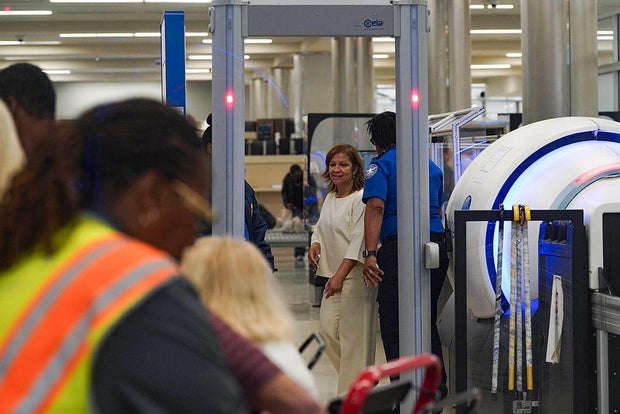
In a recent and unexpected maneuver instigated by the Trump administration, the President announced a directive to deploy Immigration and Customs Enforcement (ICE) agents at U.S. airports. This move, aimed at bolstering security amid the ongoing partial government shutdown, has sent ripples through the Department of Homeland Security (DHS) and raised concerns among airport personnel and travelers alike.
Over the weekend, President Trump took to his social media platform, Truth Social, to declare his intentions if congressional Democrats did not reach an agreement to fund DHS, which supervises the TSA and ICE among other agencies. He posted that ICE agents would be directed to airports on Monday to enhance security measures and potentially make arrests of individuals residing illegally in the U.S. This announcement has led to a frenzied response from ICE officials who were not previously informed about the directive, leaving them scrambling to formulate a feasible enforcement strategy.
This revelation was unexpected and has evidently caught DHS and ICE officials off-guard, causing a major stir within the agency’s ranks. According to several employees who spoke to CBS News under the condition of anonymity, there is a discernible air of confusion and disarray regarding how to implement the President’s orders effectively. One DHS employee candidly admitted the lack of clarity about the plan, highlighting the suddenness and the logistical complications of the directive.
Meanwhile, the pressure on airport security has been growing due to an uptick in resignations and sick calls from TSA personnel, significantly exacerbated by the ongoing government shutdown which has left many employees working without compensation. This strain was particularly evident on Saturday, which recorded the highest number of nationwide call-outs, with over 3,250 TSA employees absent. Over 400 officers have left the agency, according to DHS reports, putting additional strain on the operational capacity at several major U.S. airports.
In an effort to address these challenges, the White House’s border czar, Tom Homan, discussed on CNN the potential operational roles ICE agents may play at airports. Homan suggested that ICE could primarily focus on securing critical points of exit and entry, thereby freeing up TSA agents to concentrate on their pivotal roles in passenger and luggage screening. He also mentioned that ICE’s participation could extend to ID checks but remained non-committal on whether their duties would include carrying out immigration law enforcement arrests at these locations.
Though there was talk of using ICE agents to alleviate staffing shortages at airports, a former senior ICE official interviewed by CBS News expressed skepticism regarding the agents’ suitability for tasks that are more technical, such as operating screening machinery, given their training and expertise are more aligned with law enforcement than aviation security. The former official pointed out that augmenting airport security with Customs and Border Protection officers would be more logical, given their existing role and familiarity with international airports.
Amidst these operational challenges and strategic deliberations, DHS’s Acting Assistant Secretary, Lauren Bis, commented on the situation, emphasizing that while the administration’s aim is to ensure safety and reliability in air travel, the resistance from Democrats to fully fund DHS is jeopardizing these efforts.
The response from the Democratic side, as voiced by DHS, revolves around certain immigration enforcement reforms they want the administration to adopt. These include conditions like preventing ICE agents from wearing masks during operations.
As these developments unfold, the Flight Attendants Union has called on legislators to quickly resolve funding issues and pay TSA workers, criticizing the deployment of ICE at airports as a superfluous measure that distracts from more effective solutions. They argue that ICE’s presence could complicate missions, diluting the focus from essential security surveillance to immigration status inquiries, which might compromise overall security effectiveness.
This narrative places considerable emphasis on the specialized training TSA workers undergo, a rigorous regimen that ICE personnel do not possess, and which cannot be rapidly acquired.
The unfolding situation marks another chapter in the ongoing debates and policies surrounding national security and immigration under the Trump administration. As tensions continue to escalate over funding and operational mandates, the impacts are becoming increasingly visible, affecting not only the agencies involved but also the millions of travelers who depend on their services.