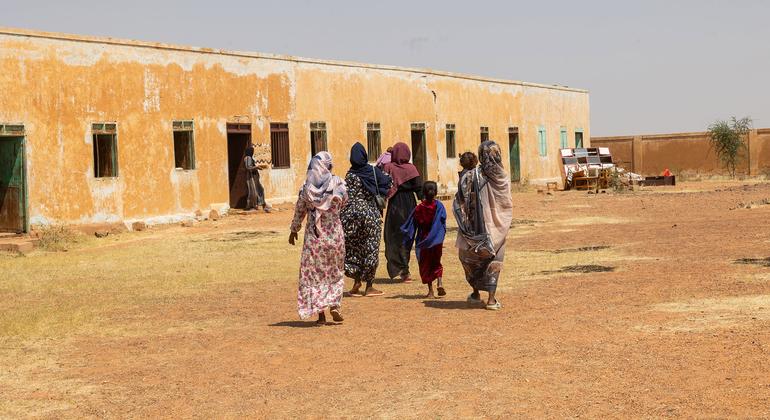
The ongoing conflict in Sudan has forced countless individuals to flee their homes in search of safety, with reports indicating that people are moving out of fear rather than by choice. Mohamed Refaat, the Chief of Mission in Sudan for the International Organization for Migration (IOM), spoke from Port Sudan to journalists in Geneva, urging all Member States and anyone able to provide support to ensure the protection of Sudanese people.
Recent reports from the war-torn country have highlighted the heavy shelling by the paramilitary Rapid Support Forces (RSF) and their allies in the Sudan People’s Liberation Movement-North (SPLM-N) on residential buildings in Dilling, South Kordofan. The conflict between the RSF and the Sudanese army has been ongoing since April 2023, following a breakdown in the transition to civilian rule. The paramilitary force overran El Fasher, the regional capital of North Darfur, after a 500-day siege, leading to further mass displacement and deep concerns for those trapped inside the city.
“People are scared,” stated Mr. Refaat, emphasizing that the displacements in Kordofan are driven by fear. Displaced individuals are fleeing from areas such as Babanusa, Kadugli, and El-Obeid. There are growing concerns for vulnerable populations, with only women and children arriving in areas like White Nile and Gedaref to the east. The prevailing insecurity and violence in Sudan pose significant protection risks for civilians and hinder safe humanitarian access.
The situation in Kadugli, the capital city of South Kordofan, has deteriorated rapidly, with recent drone attacks claiming the lives of six peacekeepers from Bangladesh. These peacekeepers were stationed at a logistics base in Kadugli as part of the UN force in Abyei, a disputed region on the border with South Sudan. Mr. Refaat estimated that around 90,000 to 100,000 people in Kadugli are at risk of displacement if the fighting persists, with El-Obeid also on the brink of being the next city under attack, potentially impacting over half a million individuals.
Regarding the crisis in El Fasher, the displacement tracking matrix of the IOM has recorded over 109,000 people who have fled the city and its surrounding villages since its fall to the RSF. Many of these displaced individuals are struggling to move further due to logistical and security challenges, raising concerns about their ability to survive when essential resources have been severely depleted.
The humanitarian situation in Sudan continues to worsen, with humanitarian aid organizations facing challenges in providing assistance to those in need. The United Nations and its partners are working tirelessly to address the growing needs of displaced populations and ensure their protection and well-being.
As the conflict in Sudan rages on, the international community must step up its efforts to support the vulnerable populations affected by the crisis. It is imperative that all parties involved prioritize the safety and security of civilians and facilitate humanitarian access to ensure that life-saving assistance reaches those in need. Only through collective action and solidarity can we hope to alleviate the suffering of the people of Sudan and work towards a peaceful resolution to the conflict.