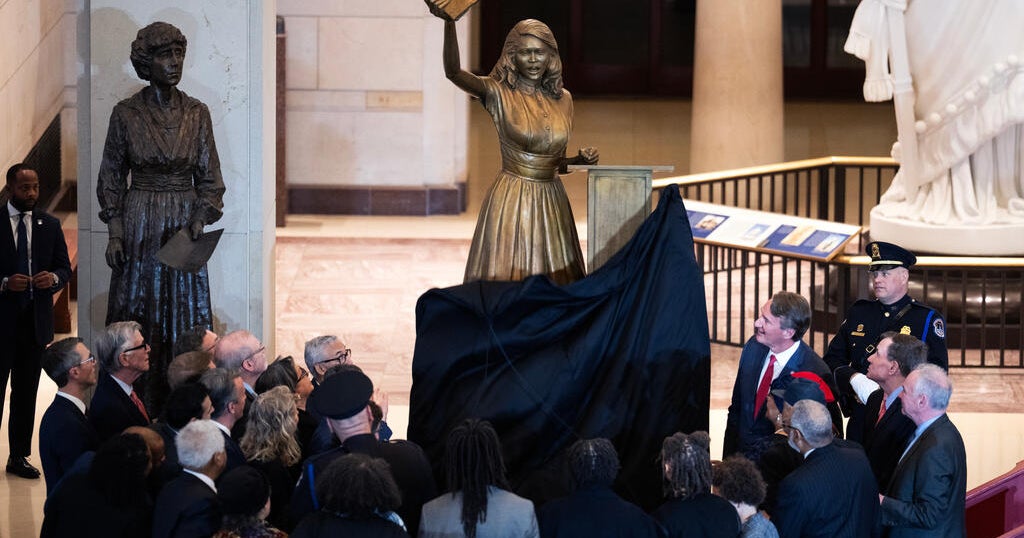
On the 8th of February, an emblematic symbol of the civil rights movement and an icon of unyielding spirit against racial segregation took her place in the U.S. Capitol. A statue of a teenage Barbara Rose Johns, protesting against the dire conditions of her racially segregated high school, was unveiled in the Capitol. This historical moment made a powerful statement as the statue replaced one of Confederate Gen. Robert E. Lee that had been removed several years prior.
The unveiling ceremony of the statue, which will represent Virginia in the U.S. Capitol, took place in the hallowed Emancipation Hall. In attendance were notable figures from both sides of the political aisle, including Republican House Speaker Mike Johnson, Democratic Minority Leader Hakeem Jeffries, Republican Virginia Gov. Glenn Youngkin, Virginia’s congressional delegation, and Democratic Gov.-elect Abigail Spanberger.
Speaker Johnson noted that over 200 members of Johns’ family were present at the ceremony, bearing witness to this monumental event. The ceremony was punctuated by the soulful renditions of “How Great Thou Art,” “Ain’t Gonna Let Nobody Turn Me ‘Round,” and “Total Praise,” performed by the talented choir from Eastern Senior High School in Washington.
Johnson, during his address, described Johns as “one of America’s true trailblazers, a woman who embodied the essence of the American spirit in her fight for liberty and justice and equal treatment under the law.” This indomitable spirit was showcased when, at the tender age of 16 in 1951, Johns led a student strike for equal education at the segregated R.R. Moton High School in Farmville, Virginia.
The protest, which Johns spearheaded alongside hundreds of her classmates, sought to bring attention to the overcrowded, dilapidated conditions of their school. This was especially poignant when compared to the well-maintained, spacious all-white schools in the same vicinity. The students’ cause was bolstered by the support of NAACP lawyers, who filed a lawsuit that would later become one of the five cases that the U.S. Supreme Court reviewed in the landmark Brown v. Board of Education case.
The Supreme Court’s decision in 1954, which declared “separate but equal” public schools unconstitutional, was a resounding victory for Johns and her classmates. It found that segregated schools were “inherently unequal,” thereby vindicating the students’ demands for equal educational facilities.
After her impactful contribution to the civil rights movement, Johns married the Rev. William Powell and took on the name Barbara Rose Johns Powell. She raised five children and served as a librarian in the Philadelphia Public Schools until her death at 56 in 1991. Terry Harrison, one of her daughters, described her mother as someone who “put God first in her life,” and as being “brave, bold, determined, strong, wise, unselfish, warm and loving.”
The statue, which now stands in the Capitol, depicts a young Johns standing to the side of a lectern, holding a tattered book over her head. The pedestal of the statue carries the engraving, “Are we going to just accept these conditions, or are we going to do something about it?” This message, together with a quote from the Book of Isaiah, “And a little child shall lead them,” encapsulates the spirit and courage of Johns’ actions.
This statue replaces the one of Lee that was removed in December 2020, following the heightened national attention over Confederate monuments after the death of George Floyd. The Lee statue had represented Virginia in the Capitol for 111 years before being relocated to the Virginia Museum of History & Culture.
Democratic Minority Leader Hakeem Jeffries, speaking at the ceremony, expressed that “the Commonwealth of Virginia will now be properly represented by an actual patriot who embodied the principle of liberty and justice for all, and not a traitor who took up arms against the United States to preserve the brutal institution of chattel slavery.”
Joan Johns Cobbs, Johns’ sister, read an entry from Johns’ journal during the ceremony. It read: “And then there were times I just prayed, ‘God, please grant us a new school, please let us have a warm place to stay where we won’t have to keep our coats on all day to stay warm. God, please help us. We are your children too.'”
The statue of Johns is part of the National Statuary Hall Collection at the Capitol, where each state is allowed to contribute two statues. Alongside Johns’ statue, the other representing Virginia is that of George Washington. The National Statuary Hall currently displays 35 of these statues, with others located in the Crypt, the Hall of Columns, and the Capitol Visitor Center. According to Johnson, the Johns statue will be placed in the Crypt.
Former Democratic Virginia Gov. Ralph Northam had requested the removal of the Lee statue. In December 2020, a state commission recommended replacing Lee’s statue with one of Johns. The Johns statue, which was sculpted by Steven Weitzman of Maryland, received its final approval from the Architect of the Capitol and the Joint Committee on the Library in July.
Johns’ legacy also continues to shine outside the Capitol. She is featured in a sculpture at the Virginia Civil Rights Memorial, located outside the state Capitol in Richmond. Her former high school, where she led the historic student strike, is now a National Historic Landmark and museum.
Republican Virginia Gov. Glenn Youngkin, speaking about the museum, said: “It’s an incredibly profound moment, a moment to stand in a tar shack classroom with a hot potbelly stove as a heater, tar paper walls, shabby desks, right where 16-year-old Barbara Rose Johns courageously organized her schoolmates and stood up to the lie — the lie was separate but equal.”