In the heart of the United States, in the state of Oklahoma, a young university student named Lukas is facing a challenging reality. He’s been granted a generous scholarship at his university. Still, the high rents outside the state have confined him to his current location. Even as he acknowledges the diminishing numbers in his community, he remains resilient, stating, “The general community is kind of shrinking, and, as time goes on, I imagine it’s just going to get smaller after this.”
Lukas’s sentiments echo those of many transgender people across Oklahoma. They have been witnessing a surge of legislative proposals that they regard as direct assaults on their rights and dignity. The introduction of several bills targeting sex education, outing transgender youth in schools, and criminalizing doctors who provide gender-affirming care has already created significant distress within the community. Consequently, many are rethinking their long-term plans to stay in Oklahoma, a place they have called home for years.
Recent legislative actions have forced many transgender people to confront the reality of their precarious situation. Even though lawmakers have retracted an attempt to raise the age to access gender-affirming care, they have already sent a clear message – the rights of transgender people of all ages in the state are under threat.
In Oklahoma City, Nile Glover, a 30-year-old transgender woman, has already made the heart-wrenching decision to leave. She and her partner, Violet, who identifies as nonbinary, are planning to relocate this month. When Glover learned about SB 129, she saw it as a warning sign. She commenced a crowdfunding campaign to cover her moving expenses as soon as the bill was introduced last month. With her partner, she drove out to Colorado in search of a new home.
Glover’s words are heavy with fear and resolution: “They’re very clearly coming for us specifically. We don’t want to stick around and wait for something to stick and live in whatever hellscape that’s going to be.” She had always intended to leave Oklahoma someday, but she never anticipated being forced out under such circumstances. “It sucks to be kind of ripped away from your family and everyone you care about,” she shared. “We’re basically starting over. That’s very scary.”
Nicole McAfee, the executive director of Freedom Oklahoma, a Two-Spirit LGBTQ advocacy organization, is closely tracking the legislative developments. Her organization believes that bills like SB 129 are proposed to intentionally appear extreme. This tactic allows legislators to strike a “compromise” that isn’t as radical as their original text. Freedom Oklahoma is monitoring at least 45 other state bills targeting LGBTQ people, with a dozen aiming to restrict access to trans healthcare. Both SB 250 and SB 252, which could limit public funding for care for minors, are likely to pass this year. Another bill, HB 1011, seeks to ban gender-affirming care for Oklahomans under the age of 21.
These bills stand in stark contrast to the recommendations of major medical associations, which consider gender-affirming care as “medically necessary” for transgender youth. The American Medical Association, for instance, has repeatedly stated that it is “inappropriate and harmful” for politicians to interfere with this type of care. McAfee underscores this point, saying, “It’s especially important to make sure that people know there’s not any age when it’s appropriate to ban best practice medical care for trans folks.”
Unfortunately, Oklahoma has already rolled back access to care for some transgender youth. In October 2022, Republican Gov. Kevin Stitt signed SB 3, which blocked funding for gender-affirming care for minors at OU Health, the state’s only children’s hospital.
On a recent Monday, Stitt delivered a State of the State address and made clear that restricting care to minors was a top priority. “I’m calling for the legislature to send me a bill that bans all gender transition surgeries and hormone therapies on minors in the state of Oklahoma,” he said to a standing ovation of legislators.
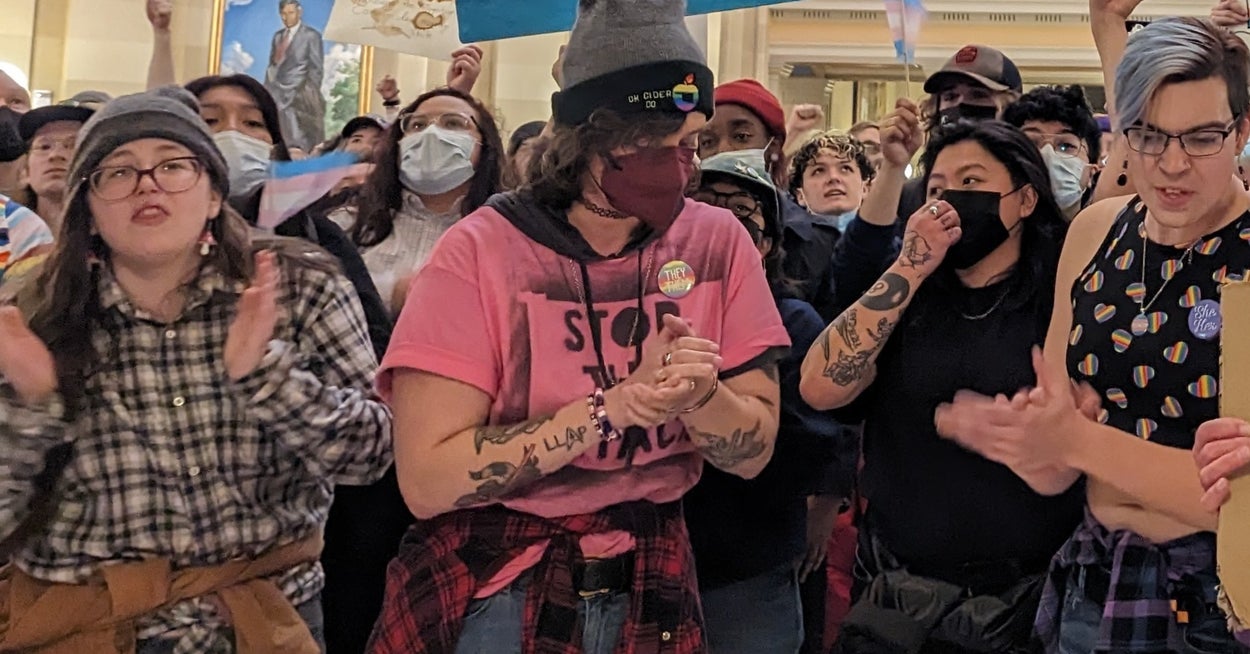
His statement, however, was met with significant opposition outside the state capitol building. Dozens of protestors — everyday transgender Oklahomans, organizers, and policy advocates — rallied in response to Stitt’s proposed future. Their voices echoed off the stone walls, a resonant testament to the ongoing struggle for rights and recognition in the state of Oklahoma.