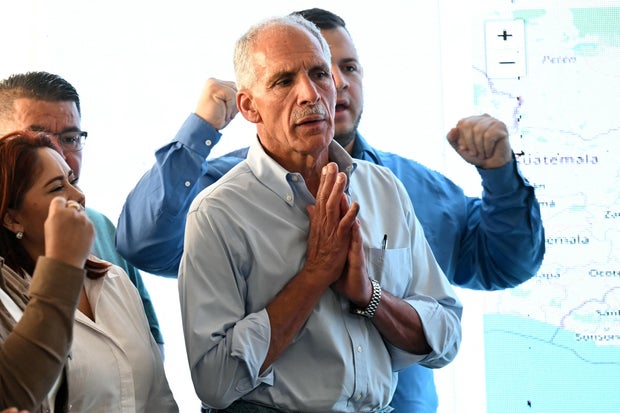
In a closely contested presidential election in Honduras, businessman Nasry Asfura, who received notable backing from former U.S. President Donald Trump, found himself in a near dead heat with a prominent rightwing television personality and political rival, Salvador Nasralla. The tension hung thick as initial results indicated a razor-thin margin separating the two candidates, reflective of the political polarization grappling one of Latin America’s poorest and most violence-stricken nations.
On Monday, Ana Paola Hall, head of Honduras’s National Electoral Council (CNE), announced that after a preliminary digital tally of Sunday’s ballots, 67-year-old Asfura led 72-year-old Nasralla by a mere 515 votes. She described the situation as a “technical tie”, urging for patience as the electoral body commenced a manual recount of the votes. The announcement left many on edge, given the high stakes involved in this election which notably left the ruling left-leaning party trailing far behind.
The buildup to this electoral showdown was notably influenced by international political dynamics, particularly from the United States. Former Mayor of Tegucigalpa, Asfura, won an endorsement from Trump just days before Hondurans went to the polls. Trump’s endorsement was part of his broader strategy to assert influence in Latin American politics, where he has not shied away from making bold statements and threats, including cutting aid to nations like Argentina and Honduras, depending on the electoral outcomes relative to his preferred candidates.
Trump’s influence loomed large; he took to his platform, Truth Social, to vocalize his concerns about the electoral process in Honduras. He claimed that the CNE had halted the vote counting on election night just as results were showing a close contest between Asfura and Nasralla. Trump warned of severe consequences should there be attempts to manipulate the election results. His intervention in the election followed his pattern of staunch support for right-leaning politicians across Latin America. Notably, his endorsed candidate in Argentina’s mid-term elections, Javier Milei, had emerged victorious, although it remained uncertain whether his backing would ensure a win for Asfura, whose campaign was themed, “Grandad, at your service!”
The potential political shift in Honduras has significant geopolitical implications, especially given the nation’s recent political history. A move back to the right could enhance U.S. influence at a time when the leftist government had been fostering closer ties with China. The campaign was also stirred by Trump’s surprising announcement that he would pardon former Honduran President Juan Orlando Hernandez, a member of Asfura’s National Party. Hernandez, who has denied any wrongdoing, is currently serving a 45-year sentence in the United States after being convicted for his involvement in extensive drug trafficking operations.
During Hernandez’s administration from 2014 to 2022, U.S. federal prosecutors argued that he transformed Honduras into a “narco-state,” contributing to the already intense levels of violence and poverty. The legacy of his governance and the subsequent U.S. legal actions against him were crucial backdrops to the unfolding electoral drama in Honduras.
This political and social context has forced many Hondurans to flee northward, escaping the dire socioeconomic conditions. Trump’s stringent immigration policies have further complicated these migration dynamics, drastically affecting remittances, which form a significant part of the Honduran economy. His administration’s actions have resulted in the deportation of nearly 30,000 Honduran migrants since his tenure began in January.
Local responses to the U.S.’s involvement in Honduran politics have been mixed. Some citizens, like fruit seller Esmeralda Rodriguez and merchant Michelle Pineda, expressed their independence, emphasizing their reliance on personal hard work over political developments influenced by foreign powers. Others, like Maria Velasquez, hoped for a government that could achieve favorable relations with Trump, aiding in their personal and national escape from poverty.
The election results were not just pivotal for the presidential seat but also impacted legislative and mayoral positions across the deeply divided country. While the nation’s political leaders have sporadically addressed issues like drug trafficking, violence, and economic instability, many Hondurans remain skeptical of substantive change post-election.
With final election results pending, due to a slow vote count, the atmosphere in Honduras remained fraught with anticipation and anxiety. Potential allegations of electoral fraud by either side could ignite further unrest in a country already struggling with profound challenges.
As the world watched, the unfolding electoral saga in Honduras not only highlighted the continued struggles within the nation but also underscored the significant international stakes involved, particularly from political figures like Trump who maintain considerable influence on the global stage. Whether this election would indeed tilt Honduras back towards the right or mark a continuation of leftist governance remained to be seen, with implications reaching far beyond its borders.