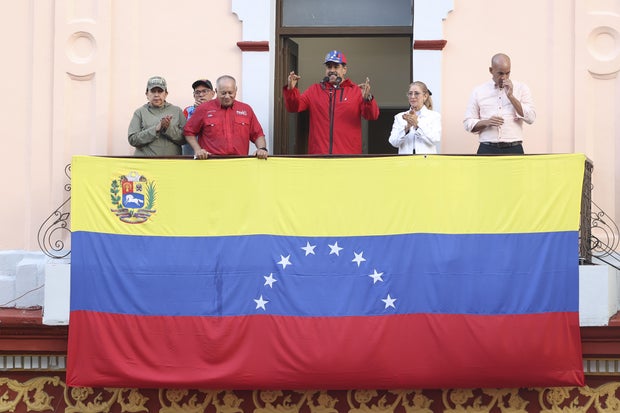
The U.S. government recently escalated its efforts to combat drug trafficking by designating the Venezuelan Cartel de los Soles as a foreign terrorist organization. The designation, which officially became effective on Monday, reflects the Trump administration’s hardened stance towards narcotics and terrorism, framing the issue within a broader geopolitical conflict with the Venezuelan government led by President Nicolás Maduro.
President Nicolás Maduro, recognized by the U.S. as the leader of the Cartel de los Soles, has condemned the designation as a spurious attempt by President Trump to justify unauthorized and punitive interventions aimed at regime change in Venezuela. In response, Maduro’s administration has issued a public rebuttal, dismissing the allegations of narco-terrorism as “ridiculous fabrications” intended to smear Venezuela and destabilize his rule.
This designation is not merely symbolic; it comes amidst a significant increase in military activities near Venezuela. The U.S. has deployed warships and over 10,000 troops to conduct training exercises in the region. More notably, the U.S. military has executed numerous strikes on vessels in the Caribbean it claims were engaged in illicit drug transportation, a number of which are alleged to have connections to the Tren de Aragua gang, another entity purportedly linked to the Maduro government.
Secretary of State Marco Rubio described the Cartel de los Soles as culpable for “terrorist violence … as well as trafficking drugs into the United States and Europe.” These allegations were compounded by July economic sanctions aimed directly at what Treasury Secretary Scott Bessent termed the “illegitimate Maduro regime’s facilitation of narco-terrorism.”
Understanding the Cartel de los Soles
The Cartel de los Soles does not resemble your typical narcotics cartel. Unlike the famed family-run Sinaloa or the Jalisco New Generation cartels, the Cartel de los Soles is a moniker for a loose network that predominantly involves Venezuelan military officials at various levels. The “Suns” in its name are symbolic of the sun insignias worn by high-ranking military officers in Venezuela—a practice that has persisted for decades.
This group was colloquially coined in the 1990s, largely related to high-ranking military officers enriched by drug trafficking. Over time, as Venezuela under Hugo Chávez and later Maduro saw an expansion in corruption, this term broadened to describe a network involving various governmental facets, including the police and other officials, engaged in illegal pursuits from mining to drug and fuel trafficking.
The term gained a more formal and accusatory dimension in 2020 when the U.S. Justice Department during Trump’s presidency indicted Maduro and several of his close allies for narcoterrorism, alleging direct cooperation with the Colombian rebel group FARC to facilitate cocaine trafficking through Venezuela to the U.S.
However, critics and analysts argue about the veracity and cohesiveness of this cartel as a structured entity. Adam Isaacson from the Washington Office on Latin America highlighted to The Associated Press that it’s misleading to envision the Cartel de los Soles as a tightly organized group with hierarchies and scheduled meetings—it’s rather a diffuse network embedded within Venezuela’s military and other state apparatus.
Implications of the Terrorist Designation
The recent terrorist designation introduces a new paradigm in the U.S. approach to dealing with the alleged narco-terrorist activities linked to Maduro’s administration. This shift is evident in the strategic military deployments and strikes conducted by the U.S. in the region, sparking debates over their legality and the overall goals of such aggressive maneuvers.
Secretary of Defense Pete Hegseth articulated that this designation extends “new options” to the U.S. in handling Maduro’s regime, though specific details about these options remain undisclosed. However, the substantial military presence, including advanced assets like the aircraft carrier USS Gerald R. Ford, signals a robust U.S. posture that could potentially support broader political objectives beyond counter-narcotics.
The situation remains tense and complex, with the U.S. justified interventions under the guise of combating drug trafficking and Maduro’s regime framing these actions as imperialistic threats to its sovereignty, potentially setting the stage for deeper international conflict. As this geopolitical chess game continues, the regional stability hangs in a delicate balance, with the international community watching closely.