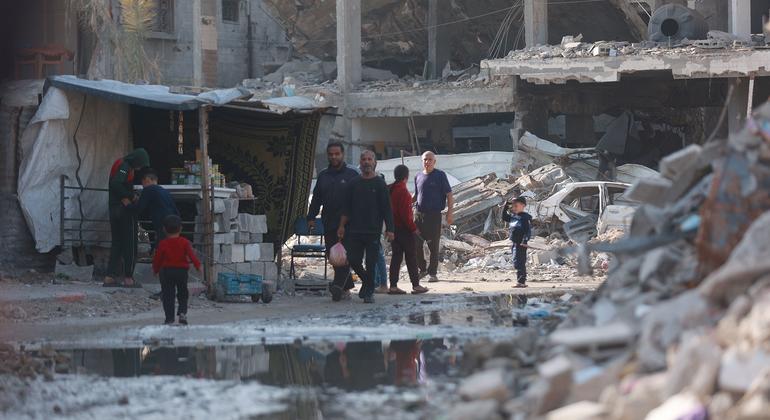
In a recent address at the launch of the United Nations Conference on Trade and Development (UNCTAD)’s 2025 Report on the Economy of the Occupied Palestinian Territory, the agency’s Deputy Secretary-General Pedro Manuel Moreno expressed grave concern over the dire economic situation in both Gaza and the West Bank. He highlighted the devastating impact of decades of movement restrictions and recent military operations, stating that these factors had “wiped out decades of progress” and left the Palestinian territories facing long-term devastation.
Moreno’s remarks were underscored by UNCTAD’s data, which revealed the extent of the economic collapse in Gaza. The report indicated that in 2024, Gaza’s GDP experienced an 83% decline compared to the previous year. This drastic decline led to GDP per capita plummeting to just $161 a year, equivalent to less than 50 cents per day, making it one of the lowest levels in the world. Additionally, Gaza’s economy shrank to just 13% of its size in 2022, indicating a severe contraction.
Senior economist Mutasim Elagraa, who oversees UNCTAD’s program supporting the Palestinian people, described the collapse as so severe that it had effectively erased seven decades of human development in Gaza. Elagraa highlighted that Gaza’s economy had lost 87% of its value since 2022, with GDP per capita reverting to levels seen 22 years ago. He emphasized that this economic crisis was the worst on record in recent decades, with national unemployment reaching 50% and Gaza’s unemployment rate surpassing 80%. Elagraa warned that multidimensional poverty now affected all residents of Gaza, further exacerbating the dire situation.
The West Bank was also not immune to the economic downturn, experiencing its most significant contraction on record. In 2024, the region’s GDP fell by 17%, while per-capita income dropped by nearly 19%. UNCTAD attributed this decline to various factors, including rising insecurity, intensified movement and access restrictions, expanding settlements, and the loss of access to 60% of West Bank land. These challenges have suppressed the economy for decades, hindering prospects for future recovery.
Moreno highlighted the fiscal strain facing the Palestinian government, describing it as the worst in history. Collapsing revenues and withheld fiscal transfers, which constitute over two-thirds of Palestinian tax income, have contributed to this dire financial situation. The report painted a bleak picture of the economic landscape in the occupied Palestinian territories, emphasizing the urgent need for intervention to prevent further deterioration.
The destruction of Gaza’s education system was also a cause for concern, with all schools and universities in the region being wiped out. This devastation has left children out of education for more than two years, representing a significant loss of human capital that will have lasting repercussions on society. Elagraa noted that this alone signified the collapse of a quarter-century of human development, stressing that education, skills, and the entire human development base had been shattered. Gaza had effectively lost 70 years of progress in this critical area.
The report estimated that over $70 billion would be required to rebuild Gaza, according to joint assessments by the UN, the European Union, and the World Bank. Elagraa emphasized that the recovery process would be arduous and protracted, spanning decades due to the extensive damage and loss incurred. The scale of reconstruction necessary to revive Gaza’s economy and infrastructure was staggering, underscoring the urgent need for international support and intervention.
In conclusion, UNCTAD’s report painted a grim picture of the economic situation in the occupied Palestinian territories, highlighting the urgent need for immediate action to address the ongoing crisis. The severe economic collapse in Gaza, coupled with the challenges facing the West Bank, underscored the pressing need for comprehensive assistance and support to prevent further deterioration and facilitate long-term recovery and stability. The international community must rally together to address the multifaceted challenges facing the Palestinian people and work towards sustainable solutions that will enable them to rebuild and thrive in the face of adversity.