The U.S. National Archives has recently unveiled an intriguing collection of government records that shed light on the captivating mystery of Amelia Earhart, the famed American aviator who mysteriously disappeared over the Pacific Ocean in 1937. This latest release includes a plethora of documents consisting of military reports, telegrams, memos, and other intriguing content that provides insight into Earhart’s ill-fated round-the-world flight attempt alongside her navigator, Fred Noonan.
Amelia Earhart’s story is not just the tale of an aviator, but a saga woven into the very fabric of 20th-century adventure and mystery. In 1937, Earhart, along with Noonan, embarked on what was to be a historic flight around the globe. The venture was ambitious and fraught with danger, and ultimately, it led to their disappearance, sparking decades of debate, theories, and explorations aimed at uncovering their fate.
The trigger for this new batch of declassified documents was an order from President Trump, directing the complete declassification and release of all U.S. government documents related to Earhart’s final expedition. Tulsi Gabbard, the Director of National Intelligence, stated that the materials released not only include newly declassified files from the National Security Agency but also encompass detailed accounts of Earhart’s last known communications, prevailing weather conditions, and the aircraft’s status at that time, along with key locations identified for search and rescue operations.
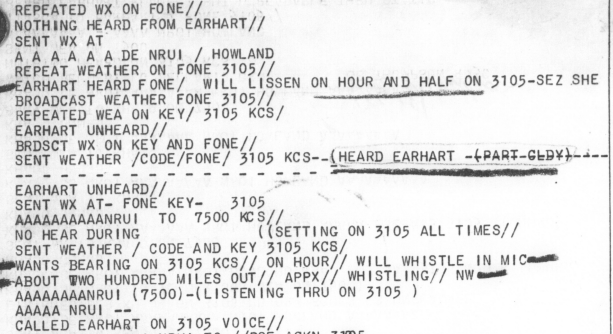
Among the intriguing documents made public is a radio log from July 1937 detailing communications with the U.S. Coast Guard cutter Itasca, the last vessel to have contact with Earhart and Noonan. This log poignantly lists multiple entries captioned “Earhart Unheard,” an ominous indicator of the communication struggles that plagued her final hours. Earhart’s last confirmed radio transmission reported her position along a navigational line which would be crucial in the subsequent search efforts.
The released records also include a noteworthy newspaper clipping from the July 16, 1960, edition of the San Mateo Times, where former Army Sergeant Thomas Devine proposed a controversial theory. He claimed to have been shown an unmarked grave in Saipan during his service in World War II, which was supposedly the final resting place of two “white people who came from the sky”—believing them to be Earhart and Noonan. Another archived article from November 18, 1970, discusses claims by a researcher suggesting that Earhart survived her initial crash landing and managed to transmit distress signals subsequently intercepted by a Pan American Airways facility.
Despite the layers of documents—some previously released and others emerging into the public domain for the first time—it seems improbable that these files will conclusively illuminate the specifics of Earhart’s disappearance. The available records draw a compelling, albeit incomplete, picture which continues to fuel both scholarly research and public fascination with her story.
Earhart’s legacy is highlighted not only by her ventures but also by the enduring public engagement with her life and mysterious end. She first captured international attention in 1932 as the first woman to fly solo across the Atlantic, and her attempt to circumnavigate the globe was one of the most daring feats of the era. Setting off from Oakland, California, on May 20, 1937, her journey ended in enigma when she and Noonan vanished after departing Papua New Guinea for Howland Island—a tiny snippet of land in the vast Pacific Ocean.
Modern efforts to unravel the mystery of Earhart’s fate have been persistent. An expedition slated for early November to Nikumaroro Island to investigate the Taraia Object—a promising anomaly detected in satellite imagery—was postponed due to logistical challenges and will now be delayed until the following year. The object, visible in images as early as 1938, has sparked significant interest with some researchers suggesting it could potentially be remnants of Earhart’s Lockheed Electra.
The fascination with Earhart’s life and disappearance reached its zenith with various theories proposed over the decades—from her being captured by Japanese forces, living under a new identity, to more tragic notions of her perishing at sea. Each theory tries to provide closure to what is one of the 20th century’s most enduring mysteries.
Despite the massive interest and numerous investigations, conclusive evidence about Amelia Earhart’s fate remains elusive. The newly released documents, while adding depth and context to the existing narrative, are unlikely to quench the thirst for answers that has intrigued and baffled historians, researchers, and the public alike for over eight decades.
In sum, while the freshly declassified materials offer valuable insights into the governmental efforts to locate and understand what happened to Amelia Earhart, they leave us pondering a tantalizing question: Will the mystery of Amelia Earhart ever be fully solved?