Tragically, the nation was recently compelled to bid farewell to Charlie Kirk, a prominent 31-year-old conservative activist, following his untimely demise. Kirk, a fervent and influential figure in political discourse, was fatally shot during a public event at Utah Valley University, leaving behind his wife, Erika, and their two young children.
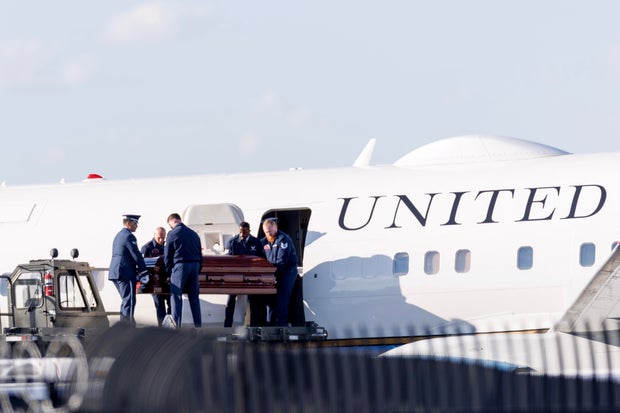
In a solemn homage to his life and contributions, Kirk’s body was transported aboard Air Force Two from Utah to Arizona, marking a poignant return to his home state where he lived and cultivated his vision for political engagement. This dignified journey was not just a transfer; it symbolized the respect and profound loss felt by many, spanning political affiliations and personal beliefs.
The aviation used for Kirk’s final journey, Air Force Two, typically reserved for the vice president of the United States, underscores the high regard in which he was held. The vice president, JD Vance, who reportedly shared a close personal and professional relationship with Kirk, participated actively in the ceremonial duties. A touching scene unfolded on a tarmac in Salt Lake City, captured in a somber video showing Vice President Vance assisting in carrying Kirk’s casket, a powerful testament to their friendship and Kirk’s impact on national politics.
Arriving in Phoenix just before dusk, the plane delivered Kirk back to his community and family. Spectators and participants in this solemn event included Second Lady Usha Vance, who, along with Erika Kirk, met the casket. Both women, clad in black and shaded by sunglasses to perhaps hide the grief in their eyes, were poignant figures of mourning and loss. The presence of these high-profile figures not only added a layer of gravitas but also highlighted the profound connections Kirk had forged during his career.
The circumstances of Kirk’s death have resonated deeply across communities, inciting a mixture of grief, confusion, and a quest for justice. He was killed while engaging in a passionate exchange of ideas—a “Prove Me Wrong” debate—an event emblematic of his career which was dedicated to fostering political discourse. Yet, as of now, the assailant remains unidentified, adding a layer of anxiety and unresolved tension to the tragedy.
Reflecting on his legacy, it’s impossible not to consider the profound influence Kirk exerted over contemporary political practices and ideologies. Not only did he stand as a beacon of conservative values, but his organization, Turning Point USA, became a pivotal platform for mobilizing youth and staging significant political dialogues. His strategic acumen and charismatic leadership were acknowledged by many, including Vice President Vance. In a heartfelt tribute on social media, Vance credited Kirk with playing a crucial role not only in political campaigns but also in shaping the administrative fabric of the current government.
The planned funeral, expected to be attended by figures including President Trump—who himself expressed intentions to honor Kirk—will likely be a gathering of numerous influential personalities, each reflecting on the impact Kirk had on their lives and the national political landscape. This event will not only serve as a moment of closure for those who knew and admired him but will also cement his status as a significant figure in the conservative movement.
Kirk’s untimely death raises numerous questions and reflections—about security, the inflammatory nature of political discourse, and the profound impact that public figures can imbue during and, intriguingly, post their lifetimes. As people look to heal and understand this shocking event, the echo of an unnamed voice over the air traffic control at Phoenix Sky Harbor International Airport that stated, “Welcome home, Charlie. You didn’t deserve it. May God bless your family,” underscores the poignant, heartfelt goodbye from a nation in mourning.
Moving forward, the legacy of Charlie Kirk will undoubtedly continue to influence discussions and possibly inspire reforms in how public figures engage in highly charged environments. His death, marked by both personal tragedy and public uproar, will serve as a somber reminder of the vulnerabilities inherent in public life and the profound ripples individuals can create in their communities and beyond.
As the investigation continues and the community seeks to heal, the memory of Charlie Kirk and the ideals he advocated will persist, discussed and dissected in public forums and private conversations. His journey back to Phoenix, though under tragic circumstances, marked a significant moment of reflection for many about the nature of political discourse, the impact of an individual life, and the paths forward from a moment of national tragedy.