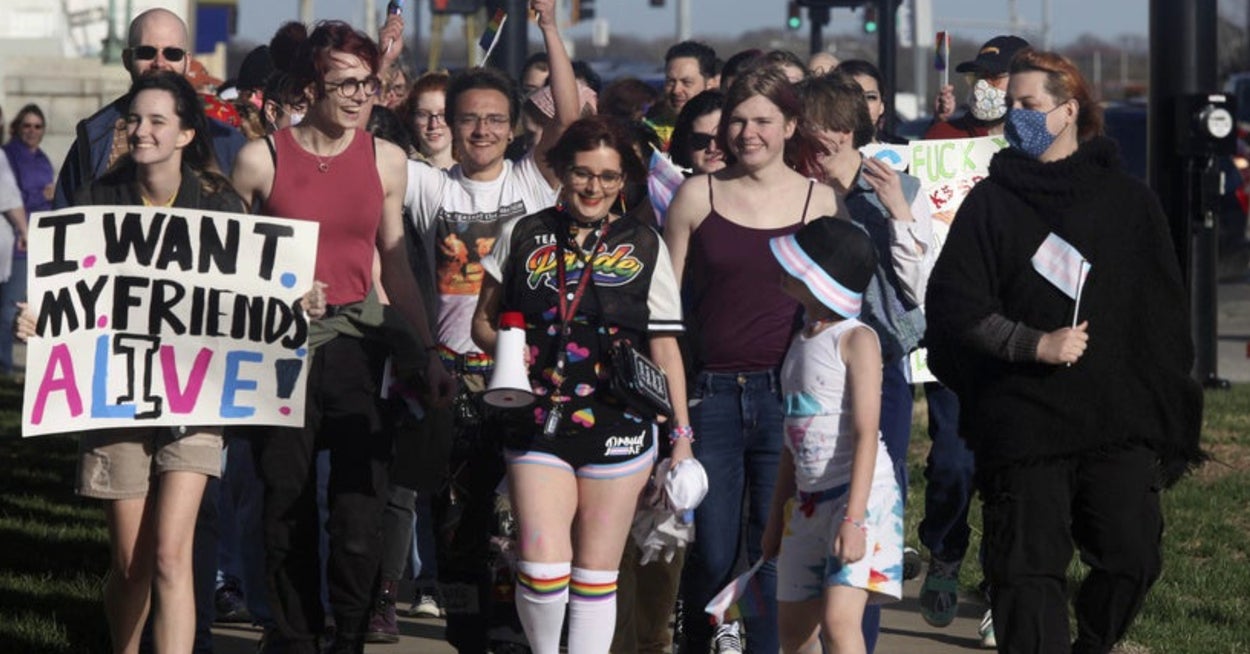
Kansas Passes Sweeping Anti-Trans Legislation, Including Sports Ban and Restroom Restrictions, as GOP Overrides Governor’s Veto
Kansas Republicans have pushed through some of the most sweeping anti-transgender legislation in the country, overriding a veto from Democratic Governor Laura Kelly to enact a ban on transgender girls and women participating in school sports, along with a separate measure that restricts access to public restrooms, locker rooms, and legal documentation changes for transgender people of all ages.
The developments mark a significant escalation in the state’s legislative war on transgender rights, and they come as part of a broader national wave of similar measures advancing through Republican-controlled statehouses. The Kansas bills combine multiple restrictions in ways that civil rights advocates say are designed to erase transgender, nonbinary, and intersex people from public life.
At the center of the controversy is a provision that would require athletes in Kansas schools to compete based on the sex they were assigned at birth. Proponents argue the measure is necessary to protect fair competition in girls’ and women’s sports. But critics point out that the actual number of transgender athletes affected is extraordinarily small, and they question the motivation and the practical implications of the law.
According to the Kansas State High School Activities Association, there are currently only three transgender girls competing in high school sports in the entire state. That tiny number has not stopped lawmakers from making the issue a top priority.
State Representative Wasinger, a Republican who has been one of the leading voices in support of the sports ban, did not directly respond to questions about whether the law would lead to invasive genital inspections of athletes. Instead, he issued a statement defending the measure by pointing to existing requirements for student athletes.
“Sports physicals are done for every athlete participating in school sports,” Wasinger said. “Every child in Kansas must provide a birth certificate to attend school in Kansas. Both should be enough for any student.”
That statement has done little to reassure opponents of the bill, who note that the legislation does not spell out how schools are supposed to verify the sex of athletes. They worry that the lack of clear guidance could lead to humiliating and discriminatory treatment of transgender and even cisgender students, especially those who do not conform to stereotypical expectations of gender.
The sports ban is only part of a much larger package of restrictions now moving through the Kansas legislature. On Tuesday, lawmakers also passed SB 180, a wide-ranging bill that ties together multiple restrictions on how transgender people can navigate public spaces and legal systems. That bill bans transgender people from using public restrooms and locker rooms that align with their gender identity, and it prohibits them from changing their name and gender markers on driver’s licenses.
Republicans have branded SB 180 as the “Women’s Bill of Rights,” arguing that it is necessary to protect women and girls from what they describe as the intrusion of biological males into female-only spaces. The bill defines sex in strictly binary terms as “either male or female, at birth.” Advocates for transgender rights say that definition is not just medically inaccurate but would have devastating consequences for transgender, gender-nonconforming, and intersex people.
Under the terms of the bill, the state would no longer recognize the gender identity of transgender people for many legal and administrative purposes. That would affect everything from access to public facilities to the ability to obtain identification that matches a person’s lived identity. For transgender people who have already changed their documents, the bill could create confusion and legal uncertainty about the validity of those records.
The impact on intersex people, those born with physical sex characteristics that do not fit typical definitions of male or female, is also a major concern. Because the bill defines sex as only male or female at birth, intersex people could be forced into categories that do not accurately describe them, or that fail to account for the diversity of human biology.
The Kansas legislation has drawn sharp criticism from civil rights organizations, medical associations, and LGBTQ advocates, who say the bills are part of a coordinated effort to marginalize transgender people and erode their ability to live openly and safely. They argue that the measures are based on fear and misinformation rather than evidence, and that they will cause real harm to some of the most vulnerable people in the state.
Governor Kelly, a Democrat, vetoed the sports ban and the broader bill, but Republicans in the Kansas legislature hold more than a two-thirds majority in both chambers. That margin allowed them to override her veto without needing any Democratic support. The successful overrides are a clear signal of the political reality in Kansas, where the GOP has consolidated power and made transgender issues a central part of its legislative agenda.
The Kansas bills are part of a growing trend of anti-trans legislation that bundles multiple restrictions into single omnibus measures. Instead of addressing one issue at a time, lawmakers in several states have combined bans on gender-affirming care, restrictions on bathroom access, prohibitions on sports participation, and limits on pronoun usage into one large bill. This approach makes it harder for opponents to fight each provision individually and allows lawmakers to paint the measures as a package of protections for women and children.
Last week, Kentucky’s Republican-controlled legislature similarly overrode a veto from its Democratic governor to enact an omnibus anti-trans bill. That law bans gender-affirming care for transgender youth, bars them from using bathrooms that align with their gender identity, and gives school officials the right to refuse to use students’ preferred pronouns. The Kentucky law has already sparked legal challenges, and advocates say it will force families to make impossible choices about their children’s health and safety.
The situation in Kansas is likely to follow a similar path. Unless a judge blocks the sports ban before it takes effect, the law will go into force on July 1. Legal challenges are expected, and civil rights groups have already signaled that they will fight the law in court. But the outcome of those challenges is far from certain, especially given the current composition of the federal judiciary and the Supreme Court’s willingness to take up cases involving transgender rights.
In the meantime, transgender students in Kansas face an uncertain future. The three transgender girls currently competing in high school sports will be directly affected by the ban, and they may be forced to stop playing the sports they love. But the impact will be felt much more broadly than those three individuals. Transgender students across the state will see these laws as a message that they do not belong, that their identities are not valid, and that they are not welcome in public life.
Mental health professionals have long documented the harmful effects of such legislation on transgender youth. Studies have shown that transgender young people who are rejected by their families, schools, or communities are at dramatically higher risk of depression, anxiety, and suicide. Laws that single out transgender people for discrimination only add to that burden.
Supporters of the measures, however, insist that they are reasonable and necessary. They argue that biological sex matters in sports and in intimate spaces, and that the government has a legitimate interest in ensuring that women and girls are not forced to compete against or share facilities with people they describe as biologically male. They also argue that the bills protect the privacy and safety of women and girls, and that they reflect the views of a majority of Kansas residents.
Those arguments have been echoed in statehouses across the country, but they have been repeatedly challenged by the scientific community. Major medical organizations, including the American Academy of Pediatrics and the American Medical Association, have come out against bans on gender-affirming care and have expressed concern about the discriminatory impact of bathroom and sports restrictions. They point out that transgender girls and women are not dominating women’s sports, and that there is no evidence that transgender people pose a threat to the safety of women’s restrooms or locker rooms.
The Kansas measures also raise serious questions about the role of government in regulating personal identity. By defining sex in rigid, binary terms and refusing to recognize the legal status of transgender people, the state is effectively deciding that some of its residents do not exist in the eyes of the law. That is a dangerous precedent, critics say, and one that will have lasting consequences for the people of Kansas.
As the July 1 effective date approaches, all eyes will be on the courts. Legal battles over the Kansas law will likely take months or years to resolve, and in the meantime, transgender students and their families will have to navigate a legal landscape that has become increasingly hostile. Whatever the courts ultimately decide, the passage of these bills has already sent a powerful and chilling message about the direction of the state.
For now, Kansas has become the latest battleground in the fight over transgender rights, and the outcome of that fight will have implications far beyond the state’s borders. The laws now on the books in Kansas are among the most extreme in the nation, and they may serve as a model for other states looking to restrict the rights of transgender people. At the same time, they have galvanized opposition, and advocates are already organizing to challenge them in court and at the ballot box.
The story is far from over, but one thing is clear: Kansas has made a dramatic move, and the lives of transgender people across the state will never be the same.