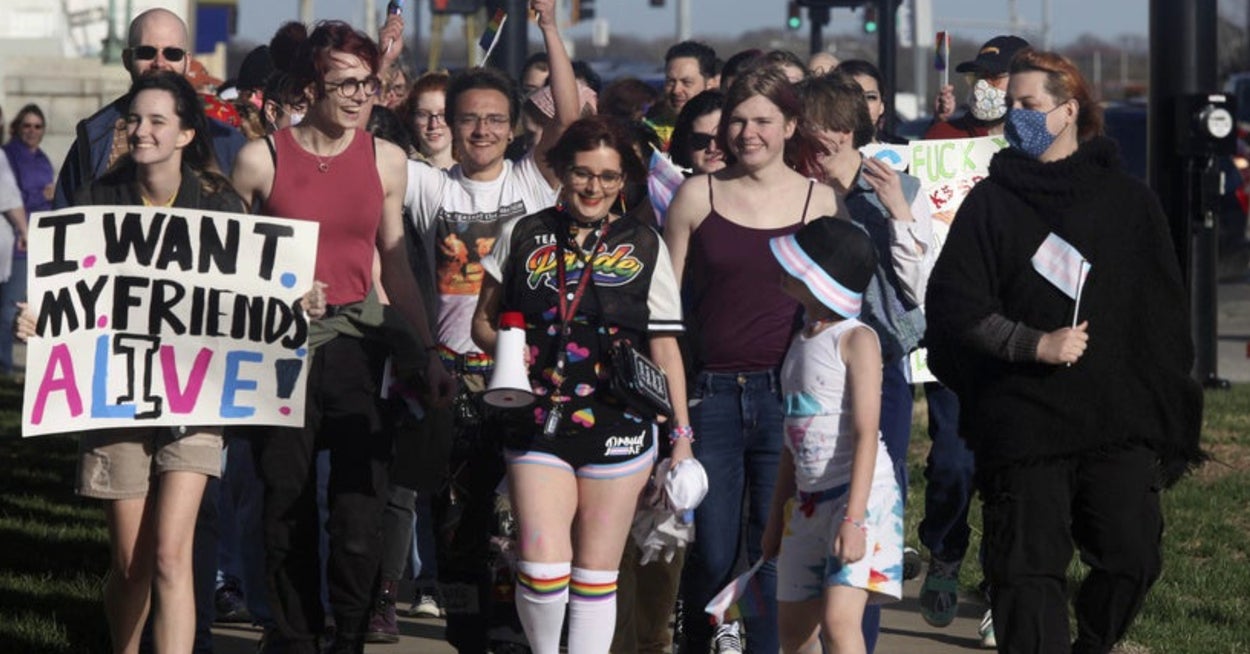
Topeka, Kansas — Republican lawmakers in Kansas have approved legislation banning transgender girls and women from competing in female school sports, siding with a national movement that supporters say protects fairness in athletics but critics say targets a tiny, already vulnerable population.
The sports measure, which would apply to school sports programs across Kansas, is scheduled to take effect July 1 unless blocked by a judge. It is one of two significant anti-transgender bills to move through the Republican-controlled Legislature this week. The other, known to supporters as the “Women’s Bill of Rights,” goes far beyond athletics, imposing restrictions on restrooms, locker rooms, and legal identification for transgender people of all ages.
Together, the measures represent one of the most aggressive anti-transgender policy pushes in the country this year.
A statement from a key lawmaker
During debate over the sports ban, Wasinger, a Republican lawmaker involved in the push, was asked whether the bill could lead to invasive forms of sex verification, including genital inspections. He did not answer those questions directly. Instead, he issued a statement defending the legislation as simple and straightforward.
“Sports physicals are done for every athlete participating in schools sports. Every child in Kansas must provide a birth certificate to attend school in Kansas. Both should be enough for any student,” Wasinger said.
That response did little to quiet critics, who point out that birth certificates and sports physicals are not reliable indicators of a student’s sex as defined by the bill. Birth certificates in some states can be amended, and physical examinations generally do not include chromosome testing or hormone analysis. Opponents say the law would force schools to make impossible judgments about students’ bodies or, worse, subject transgender girls to humiliating and medically unnecessary scrutiny.
The debate over “potential genital inspections” has emerged in multiple states considering similar sports bans. Lawmakers in Kansas did not include a specific verification procedure in the legislation, but critics say the bill’s insistence on determining a child’s sex creates a legal opening for invasive enforcement.
Three transgender girls
Supporters of the sports ban argue it is necessary to protect cisgender women and girls from unfair competition. They claim that allowing transgender girls and women to compete in girls’ sports undermines the purpose of Title IX and could jeopardize scholarships, records, and opportunities for female athletes.
But the actual numbers in Kansas tell a different story.
According to the Kansas State High School Activities Association, the organization that oversees high school athletics in the state, there are currently only three transgender girls competing in sports at the high school level. That means the law is being crafted in response to a situation that, by the state’s own count, involves exactly three students.
Advocates for transgender rights say the extraordinary amount of legislative attention directed at these three athletes is out of proportion to any real threat. There is no evidence, they say, that transgender girls have dominated competitions, taken scholarships, or harmed the fairness of girls’ sports in Kansas. In fact, transgender athletes have participated in Kansas high school sports for years without incident.
“This is a solution in search of a problem,” one opponent of the bill said. “They are writing a law that affects hundreds of thousands of students, and they can only point to three transgender girls as the reason.”
A separate, sweeping measure
The sports ban was not the only anti-transgender legislation moving through the Kansas Statehouse this week. On Tuesday, lawmakers also passed SB 180, a far broader bill that Republicans have labeled the “Women’s Bill of Rights.”
That measure defines sex in binary terms as “either male or female, at birth.” It bans transgender people from using public restrooms and locker rooms that align with their gender identity. It also prohibits changing one’s name and gender markers on driver’s licenses.
Advocates say the bill would lead to the legal erasure of transgender, gender-nonconforming, and intersex people. If sex is defined solely by what is recorded at birth, they argue, transgender people cannot exist under state law. Nonbinary people, whose identities do not fit into the categories of male or female, would also be unrecognized. Intersex people, who are born with physical sex characteristics that do not fit typical definitions of male or female, could be forced into legal categories that do not reflect their lived realities.
The bill’s bathroom provisions would apply broadly to public spaces, including schools, government buildings, libraries, and other facilities. That means transgender children, not just adults, could be barred from using restrooms that match their gender identity. They would instead be required to use facilities based on the sex they were assigned at birth, regardless of how they identify or how long they have been living as their true gender.
The driver’s license changes would create further hardship. Updating identity documents is a critical step for many transgender people, allowing them to seek employment, open bank accounts, travel, and navigate daily life without being unnecessarily outed. If the bill becomes law, transgender Kansans would lose the ability to align their legal identification with who they are.
Veto power and what comes next
Gov. Laura Kelly, a Democrat, is expected to veto both measures. But she faces an uphill fight. Republicans in the Kansas Legislature hold more than a two-thirds majority in both chambers, which is enough to overturn a gubernatorial veto and enact the bills into law without her signature.
The political math means that the only remaining obstacle may be the courts. Kansas’s sports ban will take effect on July 1 unless a judge grants an injunction. Legal challenges are widely expected, and similar laws in other states have been blocked by courts while lawsuits move through the system.
Opponents of the Kansas measures have argued that they violate the Equal Protection Clause, Title IX, and the due process rights of transgender Kansans. They also point to the practical harms that such laws create. Schools, for example, could be forced to develop policies for determining which locker rooms students may use. Employers and building operators could be caught in the middle of conflicting legal expectations. Transgender residents could be forced to choose between their safety and compliance with the law.
A national wave of anti-trans legislation
Kansas is not acting in isolation. The state’s actions are part of a broader wave of anti-transgender bills moving through Republican-controlled legislatures across the country. Many of these bills bundle multiple restrictions into a single package, making it difficult to separate sports policy from bathroom policy, medical care, and legal recognition.
Last week, Kentucky’s Republican-controlled legislature overrode a veto from Democratic Gov. Andy Beshear to pass an omnibus anti-trans bill. That law bans gender-affirming care for transgender youth, bars transgender students from using bathrooms that align with their gender identity, and gives school officials the right to refuse to use students’ chosen pronouns.
Kansas’s approach is similar in its breadth, though it takes a distinct path. The sports ban targets a very small group of students. The “Women’s Bill of Rights” reaches every transgender person in the state. Together, they create a legal environment in which transgender Kansas residents could be excluded from public life in fundamental ways.
The human cost
For the three transgender high school girls currently competing in Kansas sports, the new law could be devastating. They may be forced off the teams they have practiced with, the coaches they trust, and the competitions that have given them confidence and community. They may be required to disclose personal medical information to school officials or to undergo humiliating verification processes that no other student would face.
For transgender adults across Kansas, the separate bill threatens to strip away their legal identity and public safety. Being barred from restrooms and locker rooms can make everyday activities dangerous. Prohibiting gender marker changes on driver’s licenses can lead to discrimination at work, at the doctor’s office, and at the airport.
Supporters of the legislation say they are acting to protect women and girls and to restore a commonsense understanding of sex. But critics say the measures are rooted in fear, not evidence. They note that the state has not documented any case of a transgender athlete causing harm to Kansas school sports, and there is no public safety crisis requiring broad bathroom restrictions.
Instead, the critics say, the bills send a clear message: transgender people are not welcome in Kansas public life. The effects of that message will be felt far beyond sports fields and restrooms. It will be felt by families, schoolchildren, teachers, and anyone who steps forward to support transgender friends and neighbors.
The legislation now moves to the governor’s desk. If Kelly vetoes and Republicans override, the fight will move to the courts. But no matter what happens in the legal system, the debate itself has already had consequences. Transgender Kansans are watching, waiting, and wondering what their future holds.