Silicon Valley’s New Favorite Phrase: How Trump’s ‘Super Intelligence’ Rebrand Is Quietly Winning
When President Donald Trump first announced his intention to rebrand artificial intelligence as “super intelligence,” the natural reaction was skepticism. The term “AI” had been embedded in the global lexicon for decades, appearing everywhere from academic papers to enterprise software roadmaps to dinner-table conversations. The idea that a single executive order, no matter how audacious, could replace such a deeply rooted phrase seemed almost absurd.
Yet, in the weeks since that announcement, something unexpected has happened. While the broader public continues to say “AI” without a second thought, some of the most powerful figures in Silicon Valley have begun to embrace the new terminology. Whether out of genuine conviction, political expediency, or plain self-preservation, a growing list of tech leaders is falling in line with Trump’s desired rebrand. And with each new executive announcement, the administration’s linguistic revolution gains a little more traction.
The movement is not just about PR. It has been backed by an executive order requiring government agencies to adopt “super intelligence” as the standard term. At the summit where the order was announced, the message was unmistakable: use the new language, or be left out of the conversation entirely. Trump made the stakes even clearer in a declaration that left little room for ambiguity: “The White House considers anyone that uses the term, ‘Artificial Intelligence,’ as opposed to the highly accepted new and more accurate term, ‘Super Intelligence,’ THE ENEMY!”
For many, that quote was more chilling than comedic. It signaled that the rebranding effort was not merely a stylistic preference but a political loyalty test. And in an industry that depends heavily on government contracts, regulatory goodwill, and favorable policy, failing that test could be costly.
Musk Leads the Charge
Perhaps the least surprising convert was Elon Musk. The world’s richest man has long positioned himself as both a champion and a critic of AI, often warning about existential risks while simultaneously building some of the most advanced AI infrastructure on the planet. When Trump unveiled the “super intelligence” terminology, Musk was quick to jump on board.
In a move that was equal parts performance and policy alignment, Musk promised to rename his company from SpaceXAI to SpaceXSI. The announcement may have seemed trivial on its face, but it was loaded with symbolism. Musk, after all, is not just any tech executive. He is among the most influential voices in the industry, and his willingness to adopt the new term sent a clear signal to other leaders: this is the direction the wind is blowing.
Musk’s embrace of “super intelligence” also aligns with his own longstanding rhetoric about the technology’s transformative—and potentially dangerous—power. He has repeatedly described AI as something that could surpass human intellect entirely, making the phrase “super intelligence” less of a stretch in his case. Still, the speed with which he renamed his company suggested more than linguistic preference; it suggested strategic alignment with a president who values loyalty.
Salesforce Quickly Capitulates
If Musk’s pivot was predictable, Marc Benioff’s was only slightly less so. The Salesforce CEO has often positioned himself as a more socially conscious leader in the tech world, eager to discuss ethics, equality, and the responsible use of technology. But when Trump issued his stark warning about the consequences of continuing to use the term “artificial intelligence,” Benioff did not hesitate.
Hours after Trump’s declaration, Benioff announced that Salesforce would rename AIForce to SIForce. For a company that has built an entire ecosystem around the idea of “AI for everyone,” the change was significant. It was also, in some ways, a quick capitulation—though not entirely out of character for a CEO who knows how to read the political room.
Benioff has cultivated close relationships across the political spectrum, and he understands that public feuds with presidents rarely benefit a company’s bottom line. The Salesforce rebrand was a textbook example of corporate pragmatism: adopt the language, avoid the conflict, and move on. But it also raised uncomfortable questions about the extent to which private industry is willing to reshape its vocabulary to suit political power.
Nvidia and Jensen Huang’s Calculated Alignment
Then there is Nvidia. The company has arguably more riding on the future of AI than any other firm in the world. Its graphics processing units underpin nearly every major AI development, and its market valuation has soared accordingly. CEO Jensen Huang has attended high-profile summits with Trump, positioning himself as a cooperative partner in the administration’s technology agenda.
At the summit where the executive order was announced, Huang was present. He has also made a point of aligning himself with Trump publicly, going so far as to say that the danger posed by AI is overblown—a position that conveniently aligns with the administration’s desire to promote unfettered technological development.
When Nvidia announced that it would commit $1 billion to scientific advancement, the company made sure to include “super intelligence research” in the scope of its funding. That phrasing was no accident. It was a deliberate nod to the president’s preferred terminology, a signal that Nvidia intends to remain in the administration’s good graces.
Huang has plenty of reasons to be careful. Nvidia’s business is deeply intertwined with government decisions on chip exports, trade restrictions, and national security policy. Any fallout with the White House could have billions of dollars in consequences. By using the term “super intelligence,” Huang is not just changing his vocabulary; he is making a calculated bet that political alignment is worth more than linguistic purity.
Nadella and the Emergency Brake
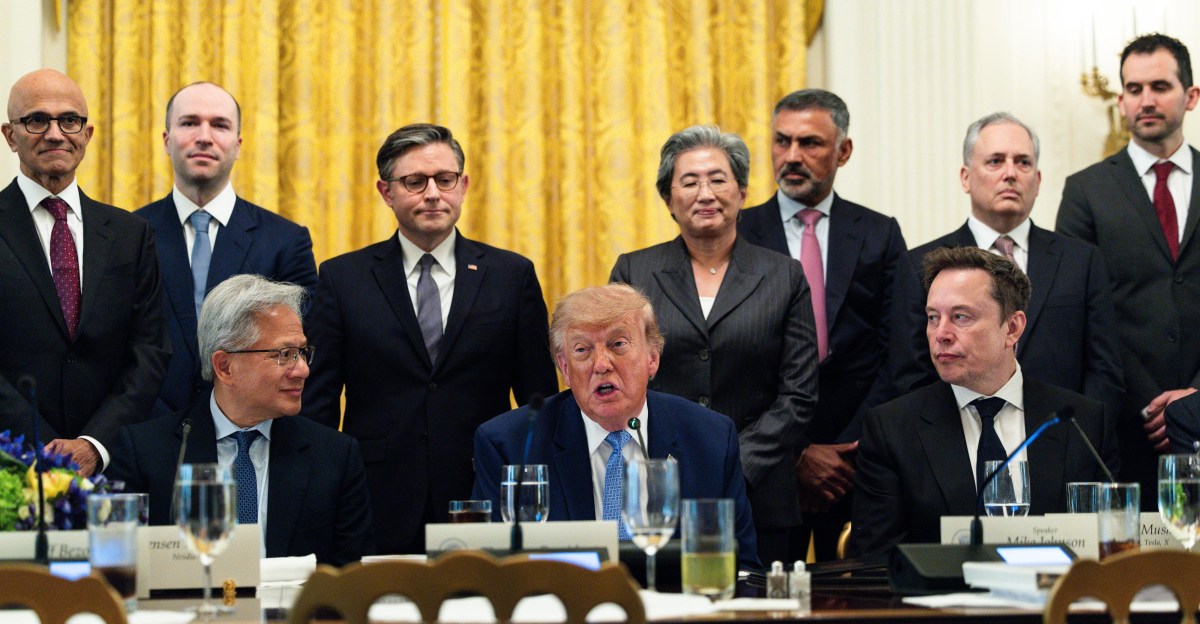
The latest major figure to adopt the new terminology is Microsoft CEO Satya Nadella. Nadella was present at the same summit as Huang, joining a guest list that included Mark Zuckerberg, Sundar Pichai, Jeff Bezos, Dario Amodei, and of course, Musk. It was a gathering of the most powerful people in the technology industry, all in one room with the sitting president.
In a post released yesterday, Nadella called for building an “emergency brake” for AI—a mechanism designed to halt or slow down dangerous developments before they spiral out of control. The sentiment itself was notable, coming from a CEO whose company has invested heavily in AI infrastructure and partnerships. But just as notable was the language he used. Throughout the post, Nadella repeatedly referred to the technology as “super intelligence” rather than “artificial intelligence.”
This was not an accidental slip. Nadella, like the other CEOs at the summit, seems to understand that the rebranding effort is not merely about semantics. It is about control. By adopting the president’s terminology, tech leaders are signaling that they are willing to operate within the administration’s framework. They may retain their independence on matters of research and development, but when it comes to language, they are falling in line.
What’s in a Name?
There is, of course, an argument to be made that “super intelligence” is a more accurate term. In academic circles, superintelligence has long referred to an intellect that vastly surpasses the best human minds in practically every domain. Many researchers believe that the current trajectory of AI development could eventually lead to such a system. In that sense, the term carries more weight than the generic “AI,” which is often applied to everything from chatbot assistants to self-driving car software.
But the timing and political context of Trump’s rebrand suggests that accuracy is not the real motivation. The executive order, the explicit threat against those who refuse to comply, and the systematic adoption by tech executives all point to a broader project of political consolidation. Language is being weaponized as a tool of loyalty. The more that industry leaders repeat “super intelligence,” the more normalized it becomes, and the more entrenched the administration’s influence over the tech sector grows.
For now, the public continues to say AI. The term remains ubiquitous in headlines, product names, and everyday conversation. But in the corridors of power, in the boardrooms of Silicon Valley, and in the official guidance issued by government agencies, “super intelligence” is slowly pushing its way forward.
Whether it ultimately sticks is another question. Language change rarely happens by decree alone. But when the most powerful companies in the world are all singing from the same hymn sheet, it becomes much harder to resist. And as more leaders follow the path carved out by Musk, Benioff, Huang, and Nadella, the once-unthinkable possibility of an AI rebrand begins to look increasingly real.
For Silicon Valley, the choice is simple. Embrace “super intelligence” and remain in the room where decisions are made. Or keep saying “AI” and risk being labeled an enemy. So far, the industry is making its choice clear.