Armand Hammer’s Surprise ‘Snakes & Ladders’ Is a Dense, Rewarding Descent: A Review
Let me begin with a necessary caveat: I haven’t had much time to fully digest the surprise Armand Hammer record that dropped this week. Surprise releases can be tricky that way, especially from an act with a catalog as dense and demanding as Billy Woods and Elucid’s. There is no way to rush through their music. The duo rarely miss, though, and my initial reaction is that Snakes & Ladders ranks among their best work. It may not have the seamless throughline production-wise that their collaborations with the Alchemist — Haram and Mercy — possess, but it is still unmistakably the singular vision of the two men at its center. The album feels like a dispatch from some dark, familiar but twisted corner of their shared imagination, and it rewards the kind of patient listening that their fans have come to expect.
From the very first track, the atmosphere is unmistakable. Ominous noises dance in the background, blasts of noise add dashes of industrial rage, bass lines throb with a restless pulse, and saxophone bleats call out to the sky like something between a warning and a prayer. This is not the polished, sample-chopped comfort of their Alchemist records. It is rawer, more fragmented, more challenging. Yet it never feels chaotic. Woods and Elucid have always had excellent taste in production, but here they seem to have brought out the best in collaborators like clipping., Kenny Segal, and Child Actor. They have successfully rallied all of these producers around a specific sound palette that keeps the record from actually sounding like it has beats from eleven different people. The tonal consistency is remarkable. Every beat feels like it belongs in the same haunted house, even as the doors open onto different rooms.
Of course, what makes Armand Hammer stand out from so many of their contemporaries is their unique and verbose flows. There is no one else in underground rap quite like them. Their verses are densely packed, full of strange asides, literary references, economic anxieties, historical bloodshed, and sudden flashes of tenderness. They have the rare ability to sound both completely in control and on the verge of unraveling. Their lyrical mastery even makes guest rappers raise their game. On “Risk,” you can practically hear $ilkmoney stalking around the mic as he seethes through his verse. He matches the album’s menacing energy with a kind of controlled fury that fits perfectly alongside Woods and Elucid. It is not just a guest feature; it sounds like a challenge accepted, a peer stepping into a ring of fire and holding his own.
The album is not all darkness and aggression, though. There are moments of surprising emotional clarity. On songs like “Gravity,” Billy Woods navigates the early stages of a burgeoning romance with shocking directness, while also acknowledging, obliquely, how hard it can be to say what you mean. There is a real tenderness buried inside his typically opaque wordplay, and the relatability lands hard. He raps:
Get it off your chest or put it to the side
As a preface, all due respect, I suggest
‘Cause it’s nothing more precious than time
That final observation — “nothing more precious than time” — feels like the emotional core of the whole project. Snakes & Ladders is an album about mortality, about the ticking clock, about the choices people make when they know the game could end at any moment. The lyrics are full of urgency, but not the kind that rushes you. Instead, they make you sit with every line, every pause, every half-buried reference.
On “Vespers,” Woods continues that approach with a different set of reference points. He name-drops Siouxsie and the Banshees, which is already unexpected for a rap song, and then he drops a line about “My nightcap three fingers of Fernet.” This may be the first time I have ever heard Fernet Branca get a shoutout in a rap song, and it feels exactly right. Fernet is an acquired taste, bitter and strange, beloved by bartenders and eccentrics. That is a pretty good metaphor for Armand Hammer’s music as a whole. It is not for everyone. It is not trying to be. It demands that you meet it on its own terms, and if you do, you will find a world of flavor and meaning that more accessible music cannot offer.
“Graveside” is another highlight, this time giving Elucid his turn to get vulnerable. Elucid often plays the more visceral and chaotic counterpart to Woods’ dry, academic menace. Here, though, he strips away some of his armor and speaks directly about grief and loss. The imagery is stark and devastating:
I see you in the grave, I see you in the dirt
Shouts and hollers every which way, hurting
Darkness chase light
Steel shut close curtain
There is something ancient and biblical about the language. You can feel the weight of a funeral, the shock of a sudden burial, the hopelessness of trying to reach someone who is already gone. Elucid does not overexplain. He does not need to. The lines stand alone as poetry, and they land with a seriousness that elevates the entire record. It is a sobering moment in an album that is already full of heavy themes, and it reminds us that Armand Hammer are not just clever — they are emotionally intelligent, too.
In many ways, Snakes & Ladders feels like a culmination of where Billy Woods and Elucid have been heading for years. It echoes the non-Alchemist-produced Armand Hammer records like We Buy Diabetic Test Strips, which was already a high point in their discography. That album sounded like a sonic novel, full of interludes and strange detours. Snakes & Ladders shares that restless spirit, but it feels more focused, more deliberate. It also owes a debt to their recent solo records. Woods’ Golliwog and Elucid’s Revelator both explored different corners of their respective psyches, and those explorations seem to have fed back into the duo’s chemistry. When they come together here, they sound like two men who have spent years sharpening their tools and learning exactly how to push each other further. The rapport between them is almost telepathic. They trade verses like conversation, each one responding to the other’s energy, building a world together line by line.
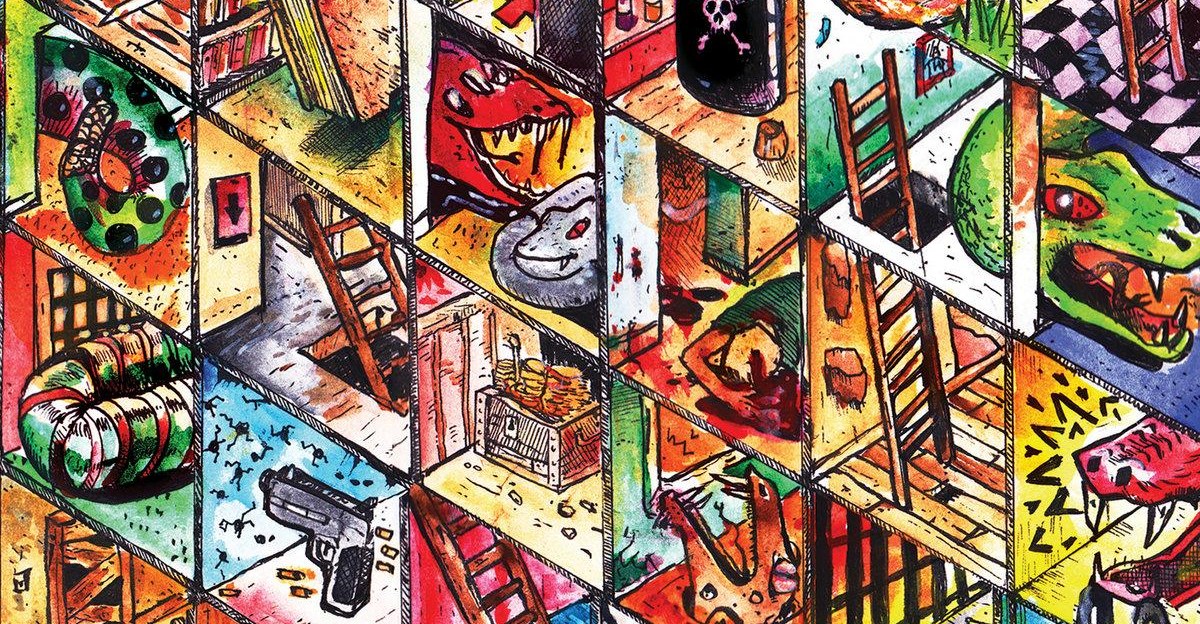
The title Snakes & Ladders is worth considering as well. It is an old board game, originally from India, that later became a British children’s pastime. In the original version, the ladders represent virtues and the snakes represent vices. The game is essentially a metaphor for the spiritual journey, where good deeds lead upward and bad deeds drag you down. That metaphor fits Armand Hammer perfectly. Their music is full of moral complexity, people making desperate choices, moments of grace and moments of collapse. Every song on this record feels like a move on that board. Sometimes you climb, sometimes you slide, and you never know which is coming next. The unpredictability is part of the point. Life is a game of chance, but it is also a game of choices. Woods and Elucid understand that tension better than almost anyone in rap, and they explore it with wit, fury, and compassion.
There is also a texture to the album that rewards repeated listening. The first pass can be overwhelming. There are so many syllables, so many references, so many sudden changes in tone. But that is not a flaw — it is a feature. Armand Hammer records are meant to be lived in. You need to sit with them, to let the lines sink in, to catch things you missed the first time. Already, on this early listening, lines are jumping out that I know I will still be thinking about in months. The saxophone bleats, the industrial noise, the way a bass line can suddenly drop out and leave you hanging — these are not just production choices, they are part of the meaning. The album is giving you a feeling, not just a message. It is a mood piece, a horror movie, a confession booth, a late-night thought spiral all at once.
If there is a criticism to be made, it is that the album’s density can occasionally feel like a barrier. It is not easy music. It does not offer immediate hooks or catchy choruses. It demands patience. But for those willing to put in the work, the rewards are immense. Armand Hammer have never been a commercial act, and they have never seemed interested in becoming one. They are artists in the truest sense, making music that stretches the boundaries of what rap can do. Snakes & Ladders is another proof of that commitment.
At this point in their career, Billy Woods and Elucid could coast on their reputation. They have already made multiple classic records. They have earned the respect of critics and peers. But they keep pushing forward, keep surprising their audience, keep finding new ways to challenge themselves and their listeners. Snakes & Ladders is not just another album in their catalog — it feels like a statement of intent. It says that they are still hungry, still curious, still willing to take risks. Even as they navigate themes of death and time, they sound incredibly alive.
I will need more time to fully unpack this record. I will need to read the lyrics carefully, to revisit the production, to live with the songs for weeks or months. But even on a first listen, I already know that Snakes & Ladders is one of the most compelling releases in their discography. It may not be as immediately cohesive as their Alchemist collaborations, but it is singular, ambitious, and deeply their own. Armand Hammer have done it again. The snakes are out, the ladders are waiting, and the game is on.