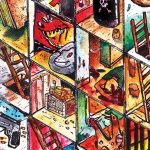
Armand Hammer’s “Snakes & Ladders” Is a Surprise Drop That Demands to Be Unpacked
Let me start with a confession: I haven’t had nearly enough time to fully digest the surprise Armand Hammer record that arrived this week. There’s a strange feeling that comes with a sudden release from artists you revere—excitement, yes, but also a kind of pressure, because you know the music is going to require more than a casual listen. Billy Woods and Elucid rarely miss, though, and after only a few rotations, my initial reaction is that Snakes & Ladders already ranks among their very best work. It may not have the seamless, single-producer throughline that defined their collaborations with the Alchemist—Haram and Mercy—but it is still unmistakably the singular vision of the two men at its center. Every choice, every texture, every strange lyrical detour feels intentional. This is a record that knows exactly what it is, even when it refuses to make itself easy.
The production is the first thing that grabs you. From the opening moments, the album wraps itself in a thick, suffocating atmosphere. Ominous noises skitter and dance in the background, never quite settling into anything comfortable. Blasts of noise interrupt the flow like bursts of industrial rage, while bass lines throb underneath with a physical urgency. Saxophone bleats call out to the sky, adding a layer of jazz-inspired chaos that feels both ancient and futuristic. Woods and Elucid have always had excellent taste in production, but on Snakes & Ladders they seem to have brought out the absolute best in an impressive list of collaborators, including clipping., Kenny Segal, and Child Actor. What’s remarkable is that even though the album features beats from what sounds like a wide array of different producers—roughly eleven different voices contributing to the sonic landscape—it never actually feels disjointed. There is a specific sound palette at work here, a shared vocabulary of shadows and fractures, that keeps the record cohesive. The beats all lean into the same eerie corners. They all breathe the same air. That is no small achievement for a project with this many hands involved.
Of course, what has always made Armand Hammer stand out from their contemporaries is their unique and verbose flows. Billy Woods and Elucid do not rap like anyone else. Their verses are crowded with clauses, allusions, sudden pivots, and sharp observations. They have a way of making language feel heavier, as if every word is carrying more weight than it should be able to bear. Their lyrical mastery is so contagious that it even elevates the guest rappers who step into their world. Take $ilkmoney, who appears on “Risk.” You can practically hear him stalking around the microphone as he seethes, each line delivered with a barely contained fury that matches the intensity of the production. He steps up his game because the track demands it. That is the effect Armand Hammer has on people: they raise the level of everyone around them, simply by existing in the same sonic space.
One of the most striking moments on the album comes with “Gravity,” a song where Billy Woods navigates the terrain of burgeoning romance with shocking directness. This is not the kind of hip-hop that hides behind metaphor or deflection. Woods approaches the subject with a rare clarity, even while acknowledging, obliquely, how hard it can be to say what you actually mean. There is a vulnerability in his voice that feels earned, and the lyrics cut straight to the heart of the tension between honesty and self-protection. He raps:
Get it off your chest or put it to the side
As a preface, all due respect, I suggest
‘Cause it’s nothing more precious than time
There is something profound in that simplicity. It is a reminder that even in a genre known for bravado, there is space for tenderness, for hesitation, for the complicated work of trying to communicate with another person. Woods does not resolve the tension; he sits in it. And that is exactly what makes the song so powerful.
Elsewhere, “Vespers” finds Woods dropping references that feel both personal and culturally specific. He mentions Siouxsie and the Banshees, a nod that immediately signals a certain kind of post-punk sensibility. Then he delivers a line that stopped me in my tracks: “My nightcap three fingers of Fernet.” I’m fairly certain this is the first time I’ve ever heard Fernet Branca get a shoutout in a rap song. It’s a small detail, but it says so much about the way Armand Hammer operates. They are not interested in the usual signifiers. They pull from the corners of their own lives, from their own peculiar obsessions, and they trust that the listener will either keep up or catch up later. That kind of confidence is rare.
Another highlight is “Graveside,” where it is Elucid’s turn to get vulnerable. Where Woods often leans into dry wit and intellectual detachment, Elucid brings a rawer, more visceral energy. On this track, he stares directly into the face of loss. The grief is palpable, almost overwhelming. He raps:
I see you in the grave, I see you in the dirt
Shouts and hollers every which way, hurting
Darkness chase light
Steel shut close curtain
The imagery is stark and unflinching. There is no attempt to soften the blow, no effort to dress death up in comfortable metaphors. Instead, Elucid sits with the pain, letting the weight of it press down on the listener. It is a devastating moment, but it is also a beautiful one, because it reminds us that vulnerability is not weakness. It is a form of strength, a way of processing the things that would otherwise destroy us.
In some ways, Snakes & Ladders feels like a culmination of everything Billy Woods and Elucid have been working toward on their non-Alchemist-produced Armand Hammer records. The lineage goes back to albums like We Buy Diabetic Test Strips, which already showed a willingness to experiment with stranger, more fractured production choices. But it also draws from their recent solo work—Woods’ Golliwog and Elucid’s Revelator. Those records felt like the two artists stretching their own muscles, exploring individual obsessions and honing their respective approaches. On Snakes & Ladders, they bring all of that growth back into the duo format, and the result is something richer, denser, and more satisfying than either could have achieved alone. This is not just a collaboration; it is a conversation. It is two artists pushing each other, challenging each other, and ultimately meeting in the middle with a shared vision.
There is a lot to unpack here, and I suspect I will be unpacking it for weeks. That is the mark of a great record, though. It does not give up everything on the first listen. It rewards patience. It rewards repetition. It rewards the listener who is willing to sit with discomfort, to let the strange noises wash over them, to follow the lyrics down unexpected paths. Snakes & Ladders is not an easy album, but it is a thrilling one. It is a reminder that Billy Woods and Elucid remain two of the most compelling voices in underground rap, and that when they come together as Armand Hammer, they are capable of creating something truly special.
I came to this record with a caveat: I hadn’t had time to fully digest it. But even in its raw, undigested state, Snakes & Ladders announces itself as a major work. It is a record that demands your attention, your patience, and your willingness to follow it into the dark. And if you give it that, it will reward you with some of the most vivid, challenging, and ultimately human music you are likely to hear all year.