Apple Launches Vast Study of Conversational AI in Health, Seeking 200,000 Participants to Rate Medical Answers
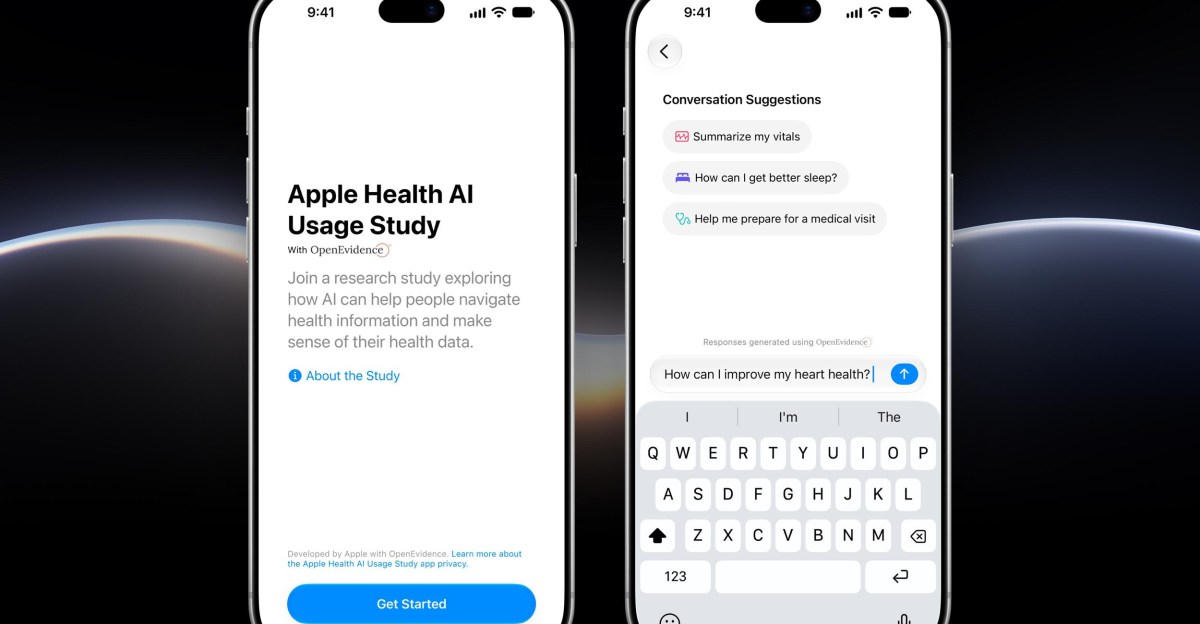
Apple announced today a major research study to understand how people use conversational artificial intelligence for health questions and how helpful the answers actually are. The Apple Health AI Usage Study, developed in collaboration with OpenEvidence, will use a custom iOS app that lets participants ask medical questions, receive evidence-linked responses, and then rate those responses on multiple quality criteria. The study is one of the largest announced by Apple in the health space, with a goal of enrolling up to 200,000 participants across the United States.
OpenEvidence is a clinical AI platform used by healthcare professionals. It generates answers to medical queries based on a curated corpus of peer-reviewed clinical information, including sources such as The New England Journal of Medicine. By working with OpenEvidence, Apple is making clear that the study is not intended to showcase a consumer chatbot but to evaluate the quality and usability of clinical-grade AI outputs in a real-world consumer setting. This partnership may also provide a degree of scientific credibility that many AI health apps lack.
The study app is available for download starting today, and enrollment opens immediately. Eligible participants must be at least 21 years old and physically located in the United States. The app requires an iPhone 15 Pro running iOS 26 or later. It is important to note that the app does not use Apple Intelligence, Apple’s name for its recent suite of AI features. Nor is it integrated with Siri. This suggests Apple wants the study to isolate the user experience of interacting with a medical AI system, rather than mixing it with the broader capabilities of Apple’s operating system.
Once participants are enrolled, they can use the app to ask health-related questions by typing into a text interface. The app returns responses designed to be easy to understand, with links to peer-reviewed clinical sources so that users can verify the information for themselves. After reviewing an answer, participants are asked to rate it based on a set of criteria that includes accuracy, detail, and relevance. The app is not designed to provide emergency medical advice or replace professional care, but rather to generate health information in a way that mirrors how people increasingly use AI tools to learn about medical conditions, medications, nutrition, and wellness.
Although the app is primarily text-based, users can dictate their questions using the iOS keyboard’s built-in dictation function. However, the app is not connected to Siri or Apple Intelligence. This design choice could be intended to limit variables in the study, ensuring that differences in user experience are due to the quality of the AI-generated answers themselves rather than to speech recognition, voice assistant personality, or other platform features.
Participants are also given the option, during enrollment, to share data from Apple’s HealthKit framework. This may include physical activity, sleep patterns, or clinical lab results stored in the Health app. If a participant chooses to share this information, the app can incorporate it into its responses, giving the AI more context about the individual’s health status. For example, a question about fatigue could be answered differently for someone who has logged very little sleep over the past week than for someone with normal sleep patterns. This personalization may be one of the most significant features of the study, as it tests whether context-aware AI can deliver more relevant information than a generic response.
Privacy and confidentiality are central to the study’s design. Apple has long positioned itself as a guardian of personal health data, and the company says it has taken measures to ensure that all information shared by participants remains confidential. Perhaps most importantly, Apple says the data collected in this study will not be used to train AI models. This is a notable reassurance at a time when many technology companies use user interactions to improve their models. By drawing a clear line between this research and model training, Apple may be seeking to build trust with participants who might otherwise worry about how their health questions and answers are stored or used.
The announcement includes a statement from Sumbul Desai, MD, Apple’s vice president of Health and Fitness. “At Apple, we believe responsible innovation starts with scientific rigor and clinical grounding. Health is deeply personal, and conducting a dedicated research study is the most thoughtful way to understand how people engage with, comprehend, and evaluate health AI in everyday life. Insights from this study will help advance the broader scientific conversation and ensure that as technology evolves, we continue building trusted tools that genuinely support people wherever they are on their health journey,” Desai said.
The study comes as generative AI has become a common destination for health questions. Many people have used chatbots to ask about symptoms, medications, or lifestyle changes, sometimes with questionable results. Concerns about AI-generated health misinformation have led to calls for more rigorous testing and evaluation. The Apple Health AI Usage Study could provide a new model for how to evaluate these tools at scale. Instead of relying on expert panels or small laboratory studies, the study invites ordinary users to judge the output of an AI system in their own words and from their own perspectives. The resulting dataset of user ratings could be analyzed to understand which features of an answer contribute most to perceived accuracy and relevance.
Still, the study has inherent limitations. Participants are self-selected, which means they are likely to be more interested in health and technology than the general population. The requirement to own an iPhone 15 Pro also restricts the sample to people who have chosen Apple’s high-end hardware. The study relies on subjective ratings rather than objective clinical outcomes. A participant might rate an answer as helpful even if a physician would find it incomplete, or they might rate a medically sound answer as unhelpful because it is too technical. The study cannot measure whether the information provided improves health outcomes in the long term. It can, however, offer valuable insight into what users define as useful, comprehensible, and trustworthy.
The collaboration with OpenEvidence is also notable because Apple is not building the medical knowledge engine itself. OpenEvidence has established itself as a platform for clinicians, and its answers are grounded in published medical literature. For consumers, this may mean that the information provided in the study is more reliable than the output of a general-purpose chatbot. But it is not a diagnostic tool, and Apple has stressed that the study is research, not a medical service.
Apple’s broader interest in health is well established. The Health app, HealthKit, the Research app, and a series of studies on heart health, hearing, and women’s health have made Apple a significant player in the digital health ecosystem. The company has also introduced features such as fall detection, ECG, blood oxygen and temperature sensing, and medication reminders. The new AI-focused study signals that Apple is thinking carefully about how generative AI might fit into this health ecosystem. Rather than rushing a health chatbot to market, Apple appears to be taking a more deliberate, evidence-first approach: solicit feedback from a massive group of users, learn from that feedback, and then design tools that meet people’s real needs.
For the scientific community, the study could set a new precedent for evaluating health AI. Large-scale, user-centered research is rare in this field, and the combination of a consumer technology platform and a clinical AI provider is novel. The requirement that participants rate each response on accuracy, detail, and relevance could generate a public understanding of what patients and consumers value in AI-generated health information.
As with all research studies, questions remain. How long will the study run? Will findings be published in peer-reviewed journals? Will participants be able to see aggregated results? Apple has not yet answered these questions, saying only that the insights will advance the broader scientific conversation and inform future product development. What is clear is that Apple is no longer content to leave conversational AI in health to third-party apps and generic chatbots. By launching a study that could include 200,000 people, the company is making a statement: the future of health AI must be grounded in rigorous research and, above all, in the experience of the people who use it.