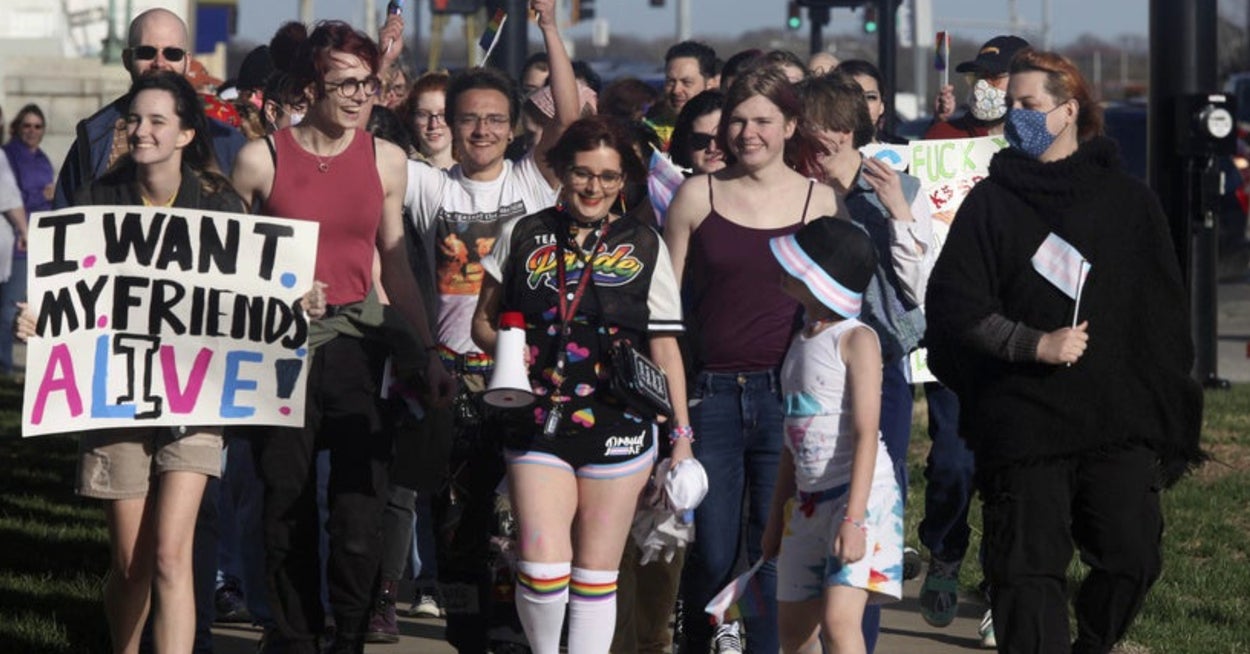
Kansas Lawmakers Override Veto to Ban Transgender Girls From School Sports, Pass Sweeping New Restrictions on Transgender Residents
TOPEKA, Kansas — Republican lawmakers in Kansas have enacted a ban on transgender girls and women participating in school sports, overriding the state’s Democratic governor in a move that critics say is based on fear rather than evidence. The measure is part of a broader wave of anti-transgender legislation moving through Republican-controlled statehouses across the country, and it came as Kansas lawmakers also approved a separate, sweeping bill that would impose severe restrictions on transgender people in public spaces and legal recognition.
The sports ban, which is scheduled to take effect July 1 unless blocked by a judge, bars transgender girls and women from competing on female sports teams in schools. Supporters of the measure argue that it is necessary to preserve fair competition among cisgender women and girls. But the actual numbers in Kansas suggest that the concern is wildly disproportionate to the reality on the ground. According to the Kansas State High School Activities Association, there are currently only three transgender girls competing in high school sports in the entire state.
When asked by BuzzFeed News about whether the legislation could lead to genital inspections or other invasive verification procedures, state Rep. Wasinger, a supporter of the bill, did not answer the question directly. Instead, Wasinger issued a statement defending the measure by pointing to routine requirements already in place for student athletes.
“Sports physicals are done for every athlete participating in schools sports,” Wasinger said. “Every child in Kansas must provide a birth certificate to attend school in Kansas. Both should be enough for any student.”
Advocates for transgender rights were quick to push back, noting that birth certificates and sports physicals do not address the actual lived experiences of transgender students. They also pointed out that the existence of only three transgender girls in Kansas high school sports makes the state’s sweeping legislative response seem less about protecting fair play and more about singling out a tiny and vulnerable population.
The sports ban is not the only action taken by Kansas lawmakers this week. On Tuesday, the legislature also passed SB 180, a separate and significantly broader piece of legislation that combines a number of restrictions on transgender people of all ages. That bill includes a ban on transgender people using public restrooms and locker rooms that align with their gender identity. It also prohibits transgender people from changing their name and gender markers on their driver’s licenses. Together, these provisions would have a profound effect on the daily lives of transgender Kansans, making it harder for them to navigate public spaces, access basic services, and obtain identification documents that reflect who they are.
Republicans in the state legislature have branded SB 180 as the “Women’s Bill of Rights.” The bill defines sex in strictly binary terms as “either male or female, at birth,” and it makes no allowance for gender identity, intersex variations, or nonbinary people. Advocates say the legislation would effectively erase transgender, gender-nonconforming, and intersex people from legal recognition in Kansas. By tying the definition of sex solely to what is assigned at birth, the bill would strip away the legal basis for any protections or accommodations that transgender people have won over the years.
The two measures together represent a coordinated effort by Kansas Republicans to restrict transgender rights across multiple areas of public life. The sports ban targets young people in schools, while SB 180 targets adults and children alike in bathrooms, locker rooms, and government records. The combined effect, critics say, is a legislative assault on transgender Kansans’ ability to live openly and safely.
Republicans in the Kansas legislature hold more than a two-thirds majority in both chambers, giving them enough votes to override a veto from Democratic Gov. Laura Kelly. That supermajority has effectively neutralized the governor’s ability to block anti-transgender legislation, and it allowed the sports ban to become law despite Kelly’s opposition. The same dynamic could allow SB 180 to become law even if Kelly vetoes it, although the bill’s ultimate fate may depend on legal challenges from civil rights organizations.
Kansas’s actions are the latest example of a growing trend among conservative state legislatures: passing anti-transgender bills that bundle multiple restrictions together or that define sex so narrowly that they have sweeping consequences for transgender people across the state. These omnibus-style bills have become increasingly common as Republican lawmakers seek to maximize the impact of their legislative majorities and create legal frameworks that are difficult to challenge in court.
Last week, Kentucky’s Republican-controlled legislature similarly overrode the veto of Democratic Gov. Andy Beshear to enact an omnibus anti-trans bill. That law bans gender-affirming medical care for transgender youth, bars transgender students from using bathrooms that align with their gender identity, and gives school officials the right to refuse to use students’ chosen pronouns. The Kentucky law, like the Kansas measures, was justified by supporters as protecting children and women, but opponents say it is designed to push transgender people out of public life.
In Kansas, the sports ban has drawn particular criticism because of the extremely small number of transgender athletes who would actually be affected. With only three transgender girls currently competing in high school sports in the state, the law appears to be solving a problem that does not exist. Opponents of the measure argue that it is not about fairness at all, but about sending a message that transgender girls are not welcome in Kansas schools.
Legal challenges are widely expected. Civil rights groups have already signaled that they will go to court to block both the sports ban and SB 180 before they can take effect. They argue that the measures violate the Equal Protection Clause of the U.S. Constitution, as well as Title IX, the federal law that prohibits sex discrimination in education. They also argue that the bills single out transgender people for unequal treatment based on sex and gender identity, which courts have increasingly recognized as protected under existing civil rights laws.
In the meantime, transgender Kansans and their families are left to wonder what the future holds. For the three transgender girls currently playing sports in Kansas, the new law could mean the end of their athletic careers. For transgender adults, SB 180 could mean being barred from public restrooms or being unable to update their driver’s licenses. And for young transgender people who are just beginning to understand their identities, the message from the state legislature is clear: they are not considered equal citizens.
The Kansas measures are part of a broader national push by conservative lawmakers to pass anti-transgender legislation at the state level. According to advocacy groups, hundreds of such bills have been introduced in state legislatures across the country in recent years. Many of these bills focus on school sports, bathroom access, and gender-affirming care, but others go further, seeking to restrict what can be taught about gender and sexuality in schools, allow parents to force their children to undergo conversion therapy, or ban transgender people from serving in the military.
Supporters of the Kansas bills say they are defending biological reality and protecting women’s spaces from what they characterize as an invasion by transgender people. But transgender advocates say the bills are based on misinformation and prejudice. They point to the fact that transgender people have used public restrooms for decades without incident, and that transgender girls have competed in school sports for years without disrupting competitions or harming other athletes.
The American Civil Liberties Union and other legal organizations have called on courts to block the Kansas laws, arguing that they are unconstitutional and harmful. They also note that the bills were passed without meaningful input from transgender Kansans, educators, medical professionals, or child welfare experts. Instead, they say, the laws were driven by national political campaigns and outside interest groups seeking to use transgender people as a wedge issue in the culture wars.
As the July 1 effective date approaches, the focus now shifts to the courts. If a judge issues a preliminary injunction, the sports ban could be put on hold while litigation proceeds. But if the law is allowed to take effect, Kansas will become one of several states where transgender girls are explicitly barred from participating in school sports, and where transgender people face significant legal barriers to simply living their lives.
For now, the three transgender girls in Kansas who want to play sports face an uncertain future. So do the countless transgender Kansans who use public restrooms, drive cars, and go about their daily lives. The laws passed this week are not just policy decisions; they are declarations about who belongs and who does not. And for many transgender people in Kansas, the message is unmistakable: the state does not want them in its schools, its locker rooms, or its laws. Unless a judge intervenes, that message will become law on July 1.