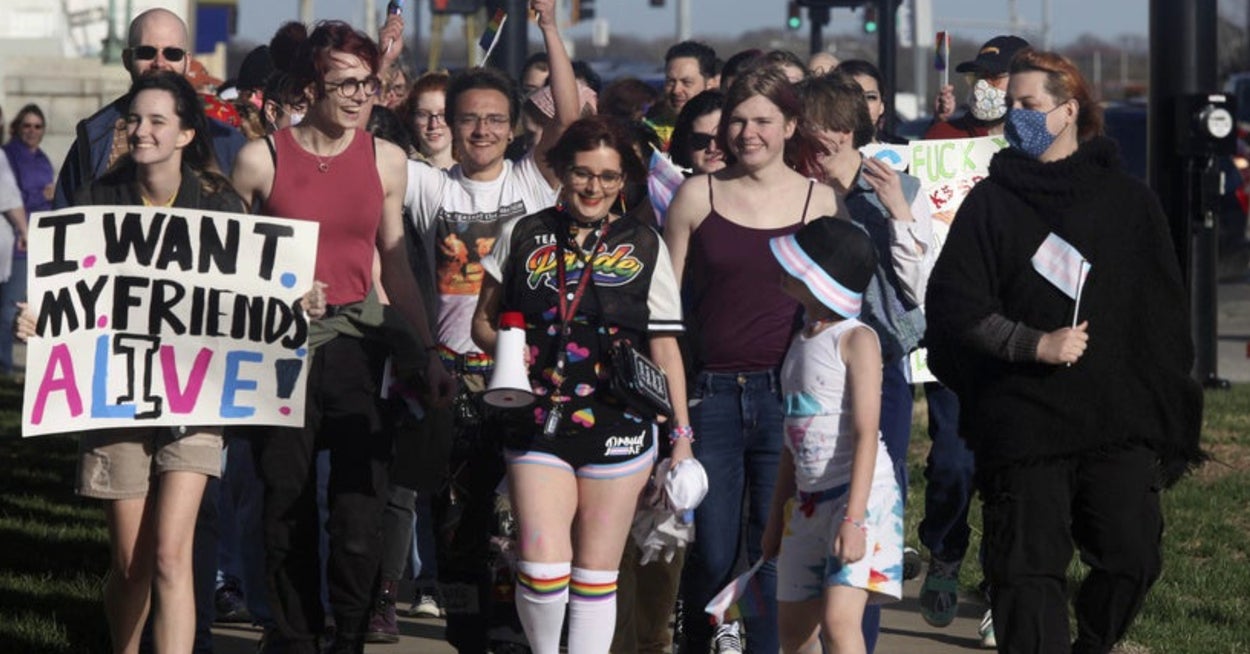
Kansas Lawmakers Pass Sweeping Anti-Trans Legislation, Including Sports Ban and Restroom Restrictions
TOPEKA, Kansas — Kansas lawmakers have approved a pair of sweeping measures that would bar transgender girls from participating in female school sports, prohibit transgender people from using public restrooms and locker rooms that align with their gender identity, and prevent them from changing their name and gender markers on driver’s licenses. The legislation, passed Tuesday, now heads to Democratic Gov. Laura Kelly, but Republicans in the Kansas Legislature hold more than a two-thirds majority in both chambers, giving them enough votes to overturn her expected veto.
The two bills represent some of the most aggressive anti-transgender legislation in the country. One measure targets transgender athletes. The other, known as SB 180, is a broad bill that Republicans have titled the “Women’s Bill of Rights.” Together, they would reshape how transgender, gender-nonconforming, and intersex people are recognized under Kansas law and how they are allowed to move through public life.
Supporters of the bills argue that they are necessary to protect fair competition in women’s sports and to safeguard privacy and safety in intimate spaces such as restrooms and locker rooms. Opponents say the legislation is discriminatory, based on false stereotypes, and would cause serious harm to a marginalized population. They also note that the laws target an extraordinarily small group of people, especially in the context of school athletics.
The Sports Ban
The sports bill would prohibit transgender girls and women from competing on female sports teams at public elementary schools, high schools, and universities. The measure is part of a wave of similar laws passed in Republican-controlled states across the country. Proponents claim that allowing transgender girls and women to compete gives them an unfair advantage over cisgender female athletes, even though medical experts and sports organizations disagree about the extent of any such advantage.
State Sen. Wasinger, a Republican who spoke about the legislation, did not answer questions from BuzzFeed News about whether the bill would require genital inspections of student athletes. Instead, he issued a statement defending the measure. “Sports physicals are done for every athlete participating in schools sports. Every child in Kansas must provide a birth certificate to attend school in Kansas. Both should be enough for any student,” Wasinger said.
Critics have raised concerns about the birth certificate requirement, noting that it could lead to invasive scrutiny of young athletes, especially transgender girls and intersex students. They argue that using birth certificates to determine athletic eligibility is both humiliating and medically irrelevant. Birth certificates do not reflect hormone levels, athletic training, or any of the factors that actually affect athletic performance.
The numbers in Kansas show how rare transgender participation in school sports actually is. According to the Kansas State High School Activities Association, there are currently only three transgender girls competing in sports at the high school level in the entire state. That tiny number has led opponents of the bill to ask why lawmakers are spending their time and energy on a problem that barely exists. They argue that the legislation is not about fairness but about singling out transgender people for political purposes.
SB 180 and the “Women’s Bill of Rights”
The second bill, SB 180, goes far beyond athletics. It is an omnibus measure that ties together a number of restrictions on how transgender people of all ages can use public spaces. The bill bans transgender people from using public restrooms and locker rooms that match their gender identity. It also prohibits transgender people from changing their name and gender markers on driver’s licenses. That means the sex assigned at birth would remain permanently on official identification documents, even if a person has legally transitioned, undergone medical treatment, or lived for years in a different gender.
Republicans have called SB 180 the “Women’s Bill of Rights.” The bill defines sex in strictly binary terms as “either male or female, at birth.” This definition is central to the bill’s potential impact. Advocates for transgender, gender-nonconforming, and intersex people say the definition would lead to the legal erasure of people who do not fit neatly into the categories of male or female. Intersex people, who are born with physical sex characteristics that do not fit typical definitions of male or female, could be especially affected. So too could people who identify as nonbinary or gender-nonconforming.
The bill’s broad language means it could affect many areas of life beyond restrooms and driver’s licenses. Legal experts say that defining sex as “either male or female, at birth” could be used to restrict access to health care, housing, employment, public accommodations, and other services. It could also affect how schools handle transgender students, how prisons and jails classify inmates, and how state agencies collect data. In effect, the bill would deny the existence of transgender people as a matter of state law.
Republicans in Kansas have the votes to make this law a reality. Kelly, the Democratic governor, has vetoed anti-trans legislation in the past. But with more than a two-thirds majority in both the Kansas House and Senate, Republicans can override her veto without a single Democratic vote. That means the only remaining obstacle is the courts.
A National Wave of Anti-Trans Legislation
Kansas is not alone in passing such sweeping measures. Last week, Kentucky’s Republican-controlled legislature overrode a veto from Democratic Gov. Andy Beshear to pass an omnibus anti-trans bill. That law bans gender-affirming care for transgender minors, bars transgender students from using bathrooms that align with their gender identity, and gives school officials the right to refuse to use students’ preferred pronouns. The Kentucky law is one of many similar measures that have been enacted across the country in recent years.
The Kansas and Kentucky bills reflect a broader shift in conservative politics. Rather than passing narrow, single-issue laws, many Republican legislatures are now bundling multiple restrictions into one bill or using broad legal definitions that apply across many areas of public life. This approach makes it harder for opponents to challenge the laws in court and ensures that transgender people face a wide range of legal barriers all at once.
Conservative advocates say these laws are necessary to protect women and girls. They argue that transgender women and girls retain physical advantages even after hormone therapy and that allowing them to compete in women’s sports undermines the purpose of Title IX, the federal law that guarantees equal opportunity for women in education and athletics. They also claim that allowing transgender people into women’s restrooms and locker rooms could create safety risks, although there is no credible evidence to support that claim.
Opponents of the laws say they are based on fear and misinformation. They point out that transgender girls and women are an extreme minority in sports, and that many athletic organizations already have policies in place to address competitive fairness. They also note that studies have found no increase in safety incidents in jurisdictions where transgender people are allowed to use facilities that match their gender identity. Instead, opponents say, these laws put transgender people at greater risk of harassment, discrimination, and violence.
What Happens Next
The Kansas sports ban is scheduled to go into effect July 1 unless a judge blocks it. Legal challenges are widely expected. Civil rights organizations have already filed lawsuits against similar laws in other states, arguing that they violate the U.S. Constitution’s guarantees of equal protection and due process. Some federal courts have blocked such laws from taking effect while legal challenges proceed, while others have allowed them to go into force. The outcome in Kansas could depend on which judges hear the case and how they interpret existing precedent.
The U.S. Supreme Court has not yet ruled directly on whether states can bar transgender athletes from competing on teams that match their gender identity. The Court’s 2020 decision in Bostock v. Clayton County, which held that discrimination based on transgender status is a form of sex discrimination under Title VII, has been cited in many legal challenges to anti-trans laws. But that case involved employment, not sports or restrooms, so its reach remains uncertain. Legal experts say it is only a matter of time before one of these laws reaches the Supreme Court.
For transgender Kansans, the impact of these laws could be immediate and severe. The three transgender girls currently competing in Kansas high school sports would be forced off their teams if the sports ban takes effect. They would lose the opportunity to compete, to be part of a team, and to experience the benefits that school sports provide. SB 180 would make it harder for them to update their identification documents, which could affect their ability to apply for jobs, enroll in college, open bank accounts, or even rent an apartment.
Parents of transgender children have testified at hearings, begging lawmakers to reject the bills. Medical organizations, including the American Academy of Pediatrics and the American Medical Association, have opposed bans on gender-affirming care and have said that access to such care is medically necessary and can be life-saving. Teachers and school administrators have expressed confusion about how to implement the new requirements, especially the birth certificate provision, which could force students to undergo invasive scrutiny.
The debate in Kansas is part of a larger national struggle over the meaning of sex and gender in law and society. Supporters of the bills believe that sex is an immutable biological fact and that public policy should be based on that fact. Opponents believe that gender identity is deeply personal and that laws should protect everyone from discrimination, including transgender people. In Kansas, as in many other states, the opponents are currently winning in the legislature. But the legal and social battles are far from over.
As the July 1 effective date approaches, all eyes will be on the courts. If the sports ban is allowed to take effect, Kansas will become a testing ground for one of the most restrictive anti-trans policies in the nation. If it is blocked, the case could eventually make its way to the Supreme Court, setting the stage for a landmark ruling on transgender rights. Either way, the lives of transgender Kansans — including the three girls who simply want to play sports — will be at the center of the fight.