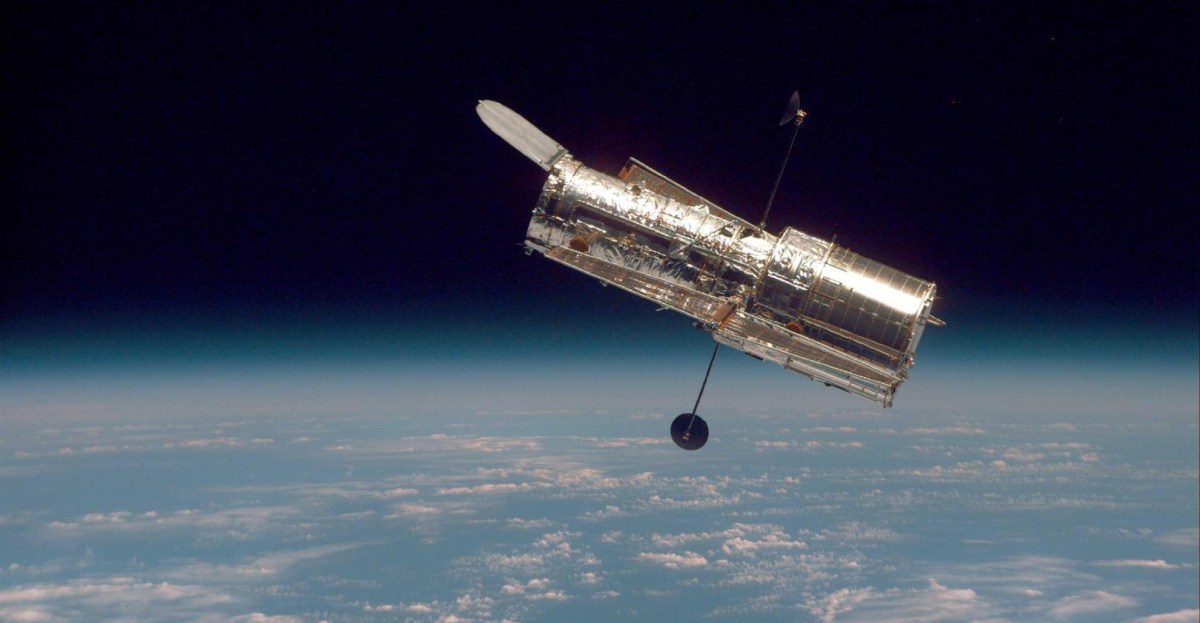
Can Private Companies Rescue Hubble? NASA Asks Industry for Help as Orbit Decays
Gravity may be the force that holds the universe together, but for orbiting spacecraft, it is also a relentless and unforgiving drag. For decades, the Hubble Space Telescope has floated above Earth’s turbulent atmosphere, capturing images of distant galaxies, dying stars, and the faint echoes of cosmic dawn. But even at its great height, Hubble is not immune to the slow, patient pull of physics below. Every day, the observatory loses a little more altitude as it brushes against the outermost fringes of Earth’s atmosphere, and every day, its future gets slightly shorter.
The Hubble Space Telescope is not in immediate danger of plunging into the atmosphere and burning up tomorrow, next week, or even next year. But the mathematics of orbital decay are unyielding. Without some kind of intervention to lift the telescope back into a higher, more stable orbit, NASA expects that Hubble’s time in space will end in the early to mid-2030s. At that point, the telescope would be lost forever, inevitably pulled down by the same gravity that once helped put it into an orbit above the hazy veil that makes life possible on Earth but obscures so much of the universe from ground-based observatories.
Rather than accept that fate quietly, NASA is doing what it has increasingly done with its largest and most ambitious projects: turning to the private sector. The agency has issued a request for proposals and ideas from commercial companies, asking them to come forward with innovative, cost-effective ways to save Hubble. Whether through a robotic spacecraft, a crewed vehicle, or some still-unimagined approach, NASA is ready to hear whatever industry has to offer. The goal is simple: extend the useful life of one of the most scientifically celebrated instruments in the history of astronomy.
A Legacy Written in Starlight
Since its launch aboard the space shuttle Discovery in 1990, Hubble has fundamentally changed how humanity sees the universe. It was originally designed to last about 15 years, with periodic servicing missions in mind. Those servicing missions became 20th-century engineering marvels. Astronauts grappled with heat, cold, and the extreme vacuum of space to replace instruments, repair broken components, and even install corrective optics after an embarrassing flaw was discovered in the telescope’s primary mirror.
The final shuttle servicing mission, carried out in 2009, left Hubble in pristine shape. Astronauts installed new cameras, repaired existing instruments, and gave the telescope a fresh set of gyroscopes. Since then, Hubble has continued to produce breathtaking images and ground-breaking observations. It has measured the acceleration of the expanding universe, discovered evidence of supermassive black holes, photographed the birth and death of stars, and provided crucial data on atmospheres of planets beyond our solar system. Even now, in the era of its more famous successor, the James Webb Space Telescope, Hubble remains an essential and productive scientific asset. Its eyes, trained on the ultraviolet and optical portions of the spectrum, see things that Webb, with its infrared focus, cannot.
The problem is not with Hubble’s instruments. Hubble is still performing well, scientifically speaking. The problem is purely mechanical, and in many ways, almost philosophical. An object in low Earth orbit is never truly alone. Even at altitudes where the sky looks black and endlessly empty, there are still scattered gas molecules left over from the upper reaches of Earth’s atmosphere. These particles produce a faint but constant drag on any spacecraft, slowing it down inch by inch. As the spacecraft slows, it loses altitude. As it loses altitude, the atmosphere becomes slightly denser. The denser air creates more drag, which slows the spacecraft a little more. It is a slow, vicious, and ultimately unstoppable cycle.
Hubble orbits Earth at an altitude of roughly 500 kilometers, or about 320 miles. That is high enough to stay clear of the thick layers of the atmosphere, but not high enough to escape its reach entirely. The drag is tiny, but it is always there. Scientists have predicted that, if nothing changes, Hubble’s orbit will continue to decay until the telescope enters the uppermost layer of the atmosphere sometime between the early and mid-2030s. Once that happens, there is no saving it. The telescope would heat up, break apart, or tumble, and eventually fall to Earth, probably leaving little or nothing intact.
The Shuttle Era Is Over
When Hubble was designed, engineers always planned for a future where the space shuttle could revisit it. The shuttle, after all, was capable of much more than simply launching satellites. It could catch up with a spacecraft already in orbit, dock, open its enormous payload bay, and allow astronauts to work directly on the telescope. Those servicing missions were spectacularly successful. They repaired Hubble, upgraded its instruments, and reboosted its orbit. On several occasions, astronauts used the shuttle’s engines to push Hubble into a slightly higher orbit, buying it years of additional life.
But the space shuttle program ended in 2011. Its retirement left Hubble with no dedicated way up and no dedicated repair crew. For more than a decade, the telescope has been on a slow, silent slide, drifting ever closer to its atmospheric grave. NASA has occasionally mused about possible servicing missions, but the agency’s primary focus shifted elsewhere. The successor to Hubble, the James Webb Space Telescope, was launched in 2021 and quickly became a glamorous new observer of the cosmos. Hubble, meanwhile, soldiered on, but its orbit remained a ticking clock.
Now, with the deadline only a decade or so away, NASA has decided to ask the experts. Not only the traditional aerospace contractors, but the newer generation of commercial space companies that have been making headlines with reusable rockets, private capsules, and ambitious plans to extend human presence into near-Earth space.
A Call to Innovators
NASA’s message to the private sector is a mix of optimism and something close to desperation. The agency is actively inviting companies and entrepreneurs to submit proposals for commercial capabilities that could safely reboost Hubble before it is too late. This is not yet a promise of a mission, but it is an open door. NASA is asking for concepts, for feasibility studies, and for detailed engineering plans that could eventually lead to a dedicated servicing and reboost mission.
As NASA put it, Hubble still has important science ahead of it, and the agency should be looking at every reasonable opportunity to keep the telescope delivering for as long as possible. In the words of the agency, if there are innovative and cost-effective ways to extend the life of an asset already on orbit, then NASA owes it to the American taxpayer and the scientific community to explore them. Extending Hubble’s life, NASA argues, would mean more discoveries, more science, and more opportunities to expand our understanding of the universe.
The wording is carefully chosen, and the message is clearly aimed at a constellation of potential partners. A commercial mission to reboost Hubble could be robotic or crewed. It could be launched on a newly developed rocket or on an existing capsule. It could involve docking with the telescope, attaching a small propulsion module, or using some other clever mechanism to nudge Hubble into a higher orbit. The important thing is that it be safe, feasible, and affordable.
The SpaceX Study
One obvious candidate has already raised its hand. SpaceX, the company founded by Elon Musk, has previously discussed a possible mission to reboost Hubble using its Crew Dragon spacecraft, one of two crew-capable vehicles currently operating in low Earth orbit. In partnership with the Polaris Program, a private spaceflight initiative, SpaceX conducted a study with NASA to evaluate whether a Crew Dragon could rendezvous with Hubble, grapple the telescope, and use its own thrusters to push Hubble into a higher orbit.
The study was serious enough that NASA officials openly acknowledged its results. The general conclusion was that such a mission is technically possible, though not without risks and complications. Hubble was not designed to be grabbed by a spacecraft like Crew Dragon. Its structure is old and intricate, and there are many scientific instruments and appendages that could be damaged by an accidental bump or scrape. Still, the idea of using a crewed capsule to save Hubble is one of the few concepts on the table that does not require building an entirely new spacecraft from scratch. A Crew Dragon could carry several crew members who, if necessary, could conduct spacewalks to help with the connection. But Hubble was designed to be serviced by astronauts using the shuttle’s robotic arm, not by modern commercial capsules. That complicates matters.
Other private companies may offer different solutions. Robotic spacecraft could in theory be sent to dock with Hubble, much like cargo vehicles dock with the International Space Station. But docking with a satellite that was never designed for autonomous rendezvous is no simple feat. There would be a need for extreme precision, careful planning, and the ability to handle unforeseen emergencies without human intervention. A robotic servicing vehicle would also need enough fuel to reboost Hubble and possibly to adjust its orbit with high accuracy afterward.
Why Save Hubble?
Some might ask why NASA should spend money and effort to save an aging telescope when the James Webb Space Telescope is already operating successfully. The answer is scientific diversity and continuity. Hubble observes in ultraviolet and optical light, wavelengths that Webb does not cover as well. Many fundamental questions in astronomy require simultaneous observations in multiple wavelengths. Hubble has also built up an astonishing archive of data spanning more than three decades. Scientists use that archive to track changes in cosmic objects over time, from the weather on planets in our solar system to the explosive behavior of distant quasars. Losing Hubble before its time would create a permanent gap in humanity’s ability to observe the universe in those wavelengths from above the atmosphere.
Hubble also remains a symbol of what perseverance and human ingenuity can achieve. It survived a catastrophic optical flaw in its early years, and astronauts fixed it with a workable but endless series of challenges. Now, the telescope faces its greatest challenge yet: Earth’s gravity, patiently pulling it down. NASA’s decision to involve private companies is itself a statement about the future of space exploration. The days of government-only missions are fading. Commercial enterprises now have the reliability, the experience, and in some cases the spacecraft needed to perform complex operations in orbit.
The Clock Ticks On
There is no certainty that any of these proposals will actually lead to a mission. NASA could receive a dozen ideas and reject all of them, deciding that the risks are too high or the costs are too great. But the request itself gives Hubble a new glimmer of hope. The telescope, which was already expected to live until the mid-2030s, could be given a fresh lease on life. A successful reboost could add a decade or more of operations. It could allow Hubble to continue working alongside Webb, creating a powerful tandem observatory for years to come.
In the end, this story is not simply about a machine with a useful lifetime. It is about a decision to fight for knowledge, to push back against the inevitable forces of physics for a little while longer, and to find new ways of solving old problems. Gravity may be relentless, but so too are the scientists, engineers, and explorers who look up at the stars and refuse to let their instruments go quietly into the night.
For Hubble, the next few years will be decisive. The window for action is limited but not yet closed. With the help of private industry, this remarkable telescope may still outlive every expectation, continuing to send back images and data that teach humanity about the vast, beautiful, and mysterious universe we inhabit. The race is on, and the creativity of the private sector may determine whether Hubble remains a shining eye in the sky or becomes a fleeting meteor, ending more than four decades of discovery in a bright, final streak across the dawn sky.