Kansas Lawmakers Pass Anti-Trans Sports Ban and ‘Women’s Bill of Rights’ as Veto Override Looms
Republican lawmakers in Kansas have approved a pair of sweeping anti-trans measures, including a ban on transgender girls and women in school sports and a broad bill that defines sex as binary and restricts access to restrooms, locker rooms, and driver’s licenses. The legislation now heads to Democratic Gov. Laura Kelly. If she vetoes, Republicans hold more than a two-thirds majority in the state legislature, enough to override her and turn the measures into law.
The sports measure has sparked intense debate over how schools would determine which athletes can compete. Asked whether the bill could lead to genital inspections or other invasive verification procedures, Wasinger did not directly answer. Instead, she said in a statement: “Sports physicals are done for every athlete participating in school sports. Every child in Kansas must provide a birth certificate to attend school in Kansas. Both should be enough for any student.”
Critics say the response misses the point. Sports physicals are designed to assess a student’s health, not to verify their gender. Birth certificates, meanwhile, may have been amended, may not reflect a person’s current identity, or may be inaccurate for intersex people. The statement also does not explain what would happen if a student’s birth certificate lists one sex but the student has been living and competing as another for years.
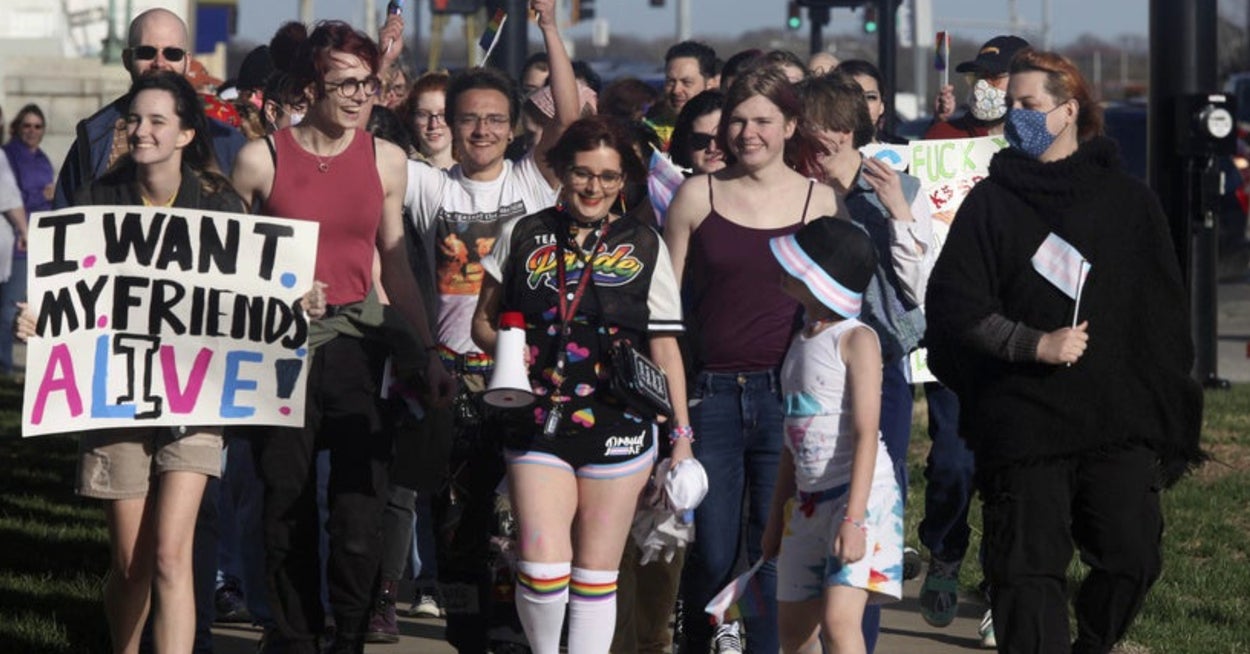
The actual number of students affected in Kansas is tiny. According to the Kansas State High School Activities Association, only three transgender girls are currently competing in high school sports. Supporters of the ban say it is necessary to protect fair competition among cisgender women and girls. Opponents argue that targeting three students is a solution in search of a problem, and that the real effect is to exclude transgender youth from the benefits of school athletics—friendships, teamwork, physical health, and a sense of belonging.
On Tuesday, the legislature also passed SB 180, a separate and much broader measure that ties together a number of restrictions on how trans people of all ages can move through public spaces. Republicans call it the “Women’s Bill of Rights.” The bill defines sex in binary terms as “either male or female, at birth.” It would prohibit transgender people of all ages from using public restrooms and locker rooms that align with their gender identity. It would also prohibit changing one’s name and gender markers on driver’s licenses. For transgender people, the consequences would be far-reaching. Accurate identification is essential for voting, opening a bank account, boarding a plane, applying for a job, renting an apartment, and accessing many healthcare services. Being forced to carry documents that show the wrong name or gender can out a person, invite harassment, and lead to discrimination.
Advocates for transgender, gender-nonconforming, and intersex people say the bill’s rigid definition of sex would lead to their legal erasure. By declaring that everyone is either male or female at birth and that nothing can change that, the state would refuse to recognize people who transition. Intersex people, who are born with physical sex characteristics that do not fit typical definitions of male or female, would be forced into categories that do not describe them. The bill’s title, “Women’s Bill of Rights,” is misleading, critics say, because the law would not expand rights for women so much as strip protections from trans people and codify discrimination in state law.
Republicans in Kansas have the votes to pass these measures despite the governor’s opposition. They hold more than a two-thirds majority in both chambers, which is exactly what is needed to override a veto. That means a veto from Kelly would be symbolic at best. The legislature can simply wait, vote again, and enact the bills into law over her objection.
Kansas’s action is the latest example of a growing trend in statehouses across the country: anti-trans legislation that bundles multiple restrictions into a single bill or uses broad language to reach many areas of public life. Last week, Kentucky’s Republican-controlled legislature overrode a veto by its Democratic governor and enacted an omnibus anti-trans bill. That law bans gender-affirming medical care for transgender youth, prevents trans students from using bathrooms that match their gender identity, and allows school officials to refuse to use a student’s requested pronouns. Like the Kansas measures, it was framed as a way to protect children and women, but opponents say it is part of a coordinated effort to push transgender people out of public spaces and civic life.
The speed and scope of these laws have alarmed civil rights organizations. In 2023, state legislatures have introduced hundreds of bills targeting transgender people, including measures focused on healthcare, sports, bathrooms, and public accommodations. Many have become law in Republican-controlled states, while others have been blocked by courts or vetoed by governors. The Kansas bills stand out because they combine a sports restriction with a broader legal framework that would affect transgender people of all ages, not just students.
The sports ban is scheduled to go into effect on July 1 unless a judge blocks it. Legal challenges are widely expected. Opponents are likely to argue that the law violates Title IX, the federal law that prohibits sex discrimination in education, as well as the 14th Amendment’s guarantees of equal protection and bodily privacy. Similar laws in other states have produced mixed outcomes in court. Some judges have allowed bans to take effect while litigation proceeds; others have blocked them, saying the plaintiffs are likely to succeed on the merits. The Supreme Court has not yet weighed in on transgender athletes, but its 2020 decision in Bostock v. Clayton County, which held that employment discrimination on the basis of transgender status is sex discrimination, has been cited by advocates in many challenges.
For the three transgender girls currently competing in Kansas high school sports, the coming months could bring sudden and devastating change. If the ban takes effect, they will no longer be allowed to play on girls’ teams, even if they have been accepted by their teammates, coaches, and communities. They will have to decide whether to try to compete on boys’ teams, where they may not feel safe or welcome, or give up sports altogether. The emotional and social toll, opponents say, can be severe.
The broader bill, SB 180, would affect trans people beyond schools. It would make Kansas one of the most restrictive states in the country for transgender residents. Transgender adults who have been using the correct restrooms for years would suddenly be barred. Transgender drivers would be barred from updating their licenses to reflect their identity, meaning many would be forced to carry documents that do not match who they are. The state would officially define sex as something fixed at birth, with no room for transition or intersex variation.
Supporters of the measures say they are trying to preserve privacy, safety, and fair competition. They argue that sex-based categories are necessary in sports, bathrooms, and locker rooms, and that allowing trans women and girls to use facilities that match their gender identity would put cisgender women at risk. But opponents point out that there is no evidence that trans people pose a threat in bathrooms, and that the number of trans athletes is vanishingly small. The real risk, they say, is to trans people themselves, who already face high rates of bullying, discrimination, and violence.
The Kansas legislature’s action is not the end of the story. If the bills become law, they will almost certainly be challenged in court. The litigation could take months or years. In the meantime, transgender Kansans and their families are left in a state of uncertainty, waiting to see whether the state will allow them to participate fully in public life or force them to the margins.
The passage of these bills also sends a message far beyond Kansas. Lawmakers in other states are watching. Anti-trans bills that were once considered too extreme are now being introduced, debated, and signed into law with increasing frequency. Kansas, with its supermajority and its determination to override a governor’s veto, has become the latest battleground in a national fight over the place of transgender people in American society.
Unless a court intervenes, the sports ban takes effect July 1. The future of SB 180 is less clear, but the legislature has already shown it has the votes to overcome any obstacle Kelly puts in its way. For trans rights advocates, the next few weeks will be critical. For the three trans girls in Kansas high schools, the next few weeks may decide whether they ever get to play again.