It has been over half a century since humanity last set foot on another world, and even longer since we last sent astronauts to see the Moon’s far side with their own eyes. For decades, the only people to witness the stark, cratered beauty of lunar orbit were the twelve men who walked its surface and the handful of crews who circled it during the Apollo program. Now, with the completion of NASA’s Artemis II mission—the agency’s first crewed lunar voyage since Apollo 17 in 1972—the public is finally being given an extraordinary, deeply personal look inside that historic journey. This week, NASA dropped a veritable firehose of data, imagery, and sound: over 800 gigabytes of scientific information, more than 11,000 photographs and videos, over 8.5 hours of crew audio, and a trove of crew-annotated images, all published on the newly unveiled Artemis II: Sights & Sounds of Science website. It is, by any measure, an unprecedented window into a mission that redefined what a lunar expedition can be—and it’s packed with revelations that will keep scientists and space enthusiasts busy for years.
If you thought you had already seen everything the Artemis II mission had to offer through the mission’s live broadcasts and the endless stream of social media posts, you were wrong. The new archive, hosted on NASA’s Science portal, goes far beyond the polished highlights that were released in near real-time during the flight. It represents the complete, unvarnished sensory record of a crewed mission that pushed farther from Earth than any human beings have traveled in more than half a century. The data dump is staggering in its scale and richness. There are thousands of high-resolution stills taken by the crew using a suite of specialized cameras, including a custom-built handheld unit designed to capture the subtle colors and textures of the lunar surface. There are hours of video footage, both in visible light and in various scientific filters, showing everything from routine spacecraft operations to the breathtaking spectacle of the Moon rushing past the window. There is even 8.5 hours of audio—not just the tense, clipped conversations between the crew and Mission Control in Houston, but also ambient recordings from inside the Orion spacecraft, the hum of life support systems, the occasional crackle of a headset, and the kinds of spontaneous, off-the-cuff exclamations that never make it into the official press kit.
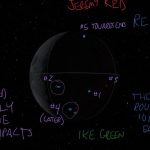
Perhaps the most striking element of the release is the inclusion of crew-annotated imagery. Astronauts are trained observers, but they are also humans, prone to the same awe and wonder as the rest of us. Throughout the mission, the four crew members—three from NASA and one from the Canadian Space Agency—marked up their images with handwritten notes, digital arrows, and scribbled explanations. One photo, in particular, has drawn significant attention: an image of the Moon’s dark side, annotated to mark the exact location where the crew observed a series of impact flashes. Those fleeting bursts of light, caused by small meteoroids slamming into the lunar surface, are well known to planetary scientists who study them from Earth and from lunar orbiters. But observing them directly with the human eye, from the window of a crewed spacecraft, is something else entirely. And according to the crew’s initial reports, these particular flashes were potentially the faintest ever recorded by a human observer. The footage of the team relaying that news to the ground is nothing short of electrifying.
In the newly released video, you can hear the excitement crackling through the comms loop as the Artemis II crew describes what they just saw. “We’ve got a flash. Another one. That was incredible,” one crew member says, their voice trailing off as they try to process the sight. Back in Houston, the flight control room erupts in applause and cheers. It’s a moment of pure joy, the kind that reminds you just how profound space exploration can be. Impact flashes are typically associated with micrometeorite impacts, which are too small and too fast to be seen directly, but the energy released when they hit the airless, rocky surface at tens of thousands of miles per hour is enough to generate a brief, brilliant flash of visible light. Seeing them with the naked eye requires a combination of the right timing, the right viewing geometry, and a little luck. That the Artemis II crew managed to catch them—and on the dark side of the Moon, no less, where the contrast is such that even the faintest glow stands out—is a genuine scientific coup.
The scientific implications of this observation are significant. For years, planetary scientists have relied on automated telescopes and lunar orbiters to count and characterize impact flashes, using them to estimate the rate at which meteoroids strike the Moon and to better understand the hazards facing future landers and surface habitats. But automated systems have biases. They can miss the faintest events, or confuse them with cosmic rays, noise, or thermal artifacts. Having trained human eyes in lunar orbit changes the game entirely. Crew members can react in real time, adjust their cameras, note the precise time and location of each flash, and provide the kind of contextual information that no robotic probe can match. The fact that these flashes were so faint, and so clearly visible to the crew, suggests that the actual rate of micrometeorite impacts on the Moon may be higher than previously thought—a finding that will feed directly into the design of future Artemis landing missions and the long-term plans for a sustained human presence on the lunar surface.
But the archive is more than just a scientific goldmine. It is also a treasure trove of public engagement, a way for ordinary people to feel like they were in the capsule with the crew. The photographs alone—tens of thousands of them, spanning every phase of the mission—offer an exhaustive visual diary. Some of the most captivating images, though, are the ones that never made it into the early release selects. There are shots of the Earth shrinking to a pale blue dot, then growing again as the spacecraft swung back around the far side of the Moon and began its journey home. There are photos of the crew sleeping, tethered to their seats, their faces illuminated by the soft glow of instrument panels. There are shots of the tiny Earth-moon system framed together, a reminder of our shared cosmic home. And there are the annotated images, which transform the raw data into a human story—marking the exact spot where they saw an impact flash, circling a curious geological feature, or writing “That’s the Sea of Tranquility down there” in the margins.
The release of this massive dataset comes as NASA and its international partners turn their attention to the future. Artemis II was never intended to be a one-off adventure; it was the proving ground for Artemis III, the mission that will once again put human boots on the lunar surface, and for the long-term goal of establishing a sustained, robotic and human presence on and around the Moon—a stepping stone to the ultimate prize of sending astronauts to Mars. The data from Artemis II will be pored over by engineers and mission planners for years, informing everything from the design of future life support systems to the development of better radiation shielding. The crew’s observations of impact flashes, for example, will help refine models of the lunar near-surface environment, which in turn will influence the siting of future landers and habitats to avoid the most hazardous regions. The high-resolution imagery of the lunar surface, taken from altitudes that no crewed spacecraft has achieved since Apollo, will help update geological maps and identify promising sites for sampling and exploration.
Yet, for all its scientific weight, the archive is also a gift to the human spirit. It’s a reminder that space exploration is not just a technical endeavor, but a deeply emotional one. The joy of seeing an impact flash—a tiny, flickering reminder that the Moon is not a static relic, but a living, changing world—resonates far beyond the pages of a scientific journal. The annotated images, scrawled with the handwriting of astronauts, make it clear that the people who fly these missions are not cold, robotic automatons. They are painters, poets, and explorers, just like the ones who first looked up at the Moon from a campfire thousands of years ago.
The Sights & Sounds of Science site is not just an archive; it is an invitation. NASA is now asking the public to dig in, download the data, and make their own discoveries. Citizen scientists can browse the images for new impact flash candidates, or listen to the audio in search of overlooked moments of scientific significance. The agency has even provided a set of tools for analyzing the images and a guide to the various data products, making it possible for armchair researchers to contribute meaningfully to the mission’s scientific legacy. This is a very modern way of doing exploration—not just bringing the data home, but letting the whole world join in the analysis. It’s democracy in space science, and it’s exactly in keeping with the spirit of Artemis, the twin sister of Apollo and the goddess of the hunt.
As the initial rush of excitement over the data release subsides, the real work will begin. Scientists will spend months—maybe years—cataloging every image, every audio clip, and every piece of telemetry. They’ll calibrate the instruments, cross-reference the crew’s observations with data from lunar orbiters, and produce the first detailed studies of what the crew saw and experienced. But for now, for the rest of us, the gift is simpler. We have over 800 gigabytes of pure adventure, a chance to sit in the crew’s seat, to hear the crackle of their voices, to see the Moon through their eyes, and to mark our own little notes in the margins of history. It is a treasure trove unlike any other, a look inside a historic mission that will define what it means to go back to the Moon for generations to come. And it’s all just a few clicks away.