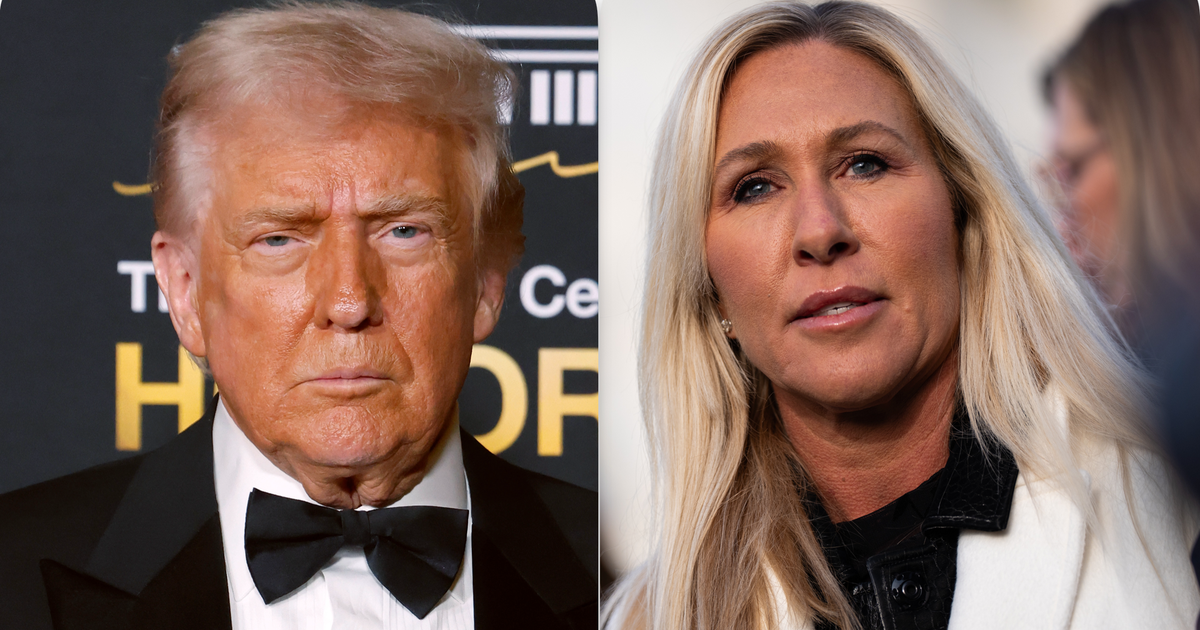
In a stunning public rebuke, President Donald Trump unleashed a torrent of criticism against former ally Representative Marjorie Taylor Greene via his Truth Social platform on Monday morning. His caustic remarks followed revelations from a “60 Minutes” interview, a CBS News program, wherein Greene accused the president of abandoning his foundational “America First” commitments. This rift marks a notable departure from Greene’s previous stance as one of Trump’s staunchest allies in Congress.
The dispute underscores a dramatic transformation in their relationship as Greene gears up to leave Congress before the end of her term. During her revealing “60 Minutes” interview with correspondent Lesley Stahl, Greene was vociferous in her assertion that the President had strayed from prioritizing domestic affairs. More explosively, she linked recent death threats against herself—and threats directed at her son—to the President’s public condemnation of her.
President Trump’s response was scathing and dismissive. He attributed Greene’s break from him to personal disappointment, insinuating that she felt spurned by him. His posts went as far as to label her a “washed up” and “low IQ traitor,” with his vitriol extending to labeling her shift in loyalty as aligning with a “very dumb person.” Moreover, Trump didn’t stop at criticizing Greene alone; he also lashed out at Lesley Stahl and “60 Minutes,” extending his discontent to the program’s management under its new ownership by Paramount, the parent company of CBS.
Greene, who had previously aligned with Trump’s policies nearly 98% of the time, noted that her disillusionment began over their differing attitudes towards engagement with the cryptocurrency and pharmaceutical industries. Her embittered relations with Trump further soured amid controversies regarding their shared connections to Jeffrey Epstein, who faced federal sex trafficking charges before his death by suicide in 2019.
The “60 Minutes” interview revealed that following Trump’s public denunciation, Greene and her family became the targets of multiple threats, including a bomb threat against her residence and direct death threats against her son. She asserted that these threats were stoked by Trump’s incendiary rhetoric, a point she emphatically made known to Trump and his circle, including JD Vance, who responded with a commitment to investigate the matter.
Despite these harsh exchanges and threats, Greene told Stahl that it was not Trump who forced her resignation from Congress. Asserting her autonomy, she starkly remarked, “I will be no one’s battered wife.” Her interview also touched on the palpable fear she perceives among Republican members of Congress, who she believes are intimidated by the prospect of facing the ire of Trump’s public scolding on social media platforms such as Truth Social.
Addressing her controversial tenure and the changing dynamics of her political conduct, Greene also extended an apology during an appearance on CNN the previous month. She expressed regret over her previous incendiary rhetoric that contributed to inflaming the already divisive political climate in America. However, back on “60 Minutes,” when pressed by Stahl on her confrontational behavior and insults in political discourse, Greene retorted by noting Stahl’s own accusatory tone, illustrating the fractious and often circular nature of such media-political interactions.
As Greene’s once-tight relationship with Trump disintegrates in such a public and acrimonious manner, it reflects broader tensions within the Republican Party and among conservative circles in the U.S. Her impending resignation from Congress and her harsh criticisms reveal significant challenges in maintaining party unity and personal political integrity amidst an increasingly volatile political environment.
Looking beyond the immediate controversy, Greene’s fallout with Trump could have considerable implications for her career trajectory as well as the dynamics within the Republican Party as it struggles to define its identity post-Trump presidency against the backdrop of upcoming electoral challenges.
As this situation continues to develop, it raises important questions about loyalty, political alignment, and the consequences of public dissent within high ranks of American political figures. It underlines the complex interplay between personal political ambitions, party loyalty, and the overarching ideological battles that continue to shape the U.S. political landscape under a global spotlight.