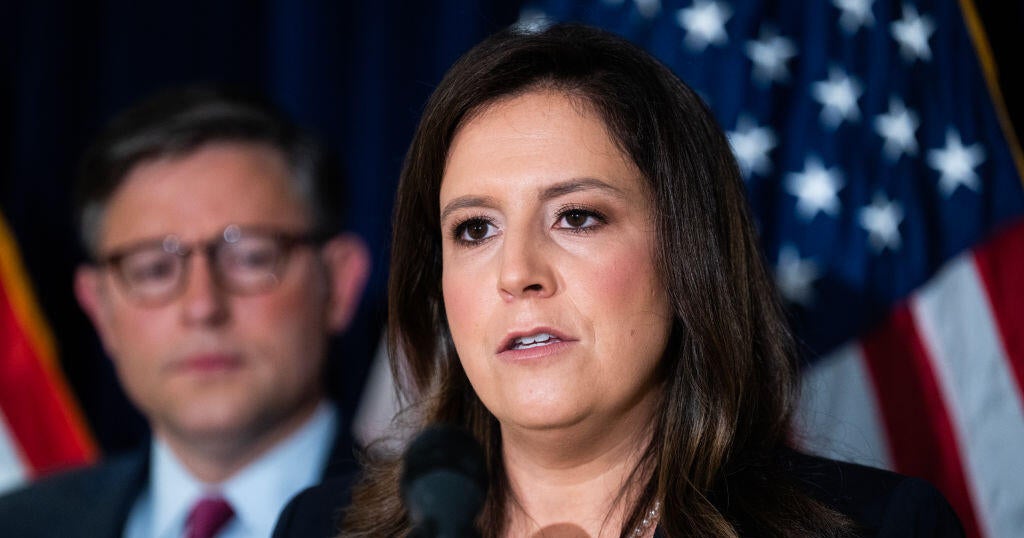
In Washington D.C. this week, significant political tensions surfaced within the House of Representatives, particularly involving GOP Representative Elise Stefanik of New York and House Speaker Mike Johnson. Stefanik vehemently criticized Johnson for his initial refusal to include a critical provision in the National Defense Authorization Act (NDAA), a situation that unfolded amid heated debates and public exchanges which highlight the intricacies of governance and party dynamics.
The crux of the disagreement centered on Stefanik’s proposed provision that aimed to ensure greater transparency and oversight concerning counterintelligence investigations. Specifically, her provision sought to mandate the FBI to inform Congress whenever it initiates such investigations into candidates running for federal office. Stefanik argued that such a measure was essential to safeguarding the democratic process and preventing the misuse of intelligence capabilities for political gains.
Despite Stefanik’s position within Johnson’s leadership team and her historical support for similar legislative measures, her frustration became palpable when the provision was omitted from the NDAA during the negotiations. She took to social media to voice her discontent, perceiving Johnson’s handling of the situation as a capitulation to House Democrats who were opposed to the inclusion of her provision.
In a post on X (formerly Twitter), Stefanik emphatically stated, “Unless this provision is added back into the bill to prevent illegal political weaponization of the intelligence community in our elections, I am a HARD NO. I have always voted in support of the defense and intelligence authorization bills, but no more.” Her message signaled a crucial standoff that threatened to derail the passage of the NDAA – a fixture in congressional approval for over six decades due to its bipartisan nature.
Continuing her public campaign, Stefanik further accused Johnson of blocking her initiative, asserting that the bill was “DOA unless this provision gets added in as it was passed out of committee.” This declaration underscored her willingness to influence the legislative process right from the negotiation phase to the final voting on the House floor, illustrating the depth of her commitment to this cause.
Amidst this growing rift, additional developments occurred. Following what Stefanik described as a “productive discussion” with President Donald Trump and Johnson, a compromise was reached whereby the provision would indeed be included in the NDAA bill. Stefanik heralded this update as a “significant legislative win delivered against the illegal weaponization of the deep state,” showcasing a momentary resolution to the escalating conflict.
However, Johnson’s response to the entire episode painted a different picture. Claiming to have been somewhat unaware of the detailed grievances, he expressed confusion over Stefanik’s aggressive approach. “I don’t exactly know why Elise won’t just call me. I texted her yesterday,” Johnson shared with reporters, indicating a possible communication breakdown within the party leadership. He further clarified that the issue had not explicitly come to his attention until recently, and suggested that jurisdiction over the matter perhaps belonged to the bipartisan leaders of the House and Senate Judiciary committees – a point Stefanik refuted by claiming jurisdiction rested with the House Intelligence Committee.
The exchange highlighted a deeper issue within the GOP leadership, where Stefanik accused Johnson of employing deceit as a tactical approach, a claim she aired publicly stating, “Just more lies from the Speaker. This is his preferred tactic to tell Members when he gets caught torpedoing the Republican agenda.”
This episode provides a vivid portrayal of the complexities and internal negotiations that characterize the legislative process in U.S. governance. It paints a picture of how individual legislators navigate their roles within the larger party dynamics, often facing the challenge of balancing personal convictions with collective party strategies. Furthermore, the public and transparent manner in which these debates unfolded points to a broader trend of political figures using media, particularly social media platforms, to directly communicate with the public and exert pressure within legislative frameworks.
The involvement of figures like President Trump in such discussions also underscores the influence of prominent party figures in legislative affairs, highlighting the interconnected nature of different branches of governance and their impact on policy-making.
Moreover, reporter Kaia Hubbard’s contributions to the reporting on this matter reflect the investigative and essential role of journalists in unpacking intricate political processes and presenting them to the public, thus enhancing understanding and transparency in government operations.
As the NDAA progresses towards a vote with Stefanik’s provision now included, the episode serves as a reminder of the persistent negotiations, strategic calculations, and the essential yet often contentious role of legislation in shaping national security and intelligence oversight in the United States.