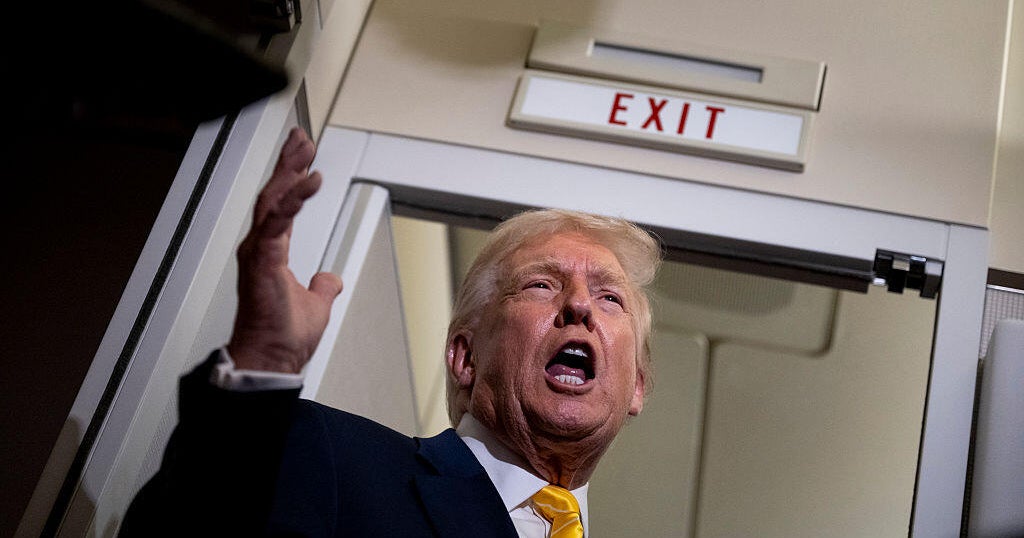
President Donald Trump indicated on Friday that he had “sort of” reached a decision regarding the United States’ course of action towards Venezuela amid speculation about possible military operations in the region. Speaking to CBS News aboard Air Force One, Trump revealed that he might have a plan in mind but fell short of disclosing any specific steps his administration would take, stating, “I can’t tell you what it would be.”
In what seems to be a focused and continuous discourse at the White House, top administration officials, accompanied by senior military and staff, have convened for at least three consecutive days to contemplate their next move concerning the Latin American nation. High-level discussions included the participation of notable figures such as Vice President JD Vance, Defense Secretary Pete Hegseth, Joint Chiefs of Staff Chairman Dan Caine, and Secretary of State Marco Rubio. These deliberations underline the strategic importance and complexity of the Venezuelan situation to the U.S. administration.
The gravity of the matter was further emphasized during President Trump’s daily intelligence briefing on Wednesday. Previously reported by CBS News, it was during this briefing that figures like Hegseth and Caine proposed several military options that the U.S. could potentially undertake in the near future. These options reportedly include targeted strikes within the Venezuelan territory, reflecting an aggressive posture towards the ongoing crises in the country.
Repeated briefings throughout the week, with an expanded group of advisors on Friday, suggest a meticulous and calculated approach by the Trump administration. Despite this deep internal review, it appears the U.S. has not yet officially informed its allied nations of its precise intentions regarding Venezuela. This lack of communication was confirmed by representatives from two Western allies who spoke to CBS News under conditions of anonymity due to the sensitive nature of the discussions.
The context of these potential military operations stems from the U.S.’s strong allegations against Venezuelan President Nicolas Maduro. The U.S. administration accuses Maduro of collaborating with armed criminal organizations involved in narcotics trafficking into the United States. These allegations are bolstered by a 2020 federal indictment labeling Maduro as a principal narco trafficker. However, despite these serious accusations and the subsequent U.S. military action against suspected drug-smuggling vessels—resulting in the deaths of at least 80 individuals—the evidential link directly connecting Maduro to these criminal activities remains disputed among some Western European countries with stakes in Latin America.
Further complicating the international landscape are the critiques from leaders like French Foreign Minister Jean-Noel Barrot, who denounced the U.S. military actions as violations of international law, particularly concerning the law of the sea. In remarks made at the G7 summit of foreign ministers in Ontario, Barrot expressed significant concern over these operations, especially given France’s extensive presence in the Caribbean via its overseas territories, home to over a million French citizens.
Amidst these international debates, there has been a noticeable build-up of U.S. military presence in the region. The USS Gerald R. Ford carrier strike group recently entered the U.S. Southern Command’s area of responsibility, which coordinates military operations across the Caribbean and South America. This move coincides with the presence of a formidable array of American military assets, including destroyers, warplanes, and special operations units, reinforcing the U.S. operational capabilities in the area.
As the situation continues to evolve, the decisions made by the Trump administration could significantly impact not only U.S.-Venezuela relations but also broader geopolitical dynamics in the region. The potential repercussions of military intervention are vast, influencing international law, regional stability, and the global perception of the United States. The cumulative discussions within the White House signal a critical juncture, with strategic decisions possibly setting the course for future U.S. foreign policy in Latin America.