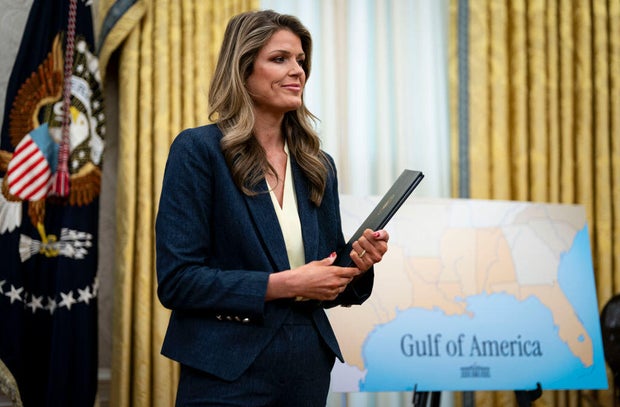
In a significant development in U.S. political and legal circles, President Donald Trump announced on Saturday his decision to nominate Lindsey Halligan, a senior White House aide, to assume the role of the top federal prosecutor for the Eastern District of Virginia. This announcement came in the wake of the unexpected departure of U.S. Attorney Erik Siebert, who abruptly resigned from the position on Friday, generating a flurry of speculation and uncertainty about the future leadership of this pivotal office.
President Trump conveyed his decision through a post on social media, shortly after departing the White House for an event. In his communication, he expressed his confidence in Halligan, describing her as “Fair, Smart, and a provider of desperately needed JUSTICE FOR ALL!” This nomination follows the interim appointment of another conservative lawyer, Mary “Maggie” Cleary, who revealed in an internal email to staff—later obtained by CBS News—that she had been named acting U.S. Attorney for the same district. Cleary, in her message to the employees, expressed humility and determination to build on the district’s “distinguished legacy.”
The rapid developments have led to some confusion and inquiries from the media, prompting CBS News to seek clarification from the White House regarding whether Cleary would continue in her acting role until Halligan’s nomination process through the Senate is completed.
Halligan has been associated with President Trump’s legal team for several years and has been prominently involved in defending the former President during the FBI’s investigation into his retention of classified documents at his Mar-a-Lago estate. This involvement was noted again by President Trump in a subsequent post where he asserted Halligan’s toughness, intelligence, and loyalty. Additionally, Trump highlighted Halligan’s role in what he termed as a fight against the “Weaponization of our Justice System” spearheaded by opposition figures, drawing attention to the controversial and widely publicized raid on his property.
More recently, Halligan has been active in a White House initiative aimed at purging what is deemed as “improper ideology” from Smithsonian museums, implying a further broadening of her responsibilities and influence within the Trump administration.
This nomination surfaces amidst volatile circumstances, particularly following the resignation of Siebert, who reportedly faced pressure from Trump’s administration to initiate criminal charges against New York Attorney General Letitia James over allegations of mortgage fraud. This situation escalated concerns about judicial impartiality and the independence of prosecutorial decisions from political influence, as raised by some federal prosecutors within the district.
In his comments on Friday, Trump did not shy away from acknowledging his desire for Siebert’s departure, affirmatively stating, “Yeah, I want him out.” The subsequent vacancy now presents Halligan with the challenge of leading an office deeply enmeshed in political controversy, especially given the ongoing investigations and prevalent tensions between the state and federal jurisdictions over cases involving high-profile figures such as AG Letitia James.
James herself has been a contentious figure in Trump’s orbit, having previously sued Trump for alleged financial fraud, with substantial fines levied against him and his organization—a decision that has been the subject of intense legal and public scrutiny, including appeals that have slightly mitigated the financial repercussions for Trump.
Adding to the theatricality of the events, Trump took to social media to assert that he dismissed Siebert, countering claims by Siebert that he had resigned on his accord. Trump’s statements reinforced his narrative of a profound legal and moral conflict at play, framing Siebert’s departure as a dismissal over political and ethical disagreements regarding prosecutorial conduct and allegiances.
Meanwhile, Maggie Cleary’s interim role and her background present another layer of complexity. Having rejoined the Justice Department and possessing a history of prosecutorial and public safety roles in Virginia, her brief tenure as acting U.S. Attorney until Halligan’s confirmation process unfolds is under scrutiny. Her past experience with political targeting, as Cleary claimed in an article about being mistakenly placed on administrative leave during the Jan. 6 Capitol riot investigations, also feeds into the ongoing narrative of political bias and retribution that seems central to this unfolding saga.
In conclusion, the nomination of Lindsey Halligan and the transitional role of Maggie Cleary mark a pivotal moment for the Eastern District of Virginia’s federal prosecutor’s office, reflecting broader themes of legal accountability, political influence, and the delicate balance of justice in a deeply divided America. As Halligan awaits the Senate’s decision, the legal and political communities alike watch closely, anticipating the impact of this change on high-stakes federal investigations and the overall integrity of the U.S. judicial system.