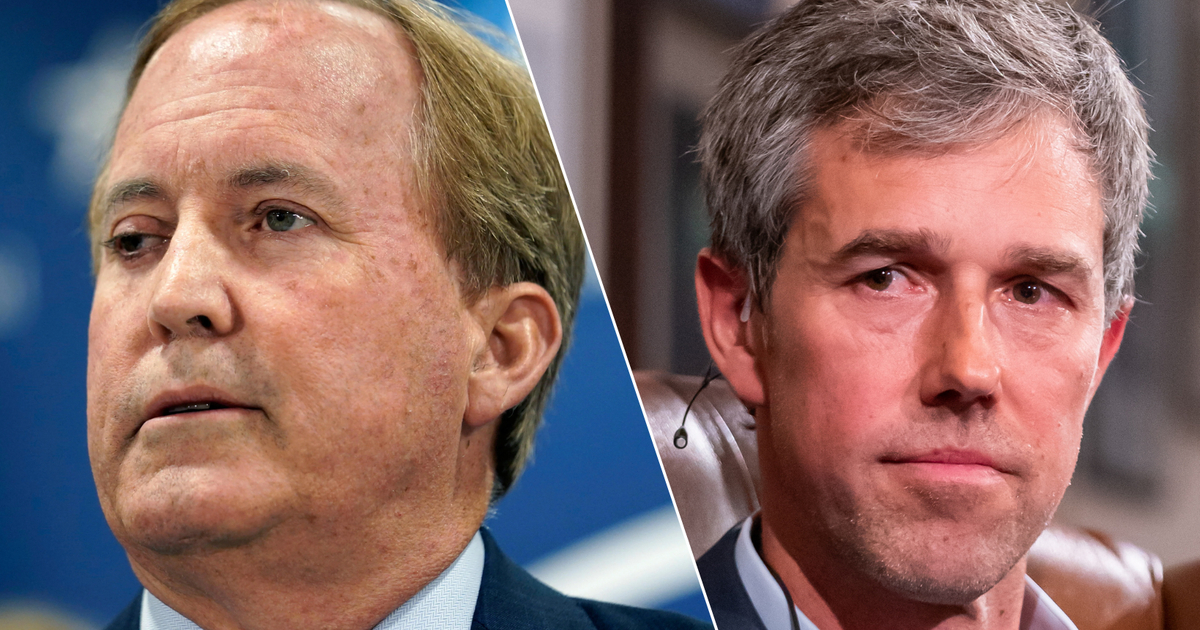
In an announcement on Wednesday, Texas Attorney General Ken Paxton unveiled the launch of an investigation targeting the political action committee founded by Beto O’Rourke. The inquiry focuses on allegations that the group has been illicitly financing out-of-state travel for Texas House Democrats, who had recently absconded from the state to forestall a vote on redistricting.
Founded under the name Powered by People, the political action committee under scrutiny is geared toward fortifying Democratic support throughout Texas. Its official website details its main objectives as registering voters, mobilizing Democratic-leaning voters, and backing Democratic candidates across the state. However, Paxton alleges that, according to “public reports,” this group stands among the primary financial supporters for the recent Democratic exodus from the Texas legislature.
This controversy took another turn when Powered by People confirmed through CBS Texas’ “Eye on Politics” reporter Jack Fink that indeed, the organization was actively fundraising to aid the Democrats who fled. This departure from the state legislature by the Democratic members was a strategic move to deprive the legislature of the quorum necessary for voting, particularly on the issue of redrawing the state’s congressional districts—a redistricting plan that proposed the addition of five seats likely to favor Republicans.
In reaction to these events, O’Rourke’s campaign issued a statement sharply criticizing Paxton, drawing attention to his previous impeachment on bribery charges and juxtaposing it against their efforts to prevent what they view as an unjust political maneuvering to seize greater congressional control.
From Paxton’s vantage point, the financial assistance provided by O’Rourke’s PAC to the absent Democrats potentially infringes on multiple state laws, including those that regulate bribery, campaign finances, and coercion of public officials, as well as potential abuse of office. Intent on digging deeper into these allegations, Paxton issued a “Request to Examine,” compelling Powered by People to release relevant documents and communications that could shed more light on the nature of its involvement with the relocating Democrats.
As a direct result of the Democrats’ departure, the Texas House faced a stumbling block in achieving a quorum, falling short for two consecutive sessions. This situation prompted Dustin Burrows, Speaker of the Texas House, to issue an ultimatum requiring the absent Democrats to return by Friday and resume their duties at the state Capitol in Austin.
Paxton, bolstered by a sharp tone of censure, directed a stern warning towards the absent Democrats, suggesting that their continued avoidance of legislative responsibilities could lead to severe consequences. He articulated the sentiments of accountability and duty, emphasizing that elected officials are expected to fulfill their obligations, not evade them. He hinted at potential job terminations for those who failed to comply, and even floated the prospect of seeking a court ruling to officially declare their seats vacant as a punitive measure for what he described as an abandonment of their office.
This intricate tussle between state law enforcement and legislative members brings to the forefront several pivotal questions about the bounds of political strategies, the interpretation of legal responsibilities of elected officials, and the overarching implications of such standoffs on legislative processes. As more details unfold and as the deadline for the Democrats’ return approaches, the political atmosphere in Texas remains tense and expectant, with various stakeholders keenly watching the next moves in this high-stakes political chess game.
The investigation touches on critical issues of governance, accountability, and the interpretation of legal statutes in political maneuvering, potentially setting precedents for how similar situations are handled in the future. As these events continue to unfold, they will likely ignite further debates on the balance between political strategy and legal boundaries, reflecting the often complex interplay between different branches of government and their respective roles in the legislative process.
This scenario also underscores the increasingly polarized nature of political discourse in America, where legislative maneuvers frequently escalate into major legal confrontations, reflecting deeper ideological divisions within the country.