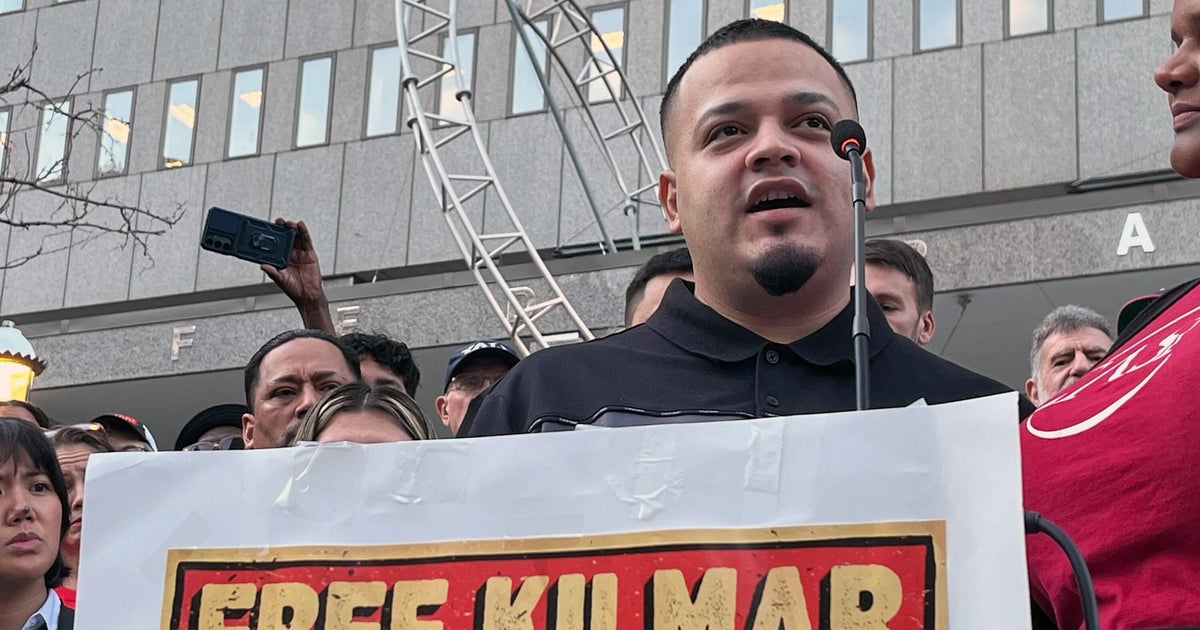
In the town of Greenbelt, Maryland, a federal judge on Friday interrogated Justice Department lawyers about plans by the Trump administration to deport Kilmar Abrego Garcia, a Salvadoran man who was previously deported in error to a prison in his home country. The interrogation came before he was returned to the U.S. to face criminal charges.
Abrego Garcia had been mistakenly sent to El Salvador earlier this year, which sparked controversy and backlash against the Trump administration. The administration is now making plans to once again deport him while his criminal case on charges of human smuggling is in progress in Tennessee. Abrego Garcia’s possible deportation has raised questions about the Trump administration’s immigration policies and the treatment of immigrants in the U.S.
During the court proceedings, U.S. District Judge Paula Xinis expressed frustration over the strategies of the immigration authorities in handling Abrego Garcia’s case. She asked why there was a delay in removing Abrego Garcia to Costa Rica, a country he has expressed interest in going to, and which has indicated its willingness to accept him.
The judge also expressed dissatisfaction with the testimony given by a U.S. immigration official, Jonathan Schultz, who seemed to be unprepared to answer questions about the administration’s plans regarding Abrego Garcia’s possible removal to Eswatini, a small African nation formerly known as Swaziland. Schultz’s inability to provide satisfactory answers about the administration’s next steps concerning Abrego Garcia’s potential removal to Eswatini or other countries, including Costa Rica, appeared to add to the judge’s disappointment.
Judge Xinis sharply criticized Drew Ensign, a Justice Department lawyer, for presenting a witness who, in her words, “knows nothing, and I mean next to nothing, about Costa Rica.” She further elaborated on her dissatisfaction, stating that despite giving specific directions about the scope of the testimony she was seeking, the Justice Department had once again disregarded her instructions. This led her to warn the Justice Department, stating, “getting to the three strikes, you’re out.”
Schultz, who works for the Enforcement and Removal Operations at Immigration and Customs Enforcement, informed the court that government officials have had discussions with numerous foreign nations about accepting Abrego Garcia upon his removal from the U.S. He confirmed that the U.S. had reached an agreement with Eswatini to accept individuals deported from the U.S. and assured the court that they would be safe from torture and persecution. However, he noted that Eswatini has not agreed to receive Abrego Garcia specifically.
The Trump administration’s efforts to deport Abrego Garcia have been met with several obstacles. In August, Judge Xinis issued an order preventing immigration officials from removing Abrego Garcia from the U.S. She is now considering whether to release Abrego Garcia from immigration custody while a challenge to his detention proceeds.
Schultz also revealed that the Trump administration had been in discussions about removing Abrego Garcia to Ghana. However, a notice of his potential deportation to the country had been sent to Abrego Garcia prematurely. Subsequently, Ghana’s foreign affairs minister, Samuel Okudzeto Ablakwa, stated on social media that his country would not accept Abrego Garcia. He further pointed out that he had made it clear to U.S. officials that Ghana’s understanding to accept a limited number of non-criminal West Africans would not be expanded.
Adding to the complexity of the case, Schultz revealed that the U.S. government had begun discussions with Eswatini about accepting Abrego Garcia after the government in Uganda, another potential destination, declined to accept him. The Ugandan government’s refusal came as a surprise, as documents obtained by CBS News in August indicated that an agreement had been reached between the Trump administration and Uganda for the East African nation to accept deportees.
As proceedings continued, it became evident that the Trump administration had not undertaken any efforts to evaluate whether Abrego Garcia would face any form of mistreatment if deported to Eswatini. Schultz could not confirm if any assessments had been made to determine if Abrego Garcia would be subjected to torture, detention, or persecution if deported.
The lawyers representing Abrego Garcia have been fighting to free their client from federal immigration detention while his immigration case unfolds. They cited a 2001 Supreme Court decision which ruled that federal law does not permit “indefinite detention” for those the government seeks to deport. The ruling stated that detention should only be for a “period reasonably necessary” to achieve their removal from the U.S. The attorneys argue that Abrego Garcia’s continued confinement is illegal, as he has been in federal immigration detention since late August, following his release from criminal custody on unrelated charges. They further assert that his continued detention is in direct violation of the Supreme Court ruling.
Highlighting the challenges faced by Abrego Garcia, his lawyer, Andrew Rossman, pointed out that his client had been in “continuous confinement” since his first arrest by immigration authorities in March. He was then deported to El Salvador where he remained detained until August, except for a brief weekend. Rossman argued that the U.S. government could have released Abrego Garcia from the Salvadoran prison, but chose not to.
The attorney further argued that the Trump administration had failed to find a country that would accept Abrego Garcia for removal. Rossman stated that they had confirmed with Abrego Garcia that he would willingly go to Costa Rica if the U.S. moved to deport him there.
The Costa Rican government had earlier expressed its intent to provide refugee status or residency to Abrego Garcia. In an August letter to the top U.S. diplomat in the country, the Costa Rican government stated that it would accept Abrego Garcia “upon the conclusion of any criminal sentence he may serve in the United States of America.”
Rossman also expressed doubts about the intentions of the Trump administration, stating that he did not believe they were intending to remove Abrego Garcia in a lawful manner. He accused the administration of spinning the globe and picking various places to fail on purpose. He suggested that the administration was selecting countries that would be completely unpalatable to Abrego Garcia, leading him to express reasonable fear of persecution or torture. These claims would then have to be adjudicated, during which Abrego Garcia would remain detained.
Rossman accused the government of having an improper and punitive aim, which was simply to keep Abrego Garcia incarcerated. He reiterated that the Trump administration had failed three times in finding a country that would accept Abrego Garcia for removal.
Judge Xinis questioned Ensign, the Justice Department lawyer, about the absence of conversation between the Trump administration, Abrego Garcia, and his lawyers regarding potential removal to Costa Rica. She asked why there had been no discussions, considering that Abrego Garcia had designated Costa Rica as his preferred country of removal.
Abrego Garcia had been living in Maryland for over a decade with his wife and children before his life was interrupted when he was taken into immigration custody in March and deported to El Salvador. However, the situation was complicated by the fact that an immigration judge had granted Abrego Garcia a withholding of removal in 2019. This legal status prohibited the Department of Homeland Security from removing him to his home country because of the likelihood of persecution by local gangs.
In response to this, Judge Xinis ordered the Trump administration in April to facilitate Abrego Garcia’s return to the U.S. Despite the order, the Department of Homeland Security resisted doing so for weeks. However, in early June, Abrego Garcia was eventually brought back to the U.S. after a federal grand jury indicted him on two counts of human smuggling. He pleaded not guilty to both counts.
In July, a federal judge overseeing his criminal case ordered Abrego Garcia to be released on bond while awaiting trial. However, he remained detained for several more weeks due to concerns that he would be swiftly taken into immigration custody following his release and deported.
Abrego Garcia was initially held at a detention center in Virginia but was later transferred to a facility in Pennsylvania. Earlier this month, his legal team’s request to reopen his immigration case and allow him to seek asylum in the United States was rejected by an immigration judge in Maryland. Abrego Garcia can appeal the decision to the Board of Immigration Appeals.
Last week, a federal judge in Tennessee expressed his belief that the Justice Department’s criminal case against Abrego Garcia may have been vindictive. The judge wrote that “The government had a significant stake in retaliating against Abrego’s success.” However, a final ruling has not been made on these claims, and a discovery and a hearing on Abrego Garcia’s claims will be allowed.
The case of Kilmar Abrego Garcia is a stark reminder of the complexities and challenges faced by immigrants in the U.S. It also shines a light on the controversial immigration policies of the Trump administration and the treatment of immigrants in the country. At present, there are 62,000 people in immigration custody, according to Schultz, the immigration official.