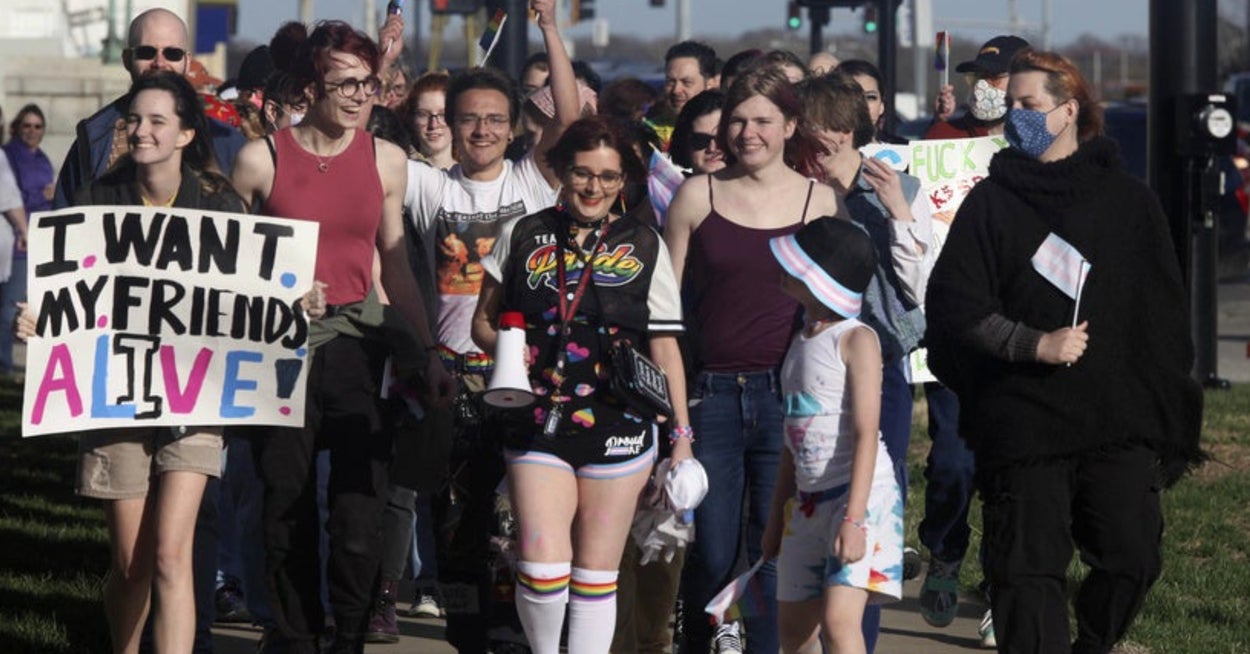
Kansas Lawmakers Pass Sweeping Anti-Transgender Legislation, Including Sports Ban and Restroom Restrictions
Kansas is poised to become the latest state to enact broad restrictions on the lives of transgender residents, after Republican lawmakers passed a pair of bills that target transgender athletes, public restroom access, and even the legal recognition of gender identity. The legislation has sparked intense debate among civil rights advocates, medical professionals, and conservative lawmakers who say the measures are necessary to protect women’s sports and privacy.
At the center of the controversy is a new sports ban that would prohibit transgender girls and women from competing in female sports categories at the high school and college levels. The bill, which passed through the Republican-controlled legislature, is now headed to Democratic Governor Laura Kelly’s desk. However, Republicans in the Kansas Legislature hold more than a two-thirds majority in both chambers, meaning they have the votes to override a gubernatorial veto. Unless a judge blocks the law before it takes effect, the sports ban is scheduled to go into effect on July 1.
The Sports Ban and the Question of Genital Inspections
One of the most contentious aspects of the sports bill is the lack of clarity around how schools would verify the sex of student athletes. When asked whether the legislation would require genital inspections or other invasive forms of verification, Kansas state Representative Wasinger, a supporter of the bill, did not provide a direct answer. Instead, Wasinger issued a statement defending the legislation by pointing to existing requirements for student participation.
“Sports physicals are done for every athlete participating in school sports. Every child in Kansas must provide a birth certificate to attend school in Kansas. Both should be enough for any student,” Wasinger said.
Critics, however, argue that a birth certificate is not a reliable indicator of a person’s gender identity, and that requiring transgender students to present documents that reflect the sex assigned at birth would effectively bar them from participating in sports altogether. Civil rights advocates also point out that birth certificates can be amended in many states, but that transgender people often face significant legal hurdles in updating theirs. Moreover, intersex individuals and others with variations in sex characteristics may have birth certificates that do not align neatly with binary categories.
Proponents of the sports ban claim that the law is needed to ensure fair competition among cisgender women and girls. They argue that transgender women and girls may retain physiological advantages from male puberty, such as greater muscle mass, bone density, and cardiovascular capacity, even after undergoing hormone therapy. However, the actual data from Kansas does not support the notion that transgender athletes are dominating or even meaningfully present in school sports. According to the Kansas State High School Activities Association, there are currently only three transgender girls competing in high school sports across the entire state.
That number stands in stark contrast to the scale of the legislative response. Lawmakers have devoted significant time and political capital to restricting the participation of three students, a fact that opponents of the bill say reveals the true motivation behind the legislation: not fairness, but the erasure of transgender people from public life.
SB 180: The “Women’s Bill of Rights”
The sports ban is not the only piece of anti-transgender legislation moving through the Kansas Legislature this session. On Tuesday, lawmakers also passed SB 180, a far more expansive bill that Republican supporters have branded the “Women’s Bill of Rights.” The bill bundles together a number of restrictions on how transgender people of all ages can navigate public spaces and official documentation.
Among the most significant provisions in SB 180 is a ban on transgender people using public restrooms and locker rooms that align with their gender identity. This would mean that a transgender woman who has lived and been recognized as female for years would be legally barred from using the women’s restroom in a public building, and would instead be forced to use men’s facilities. For transgender men, the reverse would apply. The bill also prohibits changing one’s name and gender markers on driver’s licenses, which would create a host of administrative and practical difficulties for transgender residents trying to update their identification documents.
The bill defines sex in strictly binary terms as “either male or female, at birth.” Under this definition, there is no legal recognition of nonbinary, gender-nonconforming, or intersex people. Advocates warn that the law would lead to the legal erasure of transgender, gender nonconforming, and intersex individuals. By writing into state law a definition of sex that is based solely on reproductive anatomy observed at birth, the bill would deny the existence and legitimacy of transgender Kansans.
The name “Women’s Bill of Rights” is misleading, opponents argue, because the law does nothing to protect women’s rights. Instead, they say, it strips transgender women of the right to be recognized as women under state law, and it exposes all transgender people to harassment and discrimination. LGBTQ advocacy groups have pointed out that forced use of restrooms based on birth-assigned sex does not make public spaces safer for women; rather, it puts transgender people at greater risk of violence and verbal abuse.
A Growing Pattern of Omnibus Anti-Trans Legislation
Kansas is not operating in a vacuum. The state’s sweeping bill is the latest in a series of anti-transgender laws that bundle multiple restrictions together or define their scope so broadly that they affect nearly every aspect of transgender life. This legislative strategy has become increasingly common in Republican-controlled states over the past several years.
Just last week, Kentucky’s Republican-controlled legislature overrode a veto from Democratic Governor Andy Beshear to enact an omnibus anti-trans bill. That law banned gender-affirming medical care for transgender youth, barred transgender students from using bathrooms that align with their gender identity in schools, and gave school officials the right to refuse to use students’ preferred pronouns. The Kentucky law, like the Kansas bill, passed along largely party-line votes and was passed over the objections of medical associations, pediatricians, and mental health organizations that warn that such restrictions harm vulnerable young people.
Supporters of these laws often frame them as protective measures, but critics see them as part of a coordinated effort to push transgender people out of public life. By restricting access to bathrooms, changing names and gender markers on identification, and banning athletic participation, the laws create obstacles to everyday activities, from going to school and playing sports to simply living safely in public.
The Kansas bills have drawn particular concern because of their scope. While some states have enacted separate laws on sports participation, bathroom access, and medical care, SB 180 combines several restrictions into a single piece of legislation. This makes it harder for opponents to challenge the law in court, since a judge might be forced to rule on all provisions together. It also signals a legislative intent to create a comprehensive system of exclusion, rather than addressing a single narrow issue.
What Happens Next in Kansas
The political math in Kansas makes it likely that the bill will become law, even though Governor Kelly has expressed support for transgender rights in the past. With a Republican supermajority in both the House and Senate, the legislature has more than enough votes to override Kelly’s expected veto. Unless an injunction is issued by a court, the sports ban will go into effect July 1, with SB 180 likely to follow a similar timeline unless legal challenges are filed.
Legal experts anticipate lawsuits from civil rights organizations, which could argue that the laws violate the Kansas State Constitution’s equal protection clause, as well as constitutional guarantees of equal protection under the Fourteenth Amendment. Litigants may also argue that SB 180 discriminates against transgender people by denying them the right to update their identification documents, which affects everything from voting and banking to travel and healthcare.
There are also practical concerns about how the laws would be enforced. School districts may struggle to determine which students are affected by the sports ban, and state officials would need to determine how to enforce bathroom restrictions in public buildings, including schools, universities, and government buildings. Businesses and employers will face questions about restroom access. Schools are likely to face lawsuits from students, parents, and civil rights organizations.
In the meantime, the emotional toll on transgender Kansans is impossible to measure, but the legislation will have a lasting impact on a small group of high school athletes, and on an entire community waiting to see whether their legislatures are willing to protect them or erase them.
As the debate continues, the story in Kansas reflects a broader national divide over the rights of transgender people, one in which high-profile legislation is advancing rapidly across many statehouses. The three transgender girls currently competing in Kansas high school sports deserve more than a law built around their exclusion, and the transgender residents of the state deserve a legislature that sees them not as threats, but as neighbors, students, and fellow Kansans.