Street Fighter Review: A Nostalgic Smorgasbord That Can’t Quite Find Its Rhythm
The seemingly endless conveyor belt of video game adaptations continues to roll, and this time it has picked up one of the most iconic franchises in gaming history. Street Fighter, which first appeared in arcades in 1987, has been given a new cinematic life. It follows in the footsteps of the 1994 live-action film that starred Jean-Claude Van Damme as the original video game hero, as well as the widely panned 2009 reboot Street Fighter: The Legend of Chun-Li, a movie that most fans have understandably tried to forget. Now, director Kitao Sakurai has taken the reins, delivering a version of Street Fighter that feels like a sprawling, chaotic love letter to the aging gamers who grew up pumping quarters into cabinets. The film is so densely packed with characters, catchphrases, and visual references from the games that anyone who isn’t already a devotee may find themselves desperately trying to keep up. At the same time, it attempts to be accessible enough for the uninitiated. The result is a strange balancing act that, more often than not, leaves both hardcore fans and casual viewers feeling shortchanged.
There is no questioning the passion that Sakurai and co-screenwriter T.J. Fixman bring to the project. Their approach to the material is so enthusiastic that it practically radiates from the screen, suggesting countless hours spent mastering combos and unlocking hidden characters. But that fervor, ironically, becomes the film’s undoing. The tone lurches wildly from deadly serious to borderline parody, often within the same scene. One moment, characters are delivering grim pronouncements about destiny and revenge; the next, the film is indulging in absurdist comedy that feels like a sketch from Sakurai’s previous work on The Eric Andre Show. Even the film’s most distinctive stylistic choice—using vibrant 2D anime-style sequences for flashbacks—ends up being a double-edged sword. These animated interludes are so visually striking and full of energy that they wind up overshadowing the live-action footage surrounding them. The viewer is left wishing the entire film had been animated, or at least that the live-action portions had matched the animated sequences’ sense of wonder and excitement.
For a reviewer who never mastered the games and whose memories of the earlier films are hazy at best, this new Street Fighter proved only sporadically entertaining. The fight scenes, which naturally dominate the proceedings, are colorful and elaborately staged, but they often feel underwhelming when compared to the modern action landscape. Franchises like John Wick have raised the bar for kinetic, bone-crunching mayhem, and Street Fighter struggles to compete with those heightened expectations. The choreography is serviceable, and the special effects are often impressive, but the action lacks the visceral impact that contemporary audiences have come to expect.
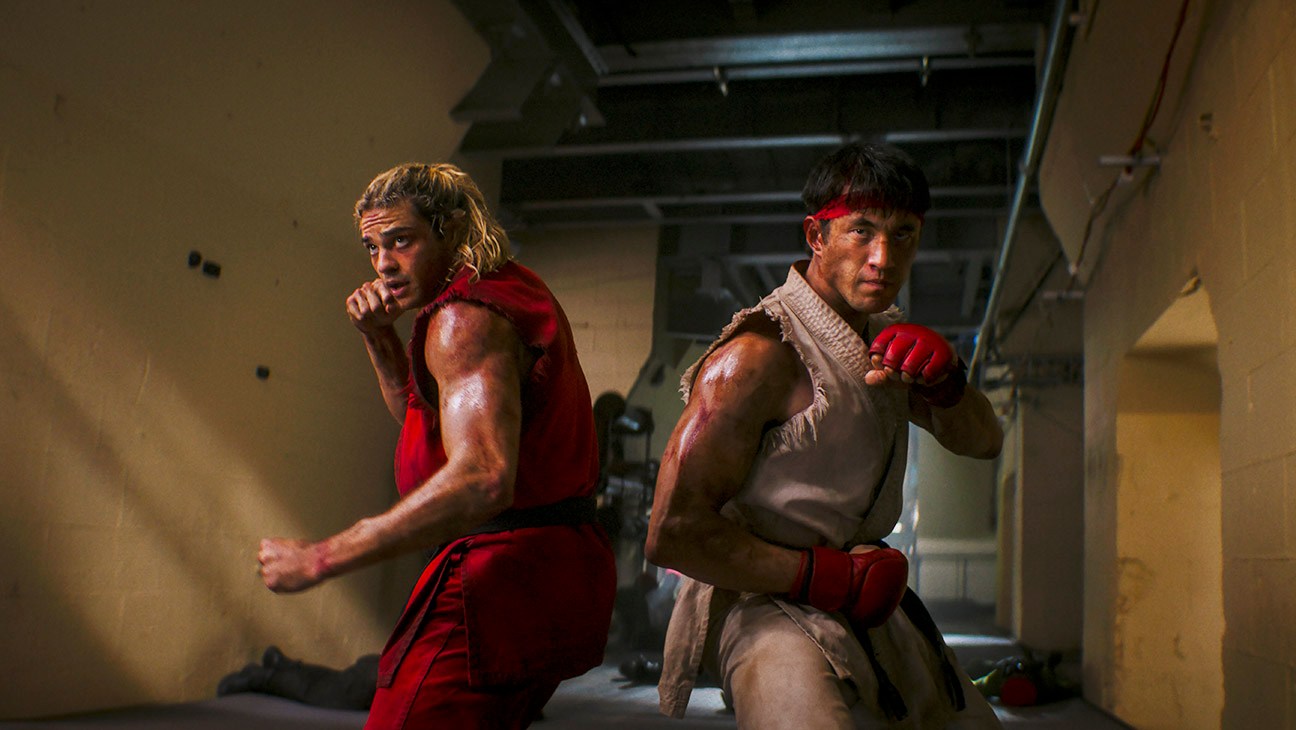
The story begins with an animated prologue set in 1987, followed by a mock tabloid television segment that attempts to bring viewers up to speed. The main narrative takes place six years later, when Ken Masters and Ryu, once brothers-in-arms, have fallen on hard times. Ken, played by Noah Centineo, has descended into a life of drunken aimlessness, spending his nights warbling karaoke versions of 4 Non Blondes songs. Ryu, portrayed by Andrew Koji, has become an unkempt purveyor of ramen so unappetizing that even a stray cat refuses to eat it. The two are brought back together by Chun-Li, played by Callina Liang, an underling of the villainous M. Bison, portrayed by David Dastmalchian. Chun-Li recruits them for the upcoming World Warrior tournament, but she and her boss both have ulterior motives. Bison hopes to exploit the fighters’ powers for his own nefarious purposes, while Chun-Li is secretly an Interpol agent seeking to bring Bison down for the murder of her father.
That is about all the plot that can be gleaned from the film, and frankly, the rest of the movie doesn’t offer much more. It quickly settles into a pattern of introducing fan-favorite characters in rapid succession, giving most of them very little to do. Describing them all would be pointless, because fans already know exactly who they are, and non-fans simply won’t care. Suffice it to say that the ensemble is a wildly colorful bunch, played by a cast of varying effectiveness. The film features some unusual casting choices, including singer Orville Peck and Curtis “50 Cent” Jackson as fighters, and former Saturday Night Live performer Kyle Mooney as Chun-Li’s Interpol handler, who harbors a major crush on her. A CGI-altered Jason Momoa, who also served as a producer, appears as the green, Hulk-like Blanka. Sakurai’s previous credits include The Eric Andre Show and the film Bad Trip, which explains the presence of his frequent collaborator Eric André as a bellowing ring announcer.
The film is filled with vintage pop music needle drops, including Ken entering the ring to, what else, “Who Let the Dogs Out.” It repeatedly invokes the mantra “To live is to fight, to fight is to live,” and it certainly lives up to that philosophy with its endless procession of fight scenes. There is a steam bath battle between a barely clothed Ryu and a corpulent opponent that might have been impressive if it hadn’t been done better in Eastern Promises. But that David Cronenberg film didn’t feature such extravagantly costumed and coiffed fighters. The design and special effects teams here have worked overtime to make the actors look like their video game counterparts, and the results are often visually striking, even when the storytelling falls short.
Centineo proves entertainingly oafish as Ken, bringing a certain charm to the role even when the script gives him little to work with. Koji, meanwhile, infuses the proceedings with some much-needed gravitas as the emotionally tortured but still formidable Ryu. Liang displays impressive charisma as the determined Chun-Li, and she is likely to become a favorite among viewers. As for Dastmalchian, he inherits the villainous role played so memorably by Raul Julia in the 1994 film. Rather than going for the campy approach, Dastmalchian opts for something creepier and more unsettling. His M. Bison is distinguished by his perverse olfactory pleasures, a strange character tic that makes him feel more sinister, if not necessarily more compelling.
The film’s confidence in its own universe is evident from its open ending, which all but guarantees a sequel. Whether that sequel will actually materialize remains to be seen. The recent Masters of the Universe crashed and burned with its latest big-screen incarnation, though it found some redemption on streaming. Street Fighter seems to be hoping for a better fate, but its jumbled tone and overstuffed narrative may prove to be its undoing. It is a film that clearly wants to honor the source material, and it is impossible to deny the affection that Sakurai and Fixman have for the games. But love alone is not enough to make a movie work. The result is a messy, chaotic, occasionally entertaining spectacle that tries to beat you into submission with sheer volume and enthusiasm. It may satisfy the most devoted fans in brief bursts, but it is unlikely to win over anyone who isn’t already invested in the world of Street Fighter. The bottom line is that this is a film that tries to beat you into submission, and whether that is a good thing or a bad thing will depend entirely on your tolerance for nostalgia-driven chaos.