The Sweet Era of Fragrance Is Ending: Why Perfume Is Getting Stranger, Bitterer, and More Interesting
If you’ve spent any time wandering through department store fragrance counters lately, you may have noticed something unsettling: everything seems to smell like dessert. Vanilla, sugar, caramel, a whisper of something warm and edible — the same comforting, calorie-laden scent profile has dominated shelves for years. But if you think that’s the future of perfume, think again. The people who create fragrances for a living are quietly steering the industry in a radically different direction. The next wave of perfumery is not about smelling polished, pretty, or delicious. It’s about smelling like you have a point of view.
For more than a decade, gourmand fragrances — perfumes built on food-inspired, dessert-like notes — have been a reliable commercial formula. They’re familiar, approachable, and almost universally appealing. But that very familiarity has become a problem. When every bottle on the shelf smells like vanilla and brown sugar, none of them feel special. Perfumers have noticed, and they’re already moving toward something far more complex, strange, and memorable.
The Pivot Away From Pure Sweetness Is Already Underway
Alberto Morillas, one of the most celebrated perfumers in the industry, has been vocal about the coming shift. In a recent interview, he predicted that the trend is moving away from simple sweetness and toward something with more depth. “These notes are quite simple,” Morillas said, “but a perfume with true depth features a slight bitterness to it.” That single sentence captures the direction of the entire industry. The goal is no longer to make you smell like a bakery display case. The goal is to make you smell interesting.
Morillas’s shortlist for the bitterness that will define this new era includes unexpected ingredients like artichoke, herbs such as thyme, grasses like vetiver, and plants such as cypriol. These are not notes designed to make you smell delicious. They are notes designed to make you smell thoughtful, deliberate, and considered. They add an edge to a fragrance, a sense of complexity that a flat, sugary scent simply cannot deliver. The result is a perfume that feels more like a statement than an accessory.
Contrast Is the New Signature
Once you accept that sweetness alone is no longer the objective, the natural next step is tension. Consumers are increasingly drawn to fragrances that pair opposing ideas inside the same bottle. Sweet plus smoky. Green plus floral. Earthy plus clean. Savory plus sweet. Mineral plus woody. These are not accidental combinations; they are carefully engineered contrasts that force the nose to pay attention.
The appeal of such fragrances is not about smelling conventionally beautiful. It’s about smelling memorable. A scent with contrast gives the person wearing it a kind of olfactory personality, something that makes people stop and ask, “What are you wearing?” A flat, sugary fragrance rarely inspires that reaction. It simply blends into the noise of the department store. But a fragrance that balances conflicting elements stays in the memory long after the wearer has left the room. In a crowded marketplace, contrast has become the most valuable tool a perfumer has.
The Notes Doing the Heavy Lifting Right Now
If you want to understand where perfumery is heading, look at the ingredients that are appearing again and again in fragrance briefs. The list reads less like a trip to the bakery and more like a walk through a damp, foggy garden. Leading the charge are tomato leaf, wet soil and petrichor, matcha, ink, smoke, salt, fig leaf, mushroom, tea, and a broad range of herbs and vegetables. Notice what’s missing: no sugar, no caramel, no cotton candy. These ingredients are not trying to charm you on first sniff. They are trying to transport you somewhere.
Each of these notes brings something unique to a fragrance. Tomato leaf, for example, has a sharp, green, slightly metallic quality that feels fresh and unexpected. Wet soil and petrichor capture the smell of rain on dry ground, an earthy scent that has become surprisingly popular in recent years. Matcha and tea offer a bitter, vegetal sophistication. Ink and smoke add an intellectual, almost rebellious edge. Salt brings a mineral, savory quality that makes everything around it feel more dynamic. Mushroom and other earthy notes ground a fragrance in something primal and organic. Together, these ingredients are redefining what perfume can be.
Perfume Is Being Asked to Transport You Somewhere Specific
Beyond individual notes, there is a deeper shift in what a fragrance is supposed to do. Jasmina Aganovic, founder of Future Society, explained it beautifully in a recent interview. “Rather than smelling like a single ingredient or traditional fragrance family,” she said, “people are increasingly drawn to fragrances that capture an ephemeral environment: clouds, fresh air after a storm, humidity-laden forests and more. There’s a growing appetite for scents that transport you somewhere or make you feel immersed in a different place.”
This reframes the entire project of perfumery. A perfume is no longer a flavor profile. It’s a location. Air after a thunderstorm. A fogged-in forest floor. The cold, mineral smell of a high mountain lake. The salt-soaked breeze of a rocky coastline. The job of a fragrance in this new era is atmosphere, not accessory. It is supposed to make you feel like you are somewhere else, even if only for a moment. That is a far more ambitious goal than simply making you smell like vanilla.
Salt Is the Breakout Note Bridging Old and New
If there is one ingredient that captures the shift better than any other, it is sea salt. Salt is familiar enough to feel wearable, but strange enough to signal that you are paying attention. Mary Testa-Gough, associate vice president of product and fragrance development at Bath & Body Works, described the rise of salt as one of the most exciting developments in fragrance. “Over the last few years, we are seeing sea salt becoming a more fashion-forward fragrance trend,” she said. “It creates a more faceted sensorial contrast.”
Her description of how salt layers with other notes is a near-perfect map of where mainstream perfumery is drifting. Salt, she explained, pairs beautifully with blue aquatic watery notes, musk, creamy vertical woods, amber, sandalwood, cedar, oud, and solar florals such as orange blossom. When combined with tropical fruits like mango, passionfruit, and pineapple, sea salt amplifies the juiciness while adding a savory mineral quality that feels both unexpected and addictive. The sweet notes are not disappearing. They are being roughed up on purpose.
This is an important point. The shift away from pure sweetness does not mean the end of sweetness altogether. It means sweetness is being placed in a context that makes it more interesting. A sugary note on its own is predictable. But when that same note is paired with salt, smoke, or bitter herbs, it becomes something new. It becomes surprising. It becomes something you have to think about, not just smell and forget.
Honey and the Complicated Return of Sweetness
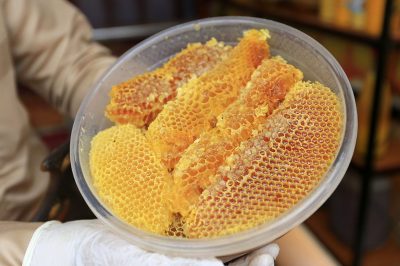
Even as the industry moves toward bitterness and contrast, there is still room for sweetness that feels more nuanced. Honey, for example, has emerged as a major trend in recent years, but not the simple, sticky sweetness of candy. Honey in modern perfumery is warm, animalic, and complex. It carries the scent of wax, pollen, and a hint of something wild. It is sweetness with a story behind it, sweetness that feels natural rather than artificial. That distinction matters. The new era of fragrance is not anti-sweet. It is anti-boring.
What This Means for the Bottle on Your Dresser
Put all the pieces together and the direction is clear. Perfumery is edging away from flattery and toward distinction. The notes gaining ground — bitter herbs, wet earth, ink, smoke, salt — are not trying to charm anyone on first sniff. They are trying to stick. They are trying to leave an impression that lasts long after the wearer has left the room. They are trying to make you smell like a person with a story, not a product off a shelf.
For consumers, this is an exciting moment. It means more options for expressing individuality. It means fragrances that evoke memories, places, and moods rather than simply mimicking the smell of dessert. It means perfume becomes a tool for self-expression rather than a uniform worn by everyone in the elevator. If the last decade of fragrance rewarded the person who smelled richest, the next one looks like it will reward the person who smells most like themselves.
Watch the launches rolling out through 2026 and beyond. Expect fewer desserts and more weather. Expect fewer vanilla bombs and more damp gardens, storm-soaked air, and salt-crusted coastlines. Expect perfume to ask something of you rather than simply flattering you. The era of bland sweetness is ending, and what comes next is stranger, braver, and far more interesting. The only question left is whether you are ready to wear it.