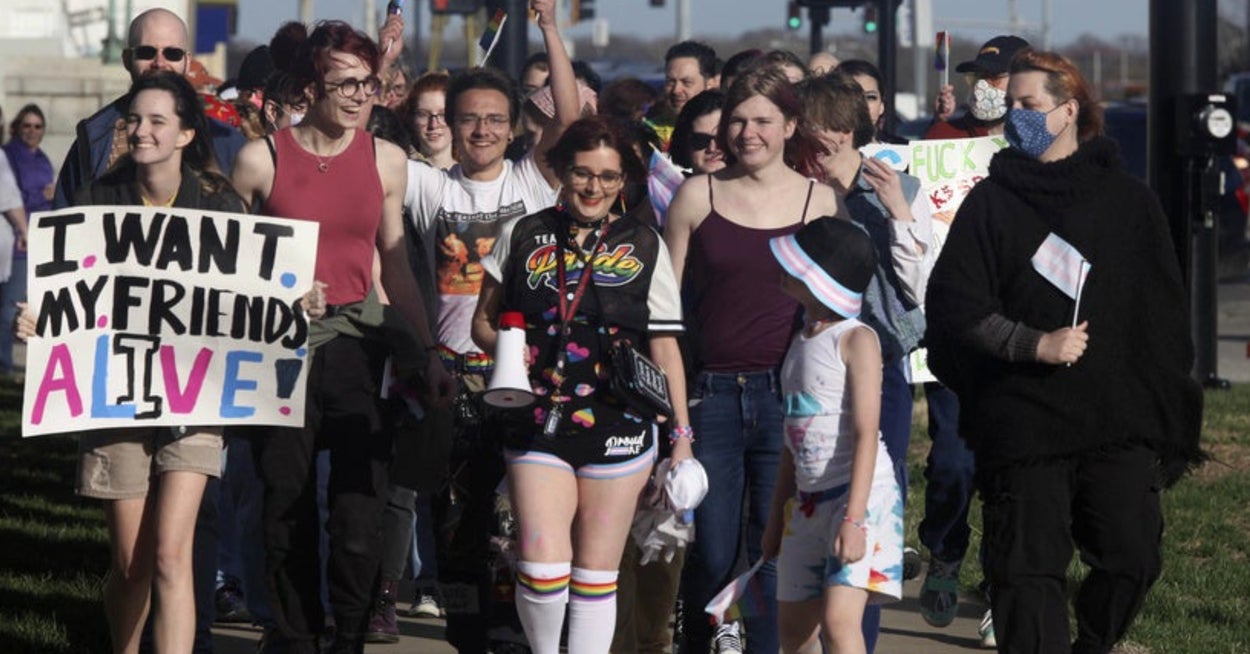
Kansas Enacts Sweeping Anti-Trans Legislation After GOP Overrides Governor’s Veto
Kansas lawmakers have delivered one of the most expansive anti-transgender policy packages in the country, overriding Democratic Gov. Laura Kelly’s veto and enacting restrictions that will affect transgender people in schools, public restrooms, and even on their driver’s licenses. The legislation includes a ban on transgender girls and women participating in school sports, as well as a separate bill that advocates say could effectively erase transgender, gender-nonconforming, and intersex people from legal recognition. Unless a judge intervenes, the sports ban is scheduled to take effect on July 1.
The sports measure has been championed by Republicans who argue that it is necessary to protect fair competition among cisgender women and girls. But the actual numbers in Kansas suggest that transgender female athletes are an extremely small group. According to the Kansas State High School Activities Association, there are currently only three trans girls competing in sports at the high school level in the entire state. That statistic has become a central point for critics, who argue that the law is a solution in search of a problem.
In a statement to BuzzFeed News, Wasinger, a Republican lawmaker who supported the sports ban, did not answer questions about potential genital inspections or other invasive verification procedures. Instead, Wasinger said, “Sports physicals are done for every athlete participating in schools sports. Every child in Kansas must provide a birth certificate to attend school in Kansas. Both should be enough for any student.”
The statement appears to be a response to growing concerns about how the sports ban would be enforced. Critics have pointed out that birth certificates often do not reflect a person’s gender identity and that physical exams are not designed to determine a student’s sex for athletic eligibility. Wasinger’s failure to address the possibility of genital inspections has only deepened concerns among advocates that the law could lead to intrusive and humiliating practices.
The sports ban is not the only restriction now heading into law in Kansas. On Tuesday, the legislature also passed SB 180, a sweeping bill that combines multiple restrictions on transgender people of all ages. Among other provisions, SB 180 bans transgender people from using public restrooms and locker rooms that align with their gender identity. It also prohibits transgender people from changing their name and gender markers on their driver’s licenses.
Republicans in the state have called SB 180 the “Women’s Bill of Rights.” The bill defines sex in binary terms as “either male or female, at birth.” Advocates for transgender rights say the definition is not just narrow but dangerous. They argue that it would lead to the legal erasure of transgender, gender-nonconforming, and intersex people, because it refuses to recognize any identity or biology that does not fit neatly into a male-female binary established at birth.
The passage of SB 180 and the sports ban was made possible by the Republican supermajority in the Kansas legislature. Republicans hold more than a two-thirds majority in both chambers, giving them the power to override Kelly’s veto without a single Democratic vote. That is exactly what happened, despite vocal opposition from civil rights groups, educators, and medical professionals.
Kansas’s sweeping action is the latest in a growing wave of anti-trans legislation across the country. In recent years, state legislatures have introduced hundreds of bills targeting transgender people, and many have become law. What makes the Kansas package notable is its breadth. Instead of focusing on a single issue, the legislation bundles multiple restrictions and uses broad definitions that could be applied in many areas of public life.
The trend is not limited to Kansas. Last week, Kentucky’s Republican-controlled legislature similarly overrode the veto of the state’s Democratic governor and passed an omnibus anti-trans bill. That measure banned gender-affirming care for transgender youth, barred transgender students from using bathrooms that align with their gender identity, and gave school officials the right to refuse to use students’ preferred pronouns. The Kentucky law, like the Kansas package, was described by advocates as one of the most extreme anti-trans laws in the country.
Supporters of these laws argue that they are necessary to protect women and girls, particularly in sports and in private spaces such as restrooms and locker rooms. They say that allowing transgender women and girls to participate in female sports creates an unfair competitive advantage. They also say that defining sex in binary terms is a matter of biological reality and that the law should reflect that reality.
Opponents, however, say these arguments are not supported by evidence. In Kansas, the fact that only three trans girls are currently competing in high school sports undermines the claim that transgender athletes are a widespread threat to fairness. Advocates also point out that the restrictions on restrooms and locker rooms are not about fairness at all, but about forcing transgender people out of public life. Forcing transgender people to use facilities that do not match their gender identity, they say, can expose them to harassment, violence, and discrimination.
The driver’s license provision in SB 180 is particularly alarming to transgender rights advocates. For many transgender people, having identification that reflects their name and gender is essential for everyday life. It is needed for employment, travel, banking, and accessing medical care. By prohibiting transgender people from updating their name and gender markers on driver’s licenses, Kansas is effectively forcing them to carry documents that do not match who they are. This can lead to dangerous situations, including being “outed” in front of coworkers, landlords, or law enforcement.
The bill’s definition of sex as “either male or female, at birth” also has serious implications for intersex people. Intersex individuals are born with physical sex characteristics that do not fit typical definitions of male or female. The law’s binary language does not account for their existence. Advocates say that, under this legislation, intersex people would be legally invisible.
The broad scope of the Kansas law is expected to trigger legal challenges. Civil rights organizations have already sued over similar laws in other states, arguing that they violate the Equal Protection Clause, Title IX, and the right to privacy. Legal experts say the Kansas package is likely to face the same kind of scrutiny. The sports ban, in particular, could be challenged under Title IX, the federal law that prohibits sex discrimination in education programs that receive federal funding.
The Biden administration has also signaled that it will protect transgender students. Earlier this year, the Department of Education proposed a rule that would make clear that Title IX protects transgender students from discrimination, including in athletics. While that rule is not yet final, it could play a role in legal challenges to state-level bans.
For now, the immediate focus is on what will happen in Kansas. The sports ban is set to take effect on July 1 unless a judge blocks it. School districts may soon have to decide how to implement the new law, and transgender students and their families are left in a state of uncertainty.
The emotional impact of the law cannot be overstated. Transgender youth already face higher rates of depression, anxiety, and suicide than their peers. Medical and mental health organizations have warned that exclusion from sports and other school activities can make these problems worse. Being told by the state that they do not belong in the bathroom, on the team, or even on their own identification can have lasting psychological effects.
The Kansas legislature’s decision is a landmark moment in the broader fight over transgender rights. It shows how far anti-trans legislation has advanced in a relatively short period of time. It also shows the importance of the courts in determining the limits of such laws. The next few months will be critical as lawsuits are filed and judges begin to weigh the constitutionality of the Kansas package.
The three trans girls currently competing in high school sports in Kansas are at the center of the storm. They simply wanted to play sports, be part of a team, and enjoy the benefits of physical activity like any other student. Now, under the new law, they may be forced to sit out. The law sends a clear message that they are not welcome in the activities that other students take for granted.
That message, advocates say, is discriminatory and harmful. The Kansas law may be called the “Women’s Bill of Rights,” but it does not expand the rights of women and girls. Instead, it strips rights from transgender people and erases the existence of intersex and gender-nonconforming individuals.
The fight is far from over. Legal challenges are expected, and the law could be blocked before it ever takes effect. But even if the courts eventually strike it down, the damage may already be done. Transgender Kansans have been told, in the strongest possible terms, that the state does not recognize them as equal citizens.
The rest of the country is watching. Kansas has become the latest battleground in a national debate over transgender rights, and the outcome of this legal fight could have consequences far beyond the state’s borders. For now, the law is on the books. Unless a judge intervenes, it will take effect on July 1, and transgender people in Kansas will be forced to navigate a new and hostile legal landscape.