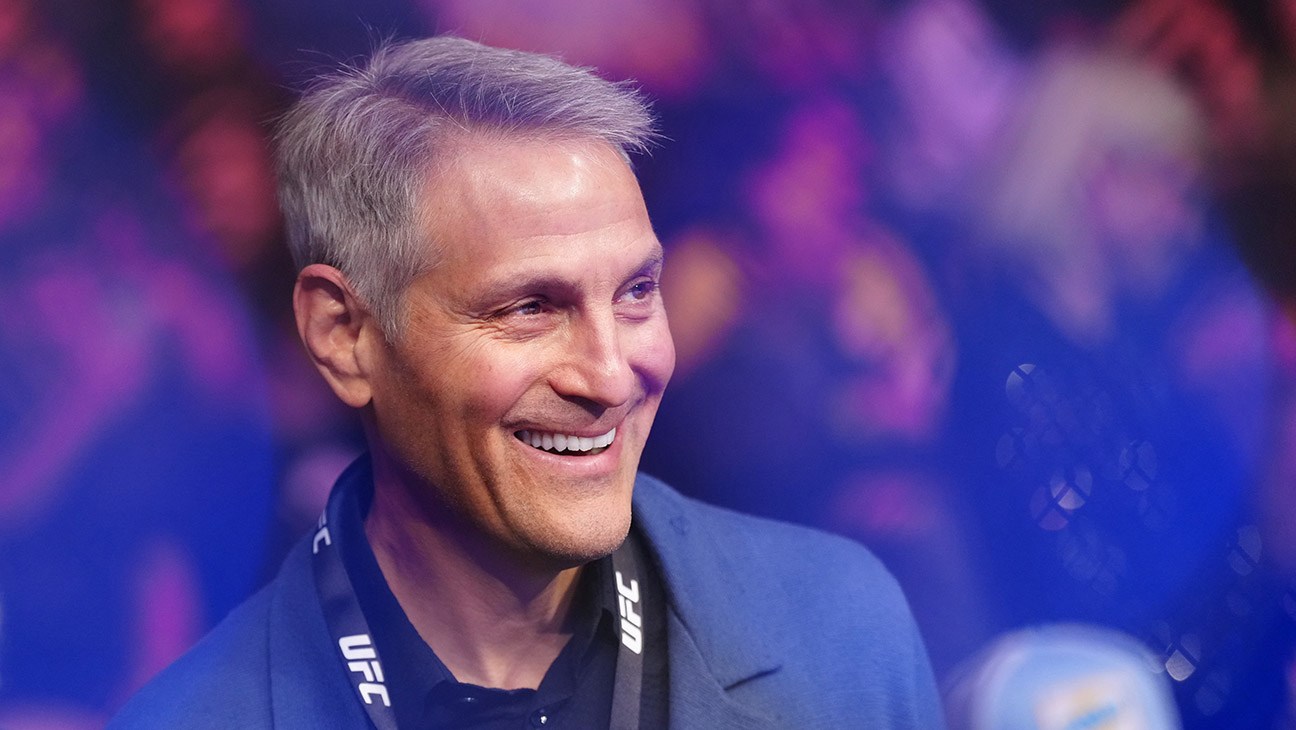
Ari Emanuel, one of the most powerful figures in Hollywood and global sports entertainment, brought his characteristic bluntness to London on Saturday for a public conversation about his new memoir, Roll the Calls. In an onstage interview with Tina Brown, the former editor-in-chief of Vanity Fair and The New Yorker, Emanuel touched on artificial intelligence, the state of American politics, the UFC’s remarkable rise, and even his brother Rahm’s potential presidential ambitions. The event, organized by Intelligence Squared, was titled “An Evening With the Dealmaker Who Reshaped Hollywood,” and Emanuel did little to disappoint an audience expecting candor.
Emanuel currently serves as executive chair and CEO of TKO Group, the parent company of WWE and UFC, while also holding the role of executive chairman of WME Group. Over the course of a career spanning decades, he has represented some of the most recognizable names in entertainment, including Larry David, Martin Scorsese, and Oprah Winfrey. He is also widely known as the inspiration for Ari Gold, the brash and fiercely aggressive talent agent played by Jeremy Piven on the HBO drama Entourage. His memoir, published by Penguin Random House in the United States and by William Collins, an imprint of HarperCollins U.K., in Britain, chronicles his journey from the CAA mailroom to the highest echelons of Hollywood dealmaking.
During the London conversation, Emanuel was asked about his philosophy as an agent to the stars. His response was typically direct. “What I say to people is: ‘You pay me 10 percent for my opinion. You’ll listen to my opinion. You don’t want to follow it, don’t follow it! Now I have gotten fired for giving my 10 percent. I’m OK with that. I’ve re-signed the people that have fired me, a couple of them, but you’re paying me for my opinion.’” For Emanuel, that principle is more important than ever in an era of rapid technological change. He argued that the rise of artificial intelligence makes human taste and judgment more valuable, not less. “In this day of AI, that’s more important than anything — your opinion, your taste,” he said. “AI doesn’t have taste, and taste only comes with time and knowledge of situations.”
Emanuel went further, suggesting that while AI can process vast amounts of data and generate competent results, it lacks the curiosity and originality that define the best creative minds. “AI is just an average, a very good average,” he said. “There is something so important that people are missing here. It is not the answer. Curiosity is important, judgment is important, taste is very important. It has no taste. As much as there are scary things about AI, those are qualities that you own that are only human.” When Brown pressed him on whether AI could ever enhance creativity, Emanuel was cautiously optimistic. “Yeah, it will,” he said. “It will add [for] a great creative mind, such as Marty Scorsese. They will be able to implement taste and creativity. My wife’s a fashion designer. She works with AI, but she’s the one who has the taste, and she’s giving it the ideas.”
Brown also raised the question of whether AI has an “absence of morality.” Emanuel acknowledged the concern but admitted he did not have a clear solution. “It’s something that has to come into it. I’m not sure how,” he said, adding that it remains unclear how ethical safeguards could be built into AI without limiting the technological opportunities it presents.
The conversation then turned to Emanuel’s dealmaking history, and Brown asked which transaction had caused him the most difficulty. Without hesitation, Emanuel pointed to the acquisition of UFC, a deal that ultimately reshaped the sports media landscape. “The hardest deal was probably the UFC deal,” he told the audience. “I had been representing UFC for 25 years. It was on Fox. …. We thought Fox was going to buy it – easy.” But Fox, he explained, did not move forward, and Warner was in the middle of downsizing. “So those two were out, and then it was us against the Chinese because they had a lot of money coming into the entertainment space,” Emanuel recalled. At the time, UFC president Dana White was reluctant to sell to a Chinese buyer, and then an unexpected external event changed the course of the negotiation. “I blame all of you from Britain because you guys didn’t elect the right person at the time. Brexit happened, and the banking system fell apart, and so we had to buy the business [when] the banking system kind of went haywire.” Despite the chaos, Emanuel and his team eventually closed the deal. “It was just one headache after another, but we got it done,” he concluded.
Beyond the financial complexities, Emanuel argued that sports and live events have a unique power to bring people together in a deeply polarized world. He described UFC as a shared cultural space that transcends political divisions. “I’d rather talk to the other side,” he said, identifying himself as a Democrat. “Sports is a common ground.” That observation led Brown to ask about the political moment in the United States, including the movement associated with former President Donald Trump. She asked whether MAGA had become “the biggest cult going.” Emanuel sidestepped the framing but made his own position clear. “I don’t want to be in MAGA. And I don’t want to be in the DSA [Democratic Socialists of America].” He also addressed the perception that UFC has become closely associated with Trump-era politics, particularly as the sport has grown in popularity among conservative audiences. When asked whether that association would outlast Trump, Emanuel predicted that it would. “Yeah, I think it’s going to outlast me,” he said.
Emanuel also revealed that he had spoken with Trump roughly four weeks before the London event. He did not go into detail about their conversation but expressed unease about the direction of U.S. policy on Ukraine. “This Ukraine [policy] thing is upsetting,” he said. He added that he intended to reach out again soon. “I think after Congress is back, I’m going to call him because I got some stuff I have to talk to him about. I plan on having a conversation.” When asked about his hopes for the Democratic Party in the upcoming midterm elections, Emanuel was succinct: “Let’s hopefully get the Senate and the House.”
The conversation also turned to his family, specifically his brother Rahm Emanuel, the former mayor of Chicago and former U.S. ambassador to Japan. Brown noted that Rahm has positioned himself as a centrist Democrat, and Ari offered a strong endorsement of his brother as a potential presidential candidate. “All kidding aside, I don’t think there’s a better candidate in the world who could be president and cares more about the world, the United States, helping kids and will fight the fight,” he said.
Throughout the evening, Emanuel’s remarks reflected the same combative, unvarnished style that has defined his public persona for years. Whether discussing the limits of artificial intelligence, the intricacies of a billion-dollar sports deal, or the future of American democracy, he returned to a central theme: human judgment, taste, and conviction still matter. In an industry increasingly shaped by algorithms and data, Emanuel insisted that the ability to make bold, informed choices remains the most valuable currency. His memoir, Roll the Calls, presumably offers a deeper look at those beliefs and the career that made him one of the most influential dealmakers in modern entertainment. But for the audience in London on Saturday, the live conversation was a reminder that Ari Emanuel is not about to soften his opinions or temper his language anytime soon.
The event was part of Intelligence Squared’s series of high-profile talks, and the title chosen for the evening captured the scale of Emanuel’s impact on the entertainment business. From representing some of Hollywood’s biggest stars to helping orchestrate the blockbuster merger that created TKO Group, he has spent decades at the center of the industry’s most consequential negotiations. His memoir promises to tell that story in his own words, and if his London appearance was any indication, the book will not lack for sharp opinions or memorable anecdotes. For now, Emanuel remains as engaged as ever in the worlds of talent, sports, and politics, and he is clearly not afraid to say exactly what he thinks.