‘The Diplomat’ Star Rory Kinnear on Trowbridge’s Surprise Resignation and That Wild Opera Dream
This article contains spoilers from the first four episodes of The Diplomat season four, through “Pagliacci.”
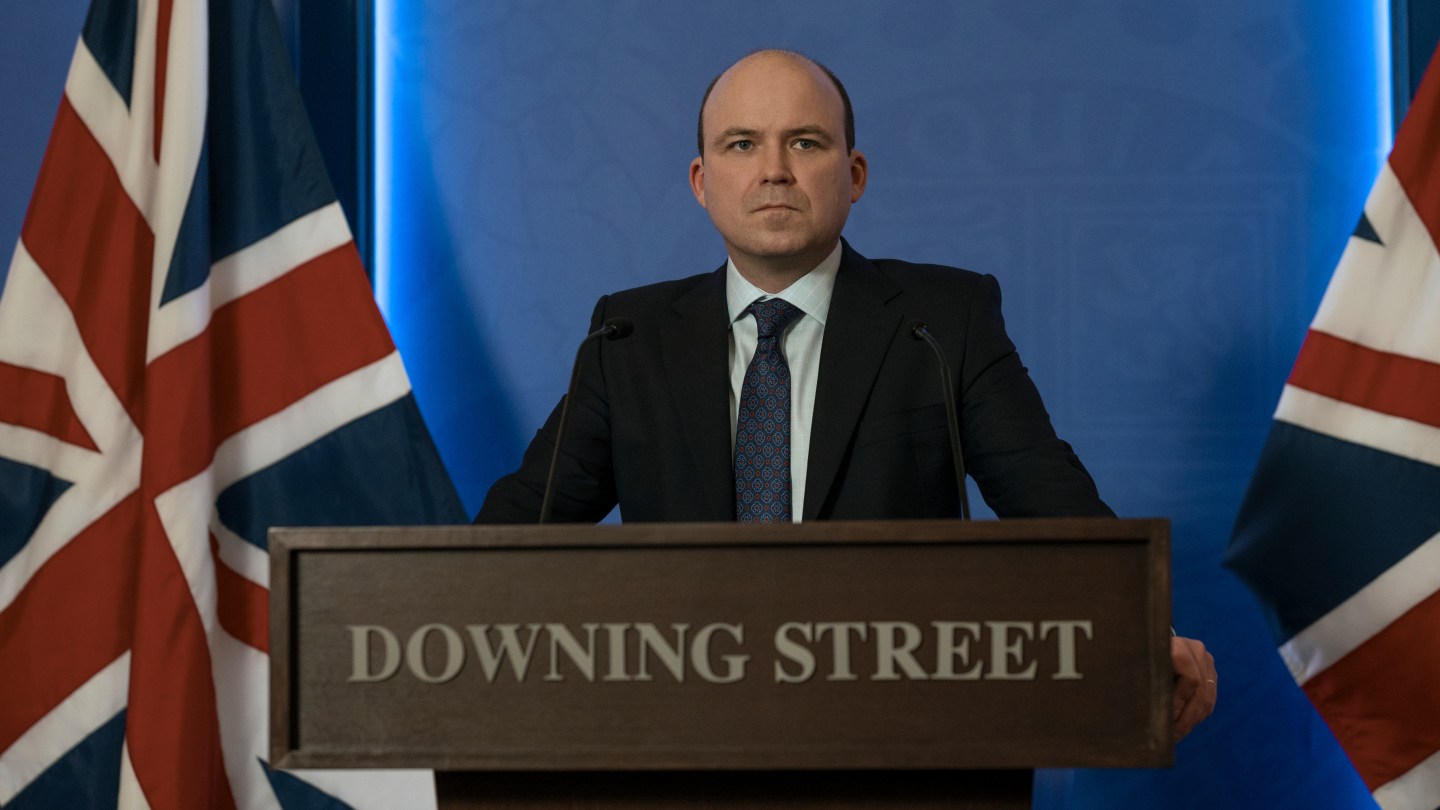
Rory Kinnear has spent four seasons playing the wild-card British prime minister Nicol Trowbridge on Netflix’s political thriller The Diplomat. But in the show’s latest season, Trowbridge’s chaotic time in office comes to a startling end. Midway through the season, in an unusually surreal episode titled “Pagliacci,” the prime minister resigns — but not before imagining that his former adviser Margaret Roylin is still alive, hallucinating that American officials are laughing at him, and dressing himself in the robes of both a king and a clown while singing an aria.
The actor’s exit lands just one episode after viewers learn that U.K. foreign secretary Austin Dennison, played by David Gyasi, has died in a helicopter crash. For a show that has always grounded its high-stakes political drama in messy human behavior, the decision to remove both Trowbridge and Dennison from the board is a major shake-up. Showrunner Debora Cahn says there were real-life reasons behind the move.
“By the time we got to this season, Rory had been prime minister for a period of time where the actual U.K. had like five different people at 10 Downing Street,” Cahn tells The Hollywood Reporter. She explains that the constant churn of leadership is an essential part of diplomacy. “You’re always learning the cast of characters from scratch. You either outlast the people that you’re working with, or you’re sent to a different country.”
Cahn wanted to put the show’s core American team through that disorienting experience. “I wanted to see our team going through the struggle of just when you think you know where the ground is under your feet, it completely changes. You’ve built all these relationships, and suddenly you have nothing.” She was also interested in exploring what happens when a difficult counterpart disappears. “I also really wanted to play with the dynamic of like, you think you’re working with somebody who’s difficult and they’re the problem, and then they leave, and it turns out you were the problem or both of you were the problem,” she says.
Kinnear already knew before production began that Trowbridge would eventually resign at some point in season four. But the specifics around his departure did not emerge until the actor received an unusual request while boarding a flight to Lithuania. “I got a message from Deb saying, ‘Do you think you’d be able to sing this?’ And she sent me the aria,” Kinnear recalls. At first he was baffled. “I thought, ‘Why on earth would I be required to do that?’” He told Cahn he thought he could, but asked how she knew he could sing. She reminded him of a moment from the beginning of season two, during a funeral scene at St Paul’s Cathedral. The entire congregation was asked to sing a hymn, and Cahn could hear Kinnear’s voice in the mix. “She’d obviously held on to that for two and a half seasons and brought it back,” Kinnear says. “So I thought, ‘OK, how does that fit into why he might be resigning?’”
Trowbridge’s resignation is immediately preceded by a risky move from Keri Russell’s Kate Wyler. Kate blackmails the prime minister by telling the newly appointed British foreign secretary Robyn Palmer, played by Abigail Marlowe, about Margaret Roylin’s involvement in the carrier ship attack that kicked off the entire series. She also reveals that Trowbridge “tried to kill” Roylin when he learned what she had done. The plan is, unsurprisingly, Hal’s idea. Rufus Sewell’s character has long advocated a more ruthless approach to foreign policy, and although Kate initially resists his “mafioso”-like thinking, she ultimately does what he suggested.
Russell says Trowbridge has always known how to get under Kate’s skin. “I just think he makes her crazy. I think he pushed her buttons,” Russell says. “He knew how to get her riled up and make it personal, and it’s too fresh. She’s doing something she doesn’t want to do anyway. She doesn’t believe in it, and then he’s attacking her when she hasn’t processed something.” Kate’s decision to weaponize Roylin’s death comes after Trowbridge suggests that she and Hal will not be invited to Dennison’s funeral. It is a cruel, personal blow delivered at the worst possible moment, and Kate responds by doing exactly what Hal wanted her to do.
The departure of both Kinnear and Gyasi was a tough development for the show’s creative team and remaining cast. “We wanted to keep Dave Gyasi and Rory Kinnear forever,” Cahn says. “I wish I could see them every day. It’s a bummer when the company shifts in some way. We’ve had the luxury of bringing a lot of people in, and sometimes the story is ejecting people out on the other end, and it sucks.”
Sewell adds that the twin losses are “tremendously shocking.” For Kate, though, the loss of Dennison is especially difficult. The show had teased the possibility of a romance between them early on, culminating in a passionate kiss in season three. Russell says that emotional history makes his death all the more devastating. “I think what that does to Kate is really hard, especially at this moment when her morals are being put to the test because he was such a moral character, so I think that fuels all of those doubts,” she says. She notes that Hal is on the other side of Kate’s moral crisis, pushing her toward a more cynical, instrumental view of power. “It’s an enormous loss for the show, for a lot of people who loved him, too. But it’s good storytelling ultimately.”
Kinnear, for his part, is sad to leave the series but confident the relationships he built will last. “Luckily, when you do a job for as long as this has been — a lot of the time we were hosting our American friends in London, and then luckily they got to return the favor when we were filming in New York — we’re in and out of each other’s lives to such an extent that we knew that we had formed these lifelong friendships,” he says. He would also be open to returning in some future capacity. “I’d be fascinated to see where Trowbridge does end up,” he says. “There are so many different roles that a retired politician finds themselves in, and I’m sure he wouldn’t spend the rest of his life lying low.”
In a conversation with The Hollywood Reporter, Kinnear opened up about learning that Trowbridge would resign, the experience of filming the surreal final episode, and what he thinks really drove the prime minister to step down.
What was your reaction when you found out that this is what would be unfolding for your character?
I got a heads up from Deb that at some point during the series, Trowbridge will be resigning, and I’ve already felt pretty lucky to have stayed on for as long as I have, given the nature of British politics over the last six or seven years. To finally receive the script, to see, as is typical of Debora’s writing, the psychological acuity she was going to bring to it, and how much she wanted to explore his inner life at the point of his greatest crisis. I sort of knew then that it was going to be a real gift for me as an actor to be able to bring that to life.
How do you feel about having to leave the show and the people that you were working with for a number of seasons?
Well, luckily, when you do a job for as long as this has been, you know that you’ve formed these lifelong friendships. So while it’s obviously sad that I won’t be able to get to go to work with them, I know that I’ll still be able to hang out with them whenever they’re in town or I’m in their town. To have been able to be part of a series that is so smart, so funny, so dramatic, so psychologically aware and so incredibly well-written and -cast is one thing. But to have left with a load of lifelong friends is far too great.
What was it like filming that very surreal episode in which Trowbridge resigns, with the Margaret Roylin hallucinations?
What was exciting about it was that you knew that it was a new flavor. Shows like this constantly have to reinvent themselves or show new aspects of themselves, and a character that has loomed as large as Trowbridge has over the four seasons, to be able to get into what really sort of drives him, what makes him tick and to see what it meant to him to be prime minister, to see what losing that meant to him, what destruction it wreaked on him, and how he thought he might be seen both as a king and as a clown and that he’d sort of straddled both roles in his prime ministership, and that we get to see them played out for real, as it were, within this kind of wild dream life.
We never really get a concrete explanation from Trowbridge about why he resigned. How much do you think Kate’s blackmail threat prompted his resignation?
Well, I do think that most politicians have a sort of self-awareness about how they can present themselves or how they can operate and what constitutes a line in the sand for something they wouldn’t be able to go on with. And I think knowing how compromised he would be, particularly in his relationship with America, and how complicated he had been with that, with this new information in their hands, I think he knew: “There’s nothing I can do without feeling I’ll be limping on. I won’t be able to do it with the gusto that I feel like I’ve been able to operate for as long as he has been prime minister.” I also think events catch up with people, and it caught up with him what happened with Roylin at the very beginning of season one, and sometimes people’s appetite goes for the hurly burly of politics. Everyone knows that you’re a long time retired and resigned once you leave it, so you keep on going, keep on going because there’s nothing quite like it in terms of the status that you’re afforded, in terms of the decisions you get to make, in terms of just the day-to-day excitement of it. But when it’s time to step away, it must be sort of crashingly obvious, and I think that’s why he leaps to resignation.
We also find out at the end of the previous episode that Austin Dennison has died. How does Trowbridge feel about that?
That’s, I think, definitely another reason that pushes him towards the resignation. They had come up together. They had been adversaries together, but they had found a use for each other as well in the highest echelons of politics. So, to have lost Roylin, to then lose Dennison — those were the good cop and bad cop on his shoulder, or the devil and the angel on his shoulder, throughout his time. I think he felt completely settled as to where he would turn. Lydia obviously provides some support, ballast and encouragement, determination for him. But without Dennison and without Roylin, there was an instability to how he saw himself.
Do you have a favorite memory or scene from playing Nicol Trowbridge in The Diplomat?
Driving up in that Jag outside the big country house in the first season, you thought, “Oh yeah, this is going to be fun. This show’s got something about it.” Getting to film in St Paul’s Cathedral, getting to film in all those amazing locations. We’re up in the Foreign Office, and there were times where you felt — I see why people in the top echelons of power try and cling on, because traveling in big motorcades or helicopters, all the ceremony of it, you can see how it can go to people’s heads and become quite addictive. I’ve made sure that I kept my feet on the ground, but you could see, particularly with a Netflix-style budget affording you — I’m sure it’s not all as quite as grand and as glamorous being prime minister, but it certainly felt it at times. And I always remember turning the corner dressed in full crown and coronation robes and singing an aria straight down the camera, and I don’t think the crew had any idea what was going on or why I was doing that or dressed like that.
The resignation of Nicol Trowbridge is one of the most unexpected and theatrically staged exits in The Diplomat’s run. It also opens up a new chapter for Kate Wyler, who must now navigate a British government without the man she spent so long trying to manage — and without the moral compass Dennison provided. The show’s willingness to upend its own power structures is exactly what has made it so compelling, and the losses of both Gyasi and Kinnear will be felt deeply. But as Russell notes, it is good storytelling. For Kinnear, it was a gift. And for viewers, it is a reminder that in The Diplomat, no one is safe — not even the prime minister.