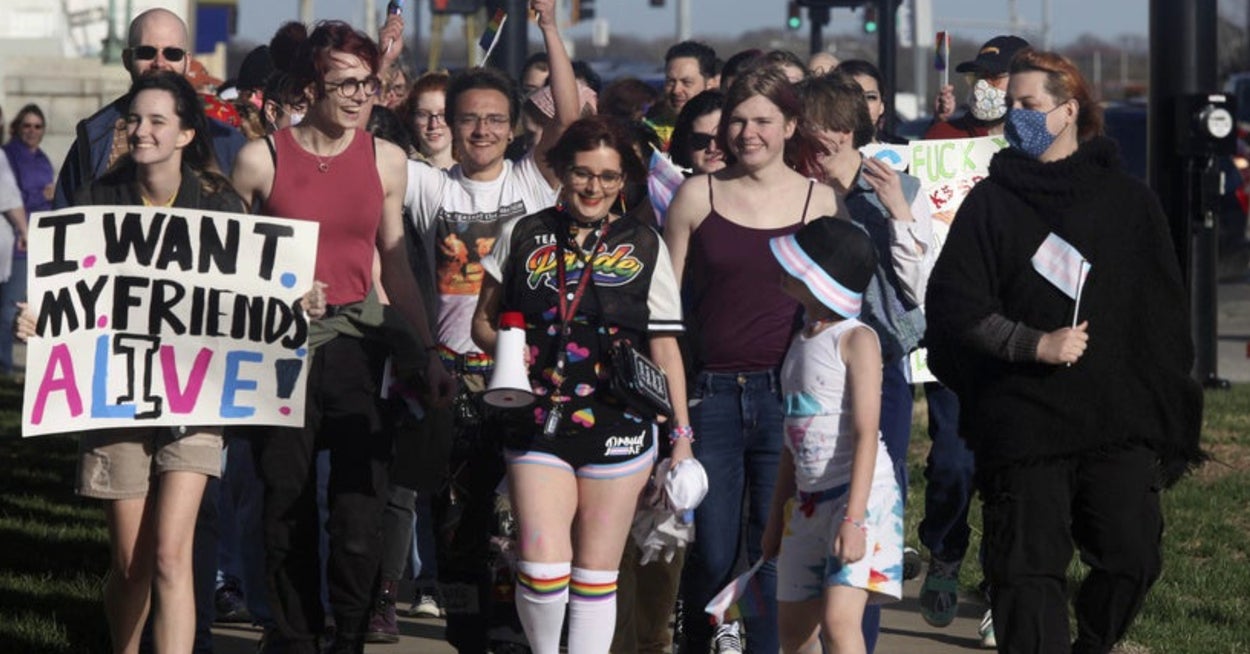
Kansas Lawmakers Pass Sweeping Anti-Trans Legislation, Including Sports Ban and So-Called ‘Women’s Bill of Rights’
TOPEKA, Kan. — Kansas lawmakers have approved a package of legislation targeting transgender residents, including a ban on transgender girls and women participating in female school sports and a broader measure that restricts access to public restrooms, locker rooms, and driver’s license changes. The moves, backed by a Republican supermajority in the state legislature, are poised to become law despite opposition from Democratic Gov. Laura Kelly, who is expected to veto the bills but lacks the votes to sustain it.
The sports ban, which passed alongside a separate and more expansive bill known as SB 180, has drawn intense scrutiny from civil rights advocates, medical professionals, and LGBTQ organizations. While proponents argue the legislation is necessary to protect fairness in women’s athletics, critics say it is a solution in search of a problem, pointing to the extremely small number of transgender athletes actually competing in Kansas schools.
State Rep. Wasinger, a key proponent of the sports measure, did not directly respond to questions about whether the bill could require genital inspections of student athletes. Instead, Wasinger issued a statement asserting that existing requirements should be sufficient. “Sports physicals are done for every athlete participating in school sports. Every child in Kansas must provide a birth certificate to attend school in Kansas. Both should be enough for any student,” Wasinger said.
The statement did little to assuage concerns among opponents, who note that requiring birth certificates or physicals could lead to invasive and discriminatory scrutiny of young athletes, particularly transgender girls and gender-nonconforming students. Several other states that have enacted similar bans have faced lawsuits challenging the constitutionality of such requirements, and legal experts say Kansas’ law could face similar hurdles.
According to the Kansas State High School Activities Association, there are currently only three transgender girls competing in high school sports in the entire state. Advocates for transgender rights seized on that figure, arguing that the bill addresses a problem that virtually does not exist. “This is not about fairness in sports,” said one advocate, who spoke on condition of anonymity for fear of retaliation. “This is about pushing transgender people out of public life entirely.”
The sports ban is just one part of a much larger legislative effort. On Tuesday, Kansas lawmakers also passed SB 180, a measure that Republicans have branded the “Women’s Bill of Rights.” The legislation defines sex in binary terms as “either male or female, at birth,” a definition that would apply across state law. The bill includes a number of restrictions affecting transgender people of all ages, including a ban on transgender individuals using public restrooms and locker rooms that align with their gender identity. It also prohibits individuals from changing their name and gender markers on driver’s licenses.
Advocates say the cumulative effect of SB 180 would be the legal erasure of transgender, gender-nonconforming, and intersex people in Kansas. By codifying a rigid, birth-based definition of sex, the bill would force transgender people to use facilities that do not match their lived gender identity in schools, government buildings, and other public spaces. It would also create inconsistencies with federal identification documents, complicating everyday activities such as banking, travel, and voting.
“This is not a single-issue bill,” said a representative from the American Civil Liberties Union of Kansas. “This is an all-out assault on the existence of transgender people in our state. It strips them of legal recognition, denies them access to public spaces, and sends a message that they do not belong.”
The bills passed along strict party lines, with Republicans in the state holding more than a two-thirds majority in both chambers. That majority is significant because it gives lawmakers the power to override any veto from Gov. Kelly, a Democrat who has previously expressed support for transgender rights. Kelly is expected to veto the legislation, but unless a judge blocks the laws, they will take effect on July 1.
Kansas is not alone in pursuing such expansive anti-trans legislation. The state’s actions are part of a broader national trend in which Republican-controlled legislatures have introduced and passed bills that bundle multiple restrictions into single omnibus packages. These bills often cover everything from medical care and sports participation to bathroom access and pronoun policies, making them difficult to challenge in court and creating a patchwork of laws across the country.
Last week, Kentucky’s Republican-controlled legislature similarly overrode a veto from Democratic Gov. Andy Beshear to enact an omnibus anti-trans bill. That Kentucky law bans gender-affirming medical care for transgender youth, prohibits transgender students from using bathrooms that align with their gender identity, and allows school officials to refuse to use students’ chosen names and pronouns. The measure was one of the most comprehensive anti-trans laws passed in the current legislative session, and it drew widespread condemnation from medical organizations, including the American Academy of Pediatrics.
Legal challenges are already underway in several states, and advocates say the Kansas laws are likely to be challenged as well. They argue that such legislation violates the Equal Protection Clause of the 14th Amendment, as well as Title IX, the federal law that prohibits sex-based discrimination in education. The U.S. Department of Education has issued guidance stating that Title IX protections extend to transgender students, although the Biden administration’s interpretation has been contested in court.
Meanwhile, supporters of the Kansas bills remain defiant. They contend that the laws are necessary to protect women and girls from what they describe as unfair competition and to uphold what they call “biological reality.” Some lawmakers have argued that the “Women’s Bill of Rights” is needed to ensure that women’s spaces remain exclusively for people who are female at birth, a position that transgender rights advocates reject as discriminatory and unscientific.
Medical and psychological organizations, including the American Medical Association and the American Psychological Association, have opposed such laws, citing evidence that transgender people face significant mental health disparities when denied access to affirming care and legal recognition. Studies have shown that transgender youth who are supported in their identity have better mental health outcomes, while those who face discrimination and exclusion are at higher risk for depression, anxiety, and suicide.
The Kansas bills have also drawn criticism from business leaders and高等教育 institutions, who warn that discriminatory laws could hurt the state’s economy by deterring companies and talent from relocating there. Similar concerns have been raised in other states, where major corporations have spoken out against anti-LGBTQ legislation.
As the July 1 effective date approaches, uncertainty looms over the state. Transgender Kansans and their families are left waiting to see whether courts will intervene. In the meantime, advocates are urging the public to pay attention to the impact of such laws, which they say go far beyond sports or bathroom access.
“This is about whether transgender people are allowed to exist openly and safely in Kansas,” said one activist. “The laws being passed here are not about fairness. They are about exclusion. And history will not look kindly on them.”
The situation in Kansas reflects a deepening national divide over transgender rights, with red states moving rapidly to restrict them while blue states enact protective measures. The clash has created a confusing and often dangerous landscape for transgender individuals, who must navigate different legal standards depending on where they live.
For now, all eyes are on Kansas, where the legislature’s action has made the state one of the most restrictive in the nation. Whether the laws survive legal scrutiny remains to be seen, but the message sent by lawmakers is unmistakable: in Kansas, transgender people are no longer welcome in the public square.