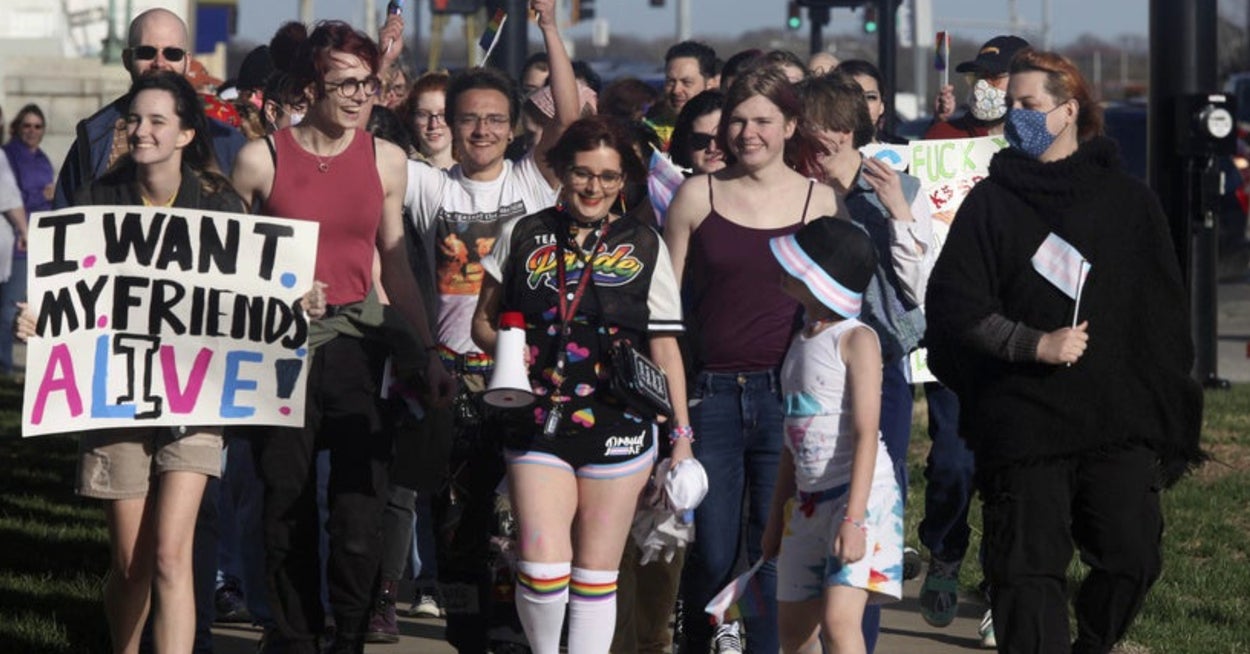
Kansas Lawmakers Pass Transgender Sports Ban as Part of Broader Wave of Anti-Trans Legislation
Kansas Republicans have advanced legislation banning transgender girls and women from participating in female school sports, joining a growing list of states enacting restrictive measures targeting transgender residents. The sports ban, which is scheduled to take effect July 1 unless blocked by a judge, is one of several recent actions by the state’s Republican-dominated legislature that advocates say will have sweeping consequences for transgender, gender-nonconforming, and intersex people across Kansas.
The legislation has drawn sharp criticism not only because of its practical impact on a very small number of student athletes, but also because of the invasive questions surrounding its enforcement. Wasinger, a Kansas lawmaker and supporter of the bill, did not answer questions from BuzzFeed News about whether the measure could lead to genital inspections of student athletes. Instead, Wasinger issued a statement defending the bill by pointing to existing requirements for school participation.
“Sports physicals are done for every athlete participating in schools sports. Every child in Kansas must provide a birth certificate to attend school in Kansas. Both should be enough for any student,” Wasinger said.
That response did little to ease concerns among critics, who note that the debate over transgender athletes has become a fixation in state legislatures despite evidence that the number of trans students actually affected is extraordinarily small. According to the Kansas State High School Activities Association, there are currently only three transgender girls competing in high school sports in the entire state. Opponents of the ban argue that legislation aimed at protecting fair competition in women’s sports is a solution in search of a problem, and that it unfairly targets a tiny group of vulnerable students.
Proponents of the bill, however, insist that the measure is necessary to preserve competitive fairness among cisgender women and girls. They argue that transgender female athletes may have physical advantages that undermine the integrity of girls’ and women’s sports. Yet the actual data from Kansas paints a far less dramatic picture: with just three trans girls participating in high school athletics, the supposed threat to girls’ sports is, by any measurable standard, negligible. Still, the political momentum behind such bills has proved powerful in Republican-controlled legislatures across the country.
The sports ban is not the only action Kansas lawmakers have taken this week. On Tuesday, the legislature also passed SB 180, a much broader measure that combines a number of restrictions on transgender people of all ages. Among other provisions, SB 180 prohibits transgender individuals from using public restrooms and locker rooms that correspond with their gender identity. It also bans transgender people from changing their name and gender markers on their driver’s licenses. The bill, which Republicans have titled the “Women’s Bill of Rights,” defines sex in strictly binary terms as “either male or female, at birth.” Advocates for transgender rights say that such a definition is not merely symbolic; it would have concrete legal consequences, effectively erasing transgender, gender-nonconforming, and intersex people from recognition under state law.
The implications of SB 180 are profound. If enacted, it would strip legal recognition from transgender people in a range of daily situations, from how they are identified on official documents to where they are permitted to use the restroom. For intersex people, the binary definition of sex ignores the biological reality that sex characteristics do not always fit neatly into male or female categories. Civil rights groups have warned that the bill could open the door to discrimination in housing, employment, healthcare, and public accommodations, while also creating an environment in which transgender and gender-nonconforming people face heightened harassment and violence.
The legislative path of these measures makes it highly likely that they will become law despite opposition from Governor Laura Kelly, a Democrat. Republicans in the Kansas legislature hold more than a two-thirds majority in both chambers, giving them the ability to override any veto issued by Kelly. That political reality means that even if the governor rejects the bills, lawmakers can still enact them without her support. The override process has become a familiar pattern in states across the country, where Republican supermajorities have used their power to push through anti-trans legislation over the objections of Democratic governors.
Kansas’s comprehensive approach is part of a broader national trend in which anti-trans measures are being bundled together or written with expansive definitions that reach far beyond their stated purpose. Rather than focusing on a single issue, many states are now advancing omnibus bills that simultaneously restrict access to gender-affirming healthcare, limit participation in school sports, regulate bathroom access, and control official identification documents. These bills are often marketed as protections for women and children, but critics say they are designed to marginalize transgender people and remove them from public life.
The situation in Kentucky illustrates how quickly this trend is spreading. Just last week, Kentucky’s Republican-controlled legislature voted to override the veto of Democratic Governor Andy Beshear and enacted an omnibus anti-trans bill. That sweeping law bans gender-affirming care for transgender youth, prevents transgender students from using bathrooms that align with their gender identity, and gives school officials the right to refuse to use students’ chosen pronouns. The Kentucky law was widely condemned by medical and educational organizations, which argue that it endangers transgender youth and interferes with the ability of doctors to provide appropriate care.
In Kansas, the sports ban is expected to face legal challenges before it can go into effect. Civil rights organizations and advocates for transgender students have signaled that they will go to court to block the measure, arguing that it violates the Equal Protection Clause and discriminates against transgender individuals. Similar laws in other states have been challenged in federal court, with mixed results. Some judges have issued injunctions against such bans, while others have allowed them to take effect while legal proceedings continue. The outcome in Kansas may ultimately depend on how courts interpret questions of sex discrimination and whether transgender people are considered a protected class under state or federal law.
For now, the immediate impact falls on a staggeringly small group of students. With only three transgender girls competing in high school sports in Kansas, the law appears to be aimed more at sending a signal than solving a widespread problem. Transgender athletes who are currently participating in sports will have to face an uncertain future, unsure whether they will be allowed to continue playing the sports they love alongside their peers.
Advocates also point out that the combination of the sports ban and SB 180 sends a chilling message to transgender residents of Kansas: that their existence is unwanted and their rights are not worthy of legal protection. The psychological toll on transgender youth, in particular, is a growing concern among mental health professionals. Studies have shown that transgender young people face higher rates of depression, anxiety, and suicidal ideation, especially when they live in states that enact laws singling them out for differential treatment.
Supporters of the Kansas bills, however, remain unmoved. They argue that protecting the fairness of women’s sports and ensuring privacy in restrooms and locker rooms are legitimate government interests. They dismiss criticisms as exaggerated and claim that the laws simply reflect biological reality.
But the numbers and the broader context tell a different story. Across the country, transgender people make up a tiny fraction of the population, and transgender female athletes represent an even smaller subset. The legislative obsession with them, critics say, has little to do with sports and everything to do with a coordinated effort to push transgender people out of public life. Kansas now stands at the center of that effort, with its legislature poised to enact some of the most sweeping anti-trans measures in the nation unless the courts step in.
As July 1 approaches, the fate of the Kansas sports ban rests in the balance. Legal challenges are almost certain to be filed. In the meantime, transgender students, their families, and advocates are left waiting to see whether Kansas will become yet another state where the rights of a vulnerable minority are sacrificed for political gain.