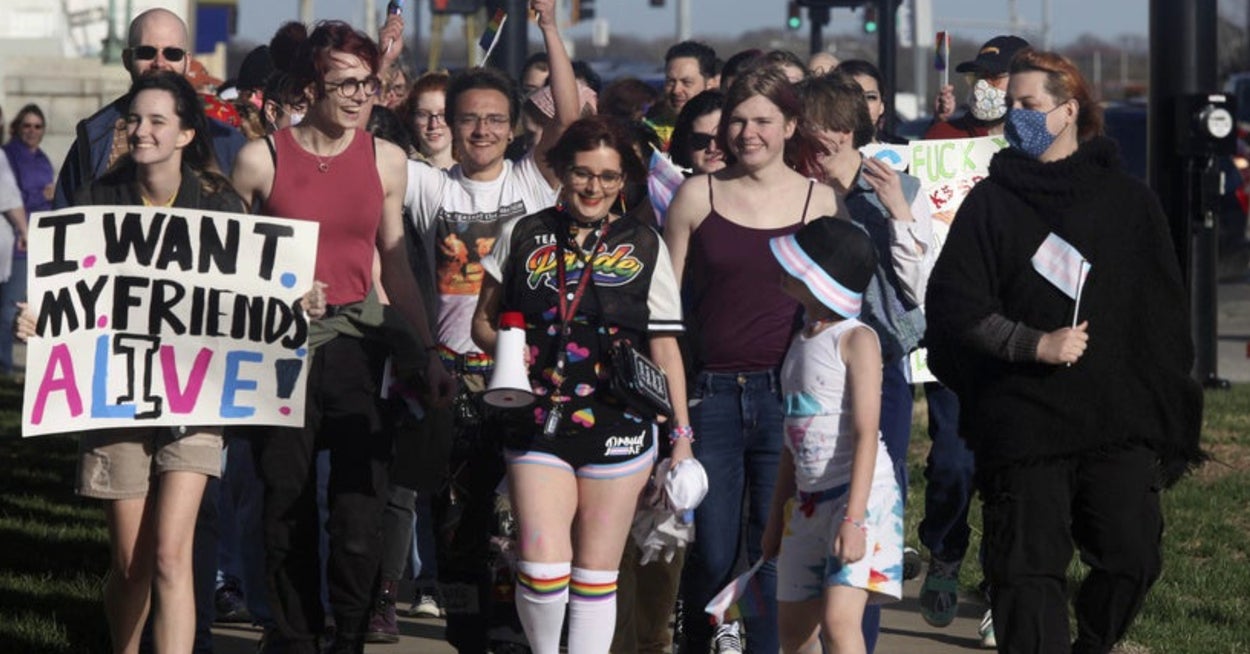
TOPEKA, Kansas — In a dramatic and sweeping move on Tuesday, the Kansas state legislature delivered a forceful blow to the rights of transgender residents, passing a series of bills that collectively represent one of the most aggressive anti-trans legislative packages in the nation. With a two-thirds majority in both chambers, Republican lawmakers have effectively dared Democratic Governor Laura Kelly to veto their measures, having already secured the raw numbers needed to overturn her objections. This renewed assault on the transgender community—particularly on transgender youth and athletes—has sent shockwaves through civil rights advocates and legal experts alike, who are bracing for a wave of litigation while the state’s most vulnerable residents face an increasingly hostile legal landscape. The bills passed with a velocity and scope that indicates a coordinated, deliberate strategy to reshape the state’s social fabric around rigid binary definitions of sex, despite the profound human consequences.
The first of these measures, a sports ban, directly targets a vanishingly small population of student athletes. Proponents argue that allowing transgender girls to compete on sports teams that align with their gender identity creates an unfair competitive advantage against cisgender girls. They claim that the legislation is necessary to protect the integrity of women’s athletics. However, data from the Kansas State High School Activities Association reveals just how microscopic this issue actually is: at the high school level across the entire state, there are currently only three transgender girls competing in sports. These three individuals have become the centerpiece of a statewide legislative crusade, raising fundamental questions about whether the policy is aimed at solving a substantive problem or simply engaging in a cynical act of cultural warfare against a marginalized minority. The disparity between the scale of the purported threat and the scale of the legislative response is staggering, highlighting that the impetus for the bill is ideological rather than practical.
When queried by BuzzFeed News about the invasive measures that could accompany such a ban—namely, the potential for genital inspections or forced chromosomal testing of athletes—Republican state Sen. Mike Wasinger declined to address the specifics directly. Instead, his defense rested on standard, already-existing protocols. “Sports physicals are done for every athlete participating in schools sports. Every child in Kansas must provide a birth certificate to attend school in Kansas. Both should be enough for any student,” he stated in a prepared statement. This response, which conflates medical readiness for physical activity with sex verification, conveniently ignores the practical reality that birth certificates can be amended and that standard sports physicals do not involve genetic, hormonal, or anatomical testing of the kind that would be necessary to verify a person’s sex at birth under a strict binary definition. The proposal to rely on these documents as immutable proof of biological sex underscores either a fundamental misunderstanding of human biology or a deliberate obfuscation at the heart of the legislation. Civil rights attorneys have pointed out that relying on birth certificates is particularly problematic, as they are often issued based on a visual inspection at the moment of birth and do not account for the complexities of intersex variations or hormonal differences.
However, the sports ban is just the tip of a much larger and more invasive iceberg. On the same day, the legislature passed Senate Bill 180, a behemoth piece of legislation that Republicans have euphemistically dubbed the “Women’s Bill of Rights.” This bill is far more insidious than the sports measure, weaving together a tapestry of restrictions that affect transgender people of all ages in nearly every corner of public life. SB 180 explicitly prohibits transgender individuals from using public restrooms and locker rooms that align with their gender identity. This mandate forces trans people into an impossible dilemma: they must choose between escalating harassment, bullying, and the threat of physical violence in the facilities they are legally forced to use, or risk breaking the law by seeking safer alternatives. For teachers, students, and working professionals alike, the simple act of using a restroom becomes a terrifying minefield of legal culpability and social ostracization.
Perhaps even more devastating for the long-term stability and safety of transgender residents is the provision that strips them of the ability to change their name and gender markers on their official driver’s licenses. For many trans people, having official identification that matches their present-day identity is not a matter of mere convenience, but of fundamental safety. Being “outed” by a mismatched ID during a routine traffic stop, a job application, or a medical appointment can lead to terrible discrimination in employment, housing, and healthcare. It can put individuals in immediate physical danger, particularly during encounters with law enforcement where tensions are already high. By legally erasing the ability to update these documents, the state ensures that transgender Kansans will carry with them a permanent, visible marker of their lesser legal status, creating a lifelong bureaucratic barrier that will follow them from state to state and from year to year.
The bill goes further still by defining sex in stark, binary, and immutable terms, declaring a person to be “either male or female, at birth.” This rigid legal definition doesn’t merely ignore the existence of intersex people—those born with variations in sex characteristics that do not fit typical binary definitions—it actively seeks to erase them from legal recognition. Advocates for civil rights have warned that this language, combined with the other punitive provisions, paves the way for the complete legal erasure of transgender, gender-nonconforming, and intersex individuals. They argue that by enshrining this definition into state law, the legislature is laying the groundwork for stripping anti-discrimination protections from a wide range of people and facilitating further discrimination in healthcare, marriage, and public accommodations. The term “Women’s Bill of Rights” is, in this view, a misnomer, as it does nothing to protect women and instead serves as a legal weapon to harm a tiny demographic.
Kansas is not acting in a vacuum. The state’s sweeping legislative package is the latest and most aggressive example of a national trend where conservative lawmakers are bundling multiple restrictions into single, omnibus bills designed to overwhelm opposition and expedite their legal consequences. Just last week, Kentucky’s Republican-controlled legislature overrode the veto of its Democratic governor to pass its own omnibus anti-trans bill. That Kentucky law went even further in scope in some areas, banning gender-affirming medical care for transgender youth, barring those youth from bathroom facilities corresponding to their identifying gender, and explicitly granting school officials the legal right to refuse to use students’ preferred pronouns. The coordinated strategy across state lines indicates a deliberate, highly organized move by national conservative advocacy groups to target transgender individuals at the state level, often circumventing federal protections and creating a checkerboard of rights across the country.
The political alignment in Kansas makes any pushback from the executive branch largely symbolic at this point. Governor Kelly has repeatedly voiced support for the transgender community and has vetoed similar, smaller bills in the past. However, the math is brutally simple and unforgiving: the Republican Party holds a supermajority in both the Kansas House and the Kansas Senate, giving them more than enough votes to override any veto with a simple two-thirds majority. This removes any substantive check on the legislative body, transforming the veto process into a theatrical rubber stamp that merely delays the inevitable. The supermajority allows the party to pursue extreme measures without the need for bipartisanship or compromise, and the absence of a governing check makes the passage of constitutionally questionable laws far easier than in states with more balanced legislatures.
The timeline for this legislation is aggressive and swift. Unless a judge steps in to grant a temporary injunction or a permanent block, the sports ban is slated to go into effect on July 1. Legal challenges are virtually assured, as civil rights organizations like the ACLU and Lambda Legal have a well-documented track record of suing states over such laws, and they likely already have legal briefs drafted. Federal courts have been markedly inconsistent in their handling of these matters, with some federal judges blocking them on equal protection and due process grounds, while others have allowed them to stand in the interim. The Supreme Court’s recent jurisprudence, which has devolved significant social policy discretion back to the states, has emboldened some lower courts to give legislatures more latitude in defining their own social policies, making the outcome of any future litigation highly uncertain.
The practical implications for the three transgender high school athletes in Kansas are immediate and drastic. They face the prospect of being barred from the teams they have trained with, the camaraderie they have built over years, and the scholarship opportunities they may have worked toward. Yet the ripple effect extends far beyond the playing field. Restroom bans affect daily necessities like going to school, working, or buying groceries. The ID restrictions affect travel, banking, and even the simple process of voting. By combining these disparate threads into one sweeping piece of legislation, Kansas Republicans have signaled that the state intends to make life functionally unlivable for transgender residents, hoping they will relocate to more welcoming states. The message is not simply about fairness in sports; it is about establishing a comprehensive system of carceral and bureaucratic exclusion.
Furthermore, the framing of the “Women’s Bill of Rights” plays into a false binary that ignores the reality of human biology and the lived experiences of millions. Intersex individuals, who possess a chromosomal or anatomical makeup that doesn’t fit strictly as “male” or “female,” will be forced into a legal category that does not reflect who they are. This is a clear violation of their inherent dignity and forces doctors, schools, and government agencies into impossible positions when confronted with the complexity of human biology. The public health impact is also profound; forcing trans youth into spaces where they are treated as outsiders significantly increases their risk of bullying, depression, anxiety, and suicidal ideation. Medical professionals have consistently opposed such legislation, noting that it is harmful to the mental and physical well-being of the individuals it targets.
In response to the passage, advocacy groups have decried the move as a targeted act of cruelty that has little to do with women’s safety or fair competition. They point out that women’s sports have existed for decades without these invasive measures and that the perceived threat is a phantom designed to rally a political base. The fact that Kansas has only three trans girls in high school sports is a testament to that phantom nature. Lawmakers are choosing to solve a problem that does not exist, while simultaneously crafting a solution that will cause unimaginable harm to the few individuals it actually targets. As the July 1 effective date approaches, all eyes will turn to the federal courts, where the future of Kansas’s transgender residents now hangs precariously in the balance. The legal battle will likely be protracted, costly, and emotionally draining for families already under siege. But one thing is clear: the state of Kansas has chosen to make itself the epicenter of the culture war on transgender rights, and the human cost of that war will be measured not in political victories, but in the shattered lives of its most vulnerable citizens. For now, the legislature has spoken, and the message is chillingly clear to transgender Kansans: you are not welcome here.