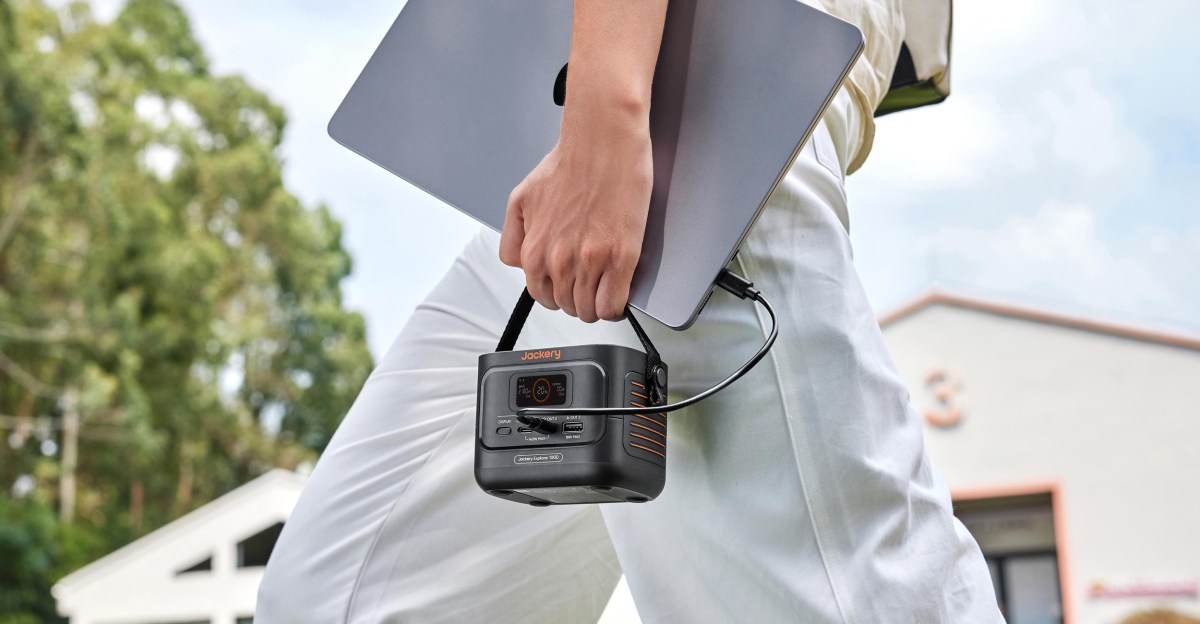
Jackery Explorer 100D Review: A Tiny LFP Power Station Built for Travel, Daily Carry, and Long-Haul Flights
Jackery has been a familiar name in portable power for years, but the company is usually associated with large, heavy power stations that can run appliances, charge an electric cooler, or keep the lights on during a blackout. With its latest release, Jackery is going in the opposite direction. The new Jackery Explorer 100D is the company’s smallest power station to date, and it is designed to slip into a backpack, fit inside a carry-on, and travel wherever you go. It packs a 96Wh battery, a pair of powerful USB-C ports, and a lithium iron phosphate (LFP) chemistry that Jackery says is safer and longer-lasting than the lithium-ion cells found in most portable chargers.
Measuring just 4.6 by 3.4 by 3.4 inches and weighing only 1.87 pounds, the Explorer 100D is closer to a large power bank than to the generator-style units Jackery is known for. But it is not just a simple phone charger. It has enough capacity and output to recharge laptops, tablets, cameras, drones, and multiple phones during a long flight, a day out, or a weekend camping trip. The 100D’s 96Wh capacity is important for air travel because it sits under the common 100Wh limit for lithium-ion batteries that airlines allow in carry-on luggage. Travelers should always double-check with their specific carrier, but the Explorer 100D is clearly aimed at people who want a serious portable power source without running into airport restrictions.
Pricing and Availability
The Jackery Explorer 100D will be available starting November 15th through Walmart for $99. If you do not want to wait, Costco already has the power station, but only in a two-pack that sells for $179.99. That works out to roughly $90 per unit, so the Costco bundle is a slightly better deal for anyone who needs two units or wants to share one with a family member. The Walmart price is still competitive for a power station with LFP cells, especially when you consider how long the battery is supposed to last.
There are certainly smaller and cheaper 30,000mAh portable chargers on the market, and you can find no-name power banks for far less than $99. But the Explorer 100D is not trying to compete with those disposable-looking accessories. According to Jackery, the LFP cells inside the 100D are engineered for up to 8 years of regular use, with a 3,000 charge cycle lifespan. That is a huge advantage over standard lithium-ion batteries, which typically degrade after a few hundred cycles. Over the long run, the 100D might outlast several cheaper power banks, making it a smarter investment for people who rely on portable power every day.
Why LFP Batteries Matter
Jackery first introduced lithium iron phosphate batteries in its products in 2023, and the Explorer 100D continues that push. LFP is a type of lithium-ion battery chemistry that uses iron and phosphate instead of the cobalt-based materials found in many consumer electronics batteries. The chemistry has become popular in electric vehicles, home battery storage, and portable power stations because it offers two major benefits: safety and longevity.
LFP batteries are more thermally stable than standard lithium-ion cells, which means they are less likely to overheat, catch fire, or enter thermal runaway. That is a significant consideration for anyone who wants to toss a power station into a carry-on and store it in an overhead bin. While all lithium batteries are subject to strict airline rules, LFP chemistry gives users an extra layer of confidence.
Longevity is another major selling point. Jackery rates the Explorer 100D for 3,000 charge cycles. A charge cycle is a full discharge and recharge, and most people do not drain a power station completely every day. If you use the 100D a few times a week, the battery could realistically keep delivering strong performance for many years. The 8-year figure Jackery mentions assumes regular use, but even if you are a heavy user, the LFP cells should hold up much better than a conventional lithium-ion pack.
Design and Portability
The Explorer 100D is small enough to fit in the palm of your hand, but Jackery has not stripped away the features that make its larger power stations useful. The unit includes an integrated handle, which makes it easy to pick up and carry. If you want a more hands-free option, Jackery also offers an optional shoulder strap, so you can wear the 100D like a small bag. That is a nice touch for long walks, concerts, photo shoots, or any situation where you need power on the go.
The compact dimensions also mean the 100D can be stored in a glove compartment, a desk drawer, a camera bag, or a small backpack. It is not much larger than a thick paperback book, and at under two pounds, it will not weigh you down. For frequent flyers, the size and weight are especially appealing because every ounce matters when you are hauling luggage through an airport. The 100D can sit at the top of a carry-on bag and still leave plenty of room for clothes, toiletries, and other essentials.
Ports and Charging Capabilities
On the front of the Explorer 100D, Jackery has included a pair of 140W USB-C ports and an additional 18W USB-A port. The USB-C ports are particularly useful because they can charge high-power devices like laptops, tablets, and some gaming handhelds at full speed. The USB-A port is handy for older devices, earbuds, smartwatches, or anything that does not require fast charging.
There is an important caveat: the Explorer 100D maxes out at 158W of total output. That means you cannot draw the full 140W from both USB-C ports at the same time, and if you plug in all three ports, the power station will have to divide its output among the devices. In practice, that is fine for most real-world situations. You could charge a MacBook Pro from one USB-C port while topping off a phone from the other, and the total draw would still be well under the limit. But if you try to charge two high-powered laptops at full speed simultaneously, one or both might charge slower.
The lack of an AC outlet is worth noting. Unlike Jackery’s larger power stations, the Explorer 100D does not include a standard wall socket. It is designed for USB-powered devices, not appliances. You will not be able to plug in a mini-fridge, a power tool, or a desktop monitor directly. That is a reasonable trade-off for the size, but it means the 100D is best thought of as a high-capacity, travel-friendly charger rather than a full home backup unit.
Solar Charging and Off-Grid Use
One of the most interesting features of the Explorer 100D is its ability to recharge from solar panels. The power station supports up to 100W of direct solar input. If you are away from an outlet and you have managed to pack a compatible solar panel, Jackery says the 100D can recharge to 80 percent capacity in about an hour and a half. That makes it a decent companion for camping, van life, hiking trips, or emergency preparedness kits.
Solar charging is not always practical because it depends on sunlight, panel placement, and weather conditions, but it is a valuable backup option. If you are out for a long weekend and you have a folding solar panel in your vehicle, you can extend the Explorer 100D’s usefulness indefinitely. It is a feature that most portable chargers do not offer, and it helps justify the price premium over a basic 30,000mAh power bank.
How Much Power Is 96Wh?
The Explorer 100D’s 96Wh capacity translates to 30,000mAh, which is a common capacity for large portable chargers. In real-world terms, 96Wh is enough to charge a typical smartphone many times over. A modern smartphone has a battery capacity of roughly 12 to 18Wh, so the 100D could theoretically provide several full charges before running dry. Of course, charging is never perfectly efficient, and some energy is lost to heat and voltage conversion, but the 100D will still handle multiple devices with ease.
For laptop users, the 100D is also useful. Many ultrabooks and compact laptops have batteries in the 40 to 60Wh range, so the Explorer 100D can top up a laptop once or even twice depending on the model and how much power it draws. That makes the 100D a great companion for people who work on the go, whether they are on a long-haul flight, working from a coffee shop, or covering a remote event.
Who Should Buy the Explorer 100D?
The Jackery Explorer 100D is aimed at a specific type of user: someone who wants more than a basic power bank but does not need the size, weight, or price of a full-size power station. It is ideal for frequent flyers who need to keep multiple devices charged during long trips. It is also great for outdoor enthusiasts who want a lightweight, solar-rechargeable power source for weekend adventures. Photographers and videographers will appreciate the ability to recharge camera batteries and drone batteries without hunting for an outlet. Students and remote workers can use it as a portable laptop charger that lasts all day.
It is not the right choice for someone who needs to run a portable refrigerator, a CPAP machine, or power tools. For those situations, Jackery still offers much larger power stations with AC outlets and thousands of watt-hours of capacity. But if your needs are limited to USB devices, the Explorer 100D could be the perfect middle ground.
The Bottom Line
The Jackery Explorer 100D is an intriguing addition to Jackery’s lineup because it proves that power stations do not have to be big and heavy to be useful. By combining a compact, carry-on-friendly design with LFP battery chemistry, multiple USB-C ports, and solar charging, Jackery has created a portable power solution that is practical for daily life and reliable for years to come.
The $99 price tag at Walmart is reasonable, especially given the 3,000-cycle lifespan and the safety benefits of LFP. If you prefer the Costco two-pack at $179.99, you can save a little money per unit and keep one at home while using the other for travel. Either way, the Explorer 100D stands out as one of the most travel-friendly power stations on the market, and it should be a strong contender for anyone who wants dependable, long-lasting power on the go.