Nintendo’s Switch 2 Remake of Ocarina of Time Modernizes a Legend — and Makes It Even More Unsettling
When The Legend of Zelda: Ocarina of Time first arrived on the Nintendo 64 in 1998, it wasn’t just another adventure game. It was a landmark. It proved that a sprawling fantasy epic could work in a fully realized 3D space, shaping the way developers approached movement, camera control, exploration, and open-world design for years afterward. Nearly three decades later, it remains one of the most important games Nintendo has ever created. But as beloved as it is, returning to the original today can be a challenge. The controls feel clunky by modern standards, the camera can fight against you, and certain design choices remind you how early the industry was in learning 3D game design. That is what makes the upcoming Switch 2 remake so promising. Based on my early hands-on time with the game, Nintendo may have cracked the code: the remake preserves the timeless epic that fans remember while removing the rough edges that made it difficult to revisit.
I spent about 90 minutes with the game at a preview event in New York City, playing through several sections of this reimagined adventure. The build included both the early moments when Link is a child exploring Hyrule and later sections where, after pulling the Master Sword from the Temple of Time, he becomes the Adult Link. Even in that limited time, I could feel the difference. This is not a simple remaster with better textures. It is a careful recreation that feels like a modern Zelda game while still honoring the original’s structure, pacing, and story. The narrative remains a standout. The emotional weight of Ocarina of Time’s famous time-jump story still lands, but now with a visual presentation that makes it even easier to lose yourself in the world.
One of the most immediately noticeable improvements is how snappy Link feels to control. Movement is fluid and responsive, and the lock-on combat system, which was revolutionary in 1998, feels more natural and engaging than ever. The remake also addresses one of the most frustrating aspects of the original: constantly pausing to switch items or weapons. In the original, navigating menus mid-dungeon could break the flow of combat and exploration. Now, holding a shoulder button slows the action and lets you switch items with the analog stick in near real time. It is a small change, but it makes a huge difference. The game feels less like a museum piece and more like a modern action-adventure, allowing you to stay in the moment while solving puzzles and fighting enemies.
The remake also comes with modern conveniences that make it more welcoming to players who were introduced to the series through Breath of the Wild or Tears of the Kingdom. There is a new progression marker called Threads of Time, which is accessible from the pause menu and helps you keep track of quests and objectives. The game also integrates with Zelda Notes in the Nintendo Switch app, allowing you to view maps and additional info on your phone. And yes, for the first time in many versions, there is a dedicated jump button. That change alone makes exploration feel less constrained and opens up new ways to interact with the environment.
The scale of the adventure, however, is much smaller than the modern open-world Zelda games. This is not a massive landscape filled with shrines and towers. Instead, it is a more focused, handcrafted journey through a Hyrule that feels compact but dense. The complexity of the quests and the tools available for combat and traversal are simpler than in the modern titles, but that simplicity is part of the charm. It feels like a classic adventure, yet it controls with the crispness of a modern one. That combination is hard to describe to someone who has never played the original, but it is exactly what makes this remake so exciting.
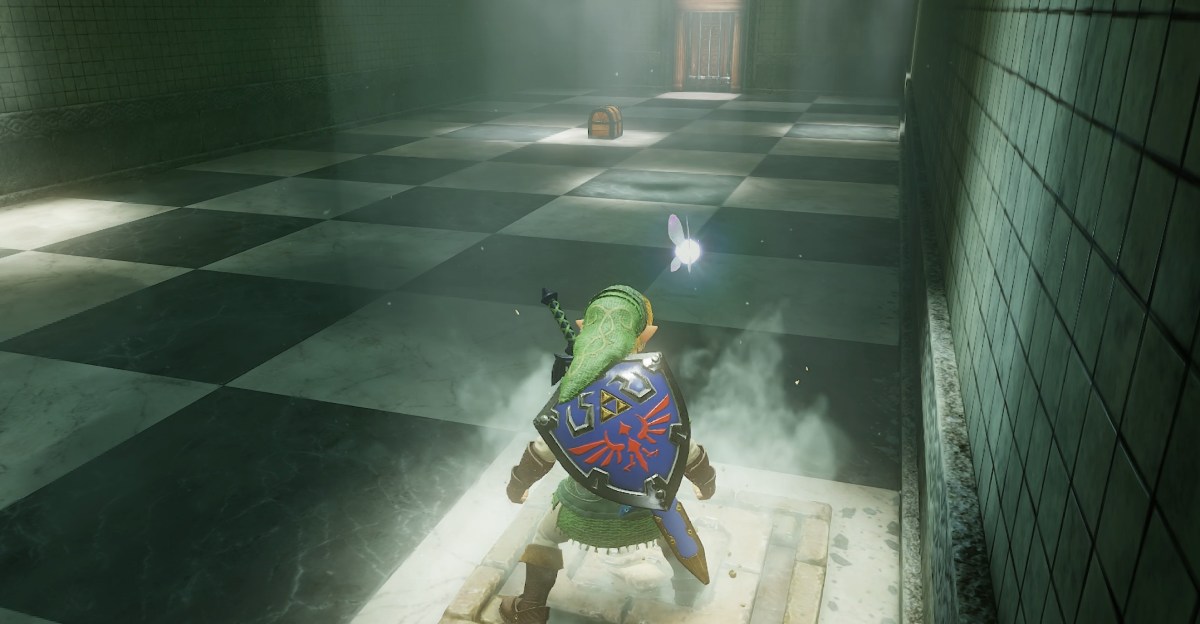
My favorite section that I played was the Forest Temple. This dungeon was already memorable in the original for its eerie atmosphere and clever puzzles, but the remake takes it to another level. The more realistic art style finally allows the game’s darker horror themes to breathe in ways that were simply not possible 28 years ago. The way light filters through the environment, the shadows that stretch across old stone, and the unsettling details in the architecture all combine to make the Forest Temple feel genuinely threatening. At one point, Link walks through a room with tall red stained glass windows. As he passes through beams of light, his body is cast in a deep, blood-red glow. It is a striking image that perfectly captures the feeling that this is a desperate journey to stop a cataclysmic evil. I actually stopped playing several times just to take in the visual changes. The atmosphere is that good.
Another welcome addition is the ability to control the camera with the right analog stick. This gives you the power to frame the action exactly the way you want, and it opens up opportunities for beautiful, cinematic moments. As someone who loves taking screenshots, I found myself constantly adjusting the angle to capture the new visual mood. The remake appears to have been built with attention to detail that rewards careful observation. Whether it’s the way light bounces off a shield or the way dust hangs in the air inside an ancient temple, there is a richness to the presentation that modernizes the game without losing its identity.
Ocarina of Time has always been a rite of passage for Zelda fans. It is the game that showed a generation what 3D adventure could be. But it can be tough to go back to the original after years of quality-of-life improvements in modern games. This remake solves that problem. It respects the past while making smart, thoughtful changes that make the game easier to get into for a new generation of players. It also arrives at a time when the Zelda franchise is bigger than ever. Breath of the Wild and Tears of the Kingdom have become massive sellers, bringing new players into the series, and the upcoming live-action Legend of Zelda movie is scheduled for April 2027. There has never been more interest in the franchise’s past, present, and future. This remake feels like the perfect bridge between that legacy and the new era.
From the few hours I had with the game, I am confident that Nintendo has delivered something special. The combination of modern quality-of-life features, stunning visual upgrades, and the timeless story of Ocarina of Time makes this the best version of a defining classic. It is not just an excuse to revisit a childhood memory; it is a full-fledged reinterpretation that makes an old master feel brand new. The horror moments are more chilling, the combat is more fluid, and the world is easier to lose yourself in than ever before. For longtime fans, this is the version they have been waiting for. For new players, it is the perfect introduction to one of the most influential games ever made.
The Legend of Zelda: Ocarina of Time launches for the Nintendo Switch 2 on Thursday, November 5th.