Ocarina of Time on Switch 2: A Timeless Legend Returns
There are few games more foundational to modern gaming than The Legend of Zelda: Ocarina of Time. Released in 1998 for the Nintendo 64, it was a landmark attempt to translate the adventure template of the 2D Zelda games into a fully realized 3D world. It taught players to lock onto enemies with Z-targeting, to ride a horse across a vast green field, to play songs that change the time of day, and to explore dungeons that felt vast and full of secrets. Decades later, in a remake built for Nintendo’s next console, that same adventure still feels magical — and now it feels more modern, more cinematic, and, surprisingly, more frightening.
Nintendo recently invited me to a preview event in New York City where I played roughly 90 minutes of the upcoming Switch 2 version. Based on my time with it, this looks like the best-looking and best-playing version of Ocarina of Time ever released. It doesn’t simply polish the graphics and smooth out the frame rate; it reinterprets the game in subtle ways that make it far more enjoyable to play in 2025. The controls feel snappier. The camera is no longer a constant source of struggle. And, for the first time, Link has a dedicated jump button.
That last addition is not as minor as it might sound. In the original N64 game, context-sensitive actions let Link leap across gaps or climb onto ledges, but only when the game decided he could. The new jump button gives players direct control over his vertical movement. It takes a moment to get used to, but it removes many of the old frustrations that came from trying to line up a jump or attack an enemy on a slightly higher platform. Combined with the ability to control the camera with the right analog stick — a blessing after years of awkward C-button camera control — the remake finally feels like a modern action game. Link can move fluidly, aim his jumps, and keep a steady view of the action.
One of the most welcome changes is how items and equipment are managed. In the original Ocarina of Time, using a different item meant pausing the game, opening a menu, and selecting the item you wanted from a grid. That broke the rhythm of combat and puzzle solving, especially when you needed to swap between a bow and a hookshot mid-battle. The Switch 2 remake streamlines this by allowing you to hold a shoulder button to bring up a radial wheel in near-real time. With the right stick, you can scroll through your inventory without fully halting the action. It’s a small change, but it makes a huge difference. Combat feels continuous and dynamic, and you’re more willing to experiment with different tools because there’s no friction in switching between them.
For those who may have come to Zelda through more recent entries like Breath of the Wild or Tears of the Kingdom, the remake also includes modern guidance systems. A new feature called Threads of Time acts as a progression marker in the pause menu. While it doesn’t hand-hold or tell you exactly where to go, it gives you a sense of your current objectives and where you are in the broader journey. This is particularly helpful for players who might otherwise feel lost in Hyrule’s large overworld and complex dungeons.
There is also integration with Zelda Notes through the Nintendo Switch smartphone app. You can view maps, dungeon layouts, and other helpful information on your phone as you play. This robs some of the purist challenge from the game, but for newer players it’s a safety net that makes the game far less intimidating. The original was known for cryptic hints and long stretches of silence before a puzzle clicked into place; now, if you’re really stuck, a quick look at your phone can point you in the right direction.
The sections I played included Link’s childhood, when he first leaves the Kokiri Forest, and much later, after he pulls the Master Sword and becomes an adult, seven years removed from his original mission. Despite playing only short, truncated sections, I came away convinced that Nintendo has done something special. The core story still shines: the sense of losing your childhood, the haunting emptiness of a Hyrule in ruins, the tragic figure of Sheik, and the ominous presence of Ganondorf. It’s all there, just rendered with more emotion and atmosphere than the N64 could ever produce.
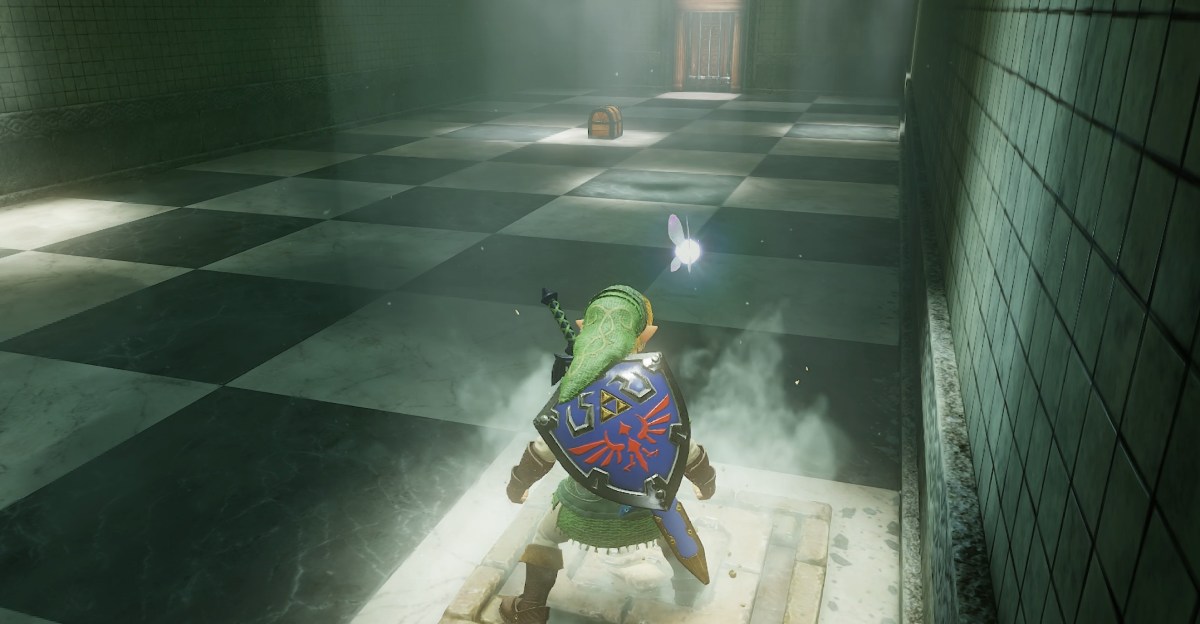
The highlight of my preview was the Forest Temple, one of the most memorable dungeons in the entire series. In the original, it was eerie and melancholic, with twisting corridors, wall paintings, and the weirdly creepy sound of a child humming. In the Switch 2 remake, it is positively unsettling. The new, more realistic art style gives the dungeon a tangible sense of decay. Red stained-glass windows line some of the halls, and when Link walks through their light, his body is bathed in deep crimson. It might sound simple, but the visual effect is striking. He looks like he’s passing through a cathedral of blood, and the mood becomes far heavier than the original could achieve. I found myself pausing just to take in the atmosphere, turning the camera around and watching Link step in and out of the colored light. It’s a reminder that Ocarina of Time’s dark themes — imminent doom, lost innocence, transformation — are not entirely absent from its brighter moments.
That right stick camera also lends itself to creating cinematic moments. If you’re the kind of player who loves to stop and take screenshots, this remake is a dream. You can easily frame Link against Hyrule Field’s rolling hills, or capture the moment he draws his sword in a dim temple corridor. The visuals are not just prettier; they’re more expressive, and the improved camera lets you appreciate every detail.
The scale of the game remains smaller and more intimate than the modern open-world Zelda titles. There are no climbing mechanics, no gliders, no massive map marked with dozens of shrines. Instead, the adventure is built around a carefully designed world where every area has a purpose, and each dungeon is a gauntlet of puzzles that build on one another. For players who grew up with Breath of the Wild, Ocarina of Time might feel simpler and more directed. But it’s no less compelling, and the tight, focused design is part of its charm.
Ocarina of Time is a rite of passage for any Zelda fan. It’s the game that established so many of the series’ most beloved tropes: the three sacred stones, the Master Sword, the time-split between child and adult, the idea that Hyrule is a place with a history and a future. Returning to the original version can be difficult for modern players; the controls are dated, the camera can be frustrating, and the menu-heavy item selection slows everything down. The remake addresses all of those issues while preserving the essential magic. It’s dramatically easier to pick up and play, which is exactly what a game of this importance needs.
And the timing could not be better. The Legend of Zelda franchise is experiencing a golden age. Breath of the Wild and Tears of the Kingdom have sold tens of millions of copies and continue to draw in new fans every year. A live-action Zelda movie is scheduled to arrive in April 2027, which will almost certainly introduce even more people to the series. But before that, Switch 2 owners will have the chance to experience the definitive version of the game that started it all — well, at least the definitive version in 3D.
If the full game lives up to the promise of this preview, The Legend of Zelda: Ocarina of Time on Switch 2 is not just a nostalgia trip. It’s a reassertion of why the game became a classic in the first place. In 1998, it showed us what was possible in three-dimensional game worlds. In 2025, it shows us that a great adventure can be timeless, especially when it’s put in the hands of developers who understand both what made it original and what would make it better.
The Legend of Zelda: Ocarina of Time launches for Nintendo Switch 2 on Thursday, November 5th.