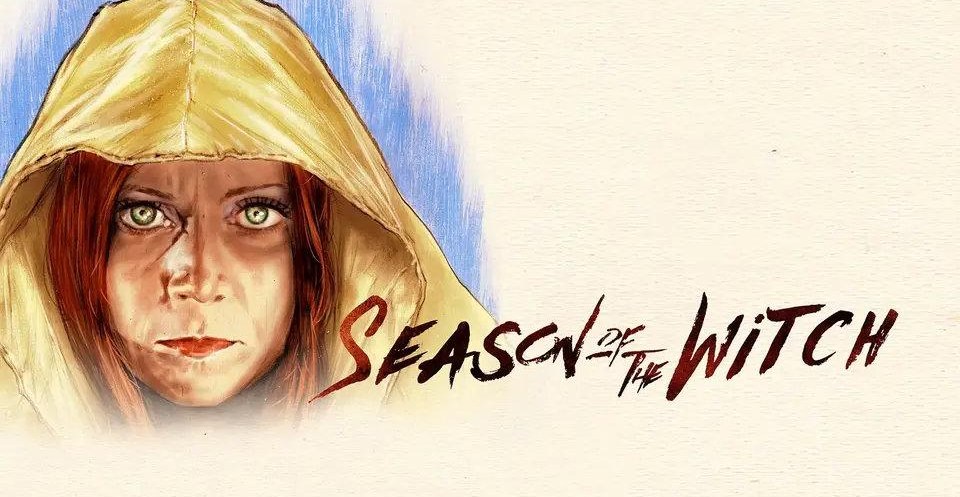
George A. Romero’s Forgotten Feminist Horror: Revisiting Season of the Witch
George A. Romero will forever be remembered as the father of the modern zombie movie. His 1968 landmark Night of the Living Dead didn’t just invent a genre; it redefined horror, turning flesh-eating ghouls into a mirror for American anxieties about consumerism, conformity, and social collapse. And with Dawn of the Dead in 1978, he cemented his reputation as a master of the macabre who could blend gore with sharp social commentary. Yet Romero’s filmography is far stranger and more varied than the zombie canon suggests. Between the revolutionary Night of the Living Dead and the outbreak horror of The Crazies, Romero quietly made two much lesser-known films: There’s Always Vanilla, a romantic comedy-drama that even many hardcore horror fans have never seen, and Season of the Witch, originally released under the much more provocative title Hungry Wives.
Hungry Wives was designed, at least on paper, to be an exploitation film. The studio that distributed it clearly wanted to cash in on the softcore porn boom of the early 1970s, packaging the movie with all the titillating promise that its title implied. But the film failed to find an audience, and it’s not hard to see why. Despite the marketing, Hungry Wives contains almost no nudity, features only a single sex scene, and is instead filled with long conversations about domestic frustration, identity, and the quiet desperation of suburban life. It was an undeniable flop upon its initial release in 1973. Years later, after Dawn of the Dead made Romero a household name among horror fans, the film was rereleased under the far more evocative title Season of the Witch, hoping to attract the attention of a new audience curious about the director’s earlier work.
Sadly, Romero’s original 130-minute cut of the film has been lost to time. However, parts of it have been recovered and restored over the years, allowing the movie to be expanded from its heavily truncated 89-minute release to a more complete 104-minute version. The fact that the distributor chopped away roughly 40 minutes of the film is itself an obvious reason for its initial failure. What Romero had actually made was not the sleazy exploitation picture the studio promised audiences. Instead, it was a slow-burn feminist drama in which the occult is almost incidental to the real story. The witchcraft is there, yes, but it functions less as a supernatural spectacle and more as a metaphor for personal liberation. This was not what audiences expecting softcore thrills wanted to see, and it’s easy to imagine their confusion and disappointment when the film they bought tickets for turned out to be a thoughtful, talky character study.
The film centers on Joan Mitchell, a woman trapped in an abusive marriage and deeply unhappy with her role as a submissive housewife. She lives a comfortable but suffocating middle-class existence, one that offers her no sense of purpose or agency. Her husband is emotionally cruel and controlling, and her daily routine is a monotonous cycle of domestic chores, social obligations, and quiet misery. Joan eventually turns to therapy in an attempt to understand her unhappiness, but it isn’t until she becomes involved with the occult that she begins to see a path toward escape. Witchcraft, for Joan, is not about devil worship or supernatural power in the traditional sense; it is about reclaiming control over her own body, her own desires, and her own future. It is a deeply personal and almost therapeutic form of rebellion against the patriarchal structures that have kept her imprisoned.
What makes Season of the Witch so interesting, and so ahead of its time, is how seriously Romero treats Joan’s journey. In the early 1970s, mainstream cinema rarely gave such nuanced attention to the interior lives of middle-aged women. Feminist themes were beginning to emerge in independent film, but they were still largely marginalized, especially in genre pictures. Romero, known primarily as a horror director, was working against type by making a film that is less concerned with scares than with psychological realism. The occult elements are present from the beginning, but they are woven into the fabric of Joan’s emotional awakening rather than being the sole focus. The movie is more interested in the reasons why a woman might turn to witchcraft than in the mechanics of the magic itself. In that sense, it feels remarkably modern, anticipating later feminist horror films that use supernatural elements to explore real-world oppression.
Of course, Season of the Witch has its issues, and it would be dishonest to pretend otherwise. The production value is quite low, even by Romero’s standards. The film was reportedly made for just $100,000, which is roughly $800,000 when adjusted for inflation. That budget is visible on screen in the film’s cramped sets, dated fashion, and occasionally clumsy editing. The acting is also wildly uneven. Star Jan White delivers an excellent performance as Joan, bringing real depth and vulnerability to a role that could easily have been reduced to a caricature. Her portrayal of a woman slowly awakening to her own power is the emotional heart of the film, and she carries the movie with remarkable grace. The same cannot be said for everyone else. Some of the supporting performers appear to be reading their lines directly off cue cards, while others chew scenery with a level of camp that borders on Pacino-esque excess. The tonal inconsistency between White’s grounded performance and the more theatrical supporting turns can be jarring, and it sometimes undermines the film’s serious intentions.
Still, there is something undeniably compelling about Romero’s directing and his boldly progressive take on feminism, especially for its time. Even with its flaws, Season of the Witch demonstrates that Romero was never just a horror filmmaker. He was a social satirist who used genre as a vehicle for exploring uncomfortable truths about American life. Here, he trades zombies for witches, but the underlying message is similar: the real monsters are often the everyday institutions and expectations that confine us. For all of its reliance on dialogue over action, the film still manages to build a tense and, at times, hallucinatory atmosphere. There are moments of dreamlike dread that feel distinctly Romero, even without a single ghoul in sight. The slow accumulation of unease, the sense that something is shifting beneath the surface of ordinary life, is handled with a deft touch that reminds viewers of his skill as a visual storyteller.
The film builds toward an ending that is somewhat predictable, especially for modern audiences familiar with feminist horror tropes, but it remains extremely satisfying nonetheless. Without spoiling the conclusion, it is enough to say that Joan’s journey reaches a point of catharsis that feels earned. The final moments resonate not because they are shocking, but because they are the logical culmination of everything Joan has been through. She has spent the entire film searching for a way out of her cage, and the ending honors that search with a quiet, almost poetic sense of justice. It is a conclusion that rewards patient viewers and reinforces the film’s themes of empowerment and self-determination.
For years, Season of the Witch was difficult to see, relegated to bootleg VHS tapes and occasional late-night screenings. Today, however, it is more accessible than ever. The restored version is available to stream on Mubi and Kanopy, giving modern audiences the chance to discover a fascinating footnote in Romero’s career. While it will never be remembered alongside Night of the Living Dead or Dawn of the Dead, it deserves to be recognized as an important work from a director who was never content to stay in one lane. It is a flawed, messy, but genuinely thought-provoking film that challenges expectations and offers a unique glimpse into the evolution of a legendary filmmaker. For those willing to look past its low budget and uneven performances, Season of the Witch reveals itself to be a hidden gem — a feminist horror drama that was far ahead of its time, and a testament to Romero’s enduring willingness to take risks.