The Cat-and-Mouse Battle Over Surveillance Cameras at Elgin Community College
ELGIN, Ill. — A quiet but determined standoff has unfolded at Elgin Community College, where staff members have taken it upon themselves to block the lenses of automated license plate reader cameras, only to find their efforts repeatedly undone by an unmarked vehicle that appears to belong to the surveillance company Flock Safety.
According to Heinrich, a staff member at the college who spoke about the ongoing situation, the conflict began when employees decided they no longer wanted the cameras to capture footage of students, faculty, and visitors on campus. Their solution was simple and improvised: black trash bags and zip ties. Staff members covered the cameras, hoping to prevent them from recording any more images. But the coverings did not stay in place for long.
Heinrich said that workers in an unmarked vehicle, which Heinrich assumed belonged to Flock, would arrive at the campus and remove the coverings. The pattern repeated itself over and over, creating a strange and somewhat surreal back-and-forth between the college staff and the company’s representatives.
“We were kind of in a back and forth for a bit where we’d cover, and then when they’d come to service, they’d remove,” Heinrich said. “Then we’d cover and then they’d remove.”
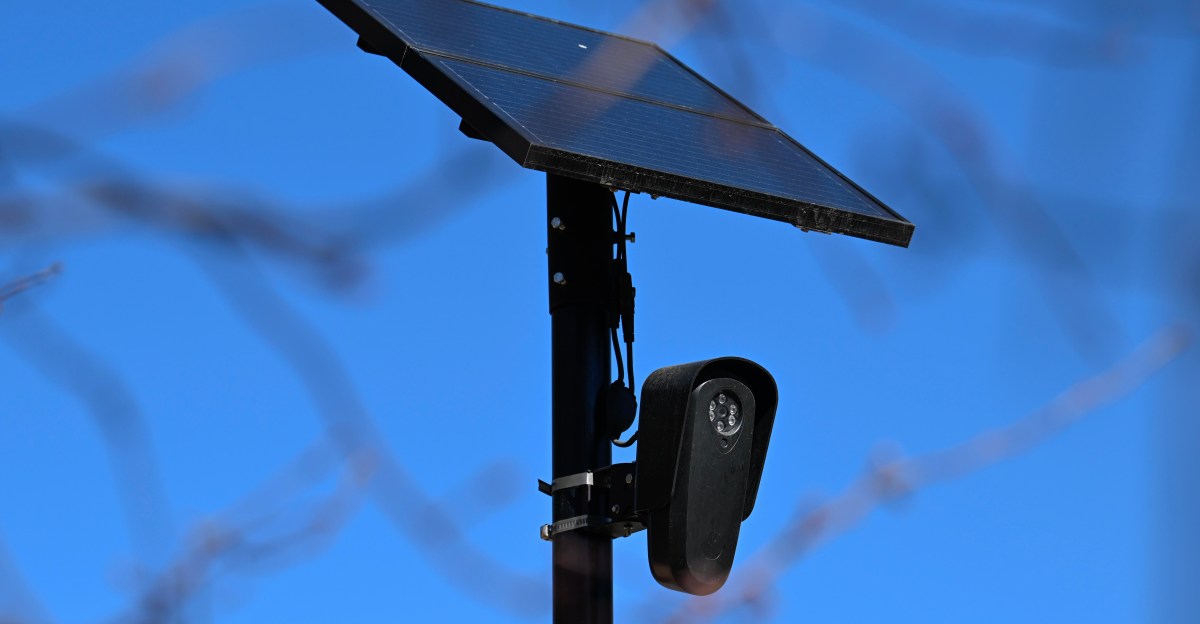
The incident raises broader questions about privacy, surveillance, and the role of private companies in public spaces. Flock Safety is a technology company that sells automated license plate recognition cameras to law enforcement agencies, neighborhood associations, and private property owners. The cameras are designed to capture every license plate that passes through a given area, creating a searchable database that can be used to identify vehicles associated with crimes, missing persons, or Amber Alerts. The company has grown rapidly in recent years, marketing its technology as a crime-fighting tool that helps police solve cases faster and deter criminal activity.
But critics have raised concerns about the proliferation of these cameras. Privacy advocates argue that automated license plate readers collect data on all drivers, not just those suspected of wrongdoing. This means that ordinary citizens who have never committed a crime can have their movements tracked, logged, and stored in a database. Over time, that data can reveal sensitive information about where people live, work, worship, seek medical care, or visit friends and family. For many, the presence of such cameras on a college campus feels particularly intrusive, since students and staff may spend large portions of their day in the same location, and the constant recording can create a chilling effect on free expression and assembly.
Elgin Community College, located in the northwest suburbs of Chicago, serves a diverse student body of thousands. Like many community colleges, it is a place where people from all walks of life come together to learn, work, and participate in public events. The decision by staff members to cover the cameras appears to have been motivated by a desire to protect the privacy of everyone who passes through the campus. By using black trash bags and zip ties, they made a visual statement that was hard to ignore. The cameras, which are typically mounted on poles and designed to be unobtrusive, suddenly became the center of attention.
Heinrich did not say whether the college administration had authorized the covering of the cameras. It is unclear whether the staff acted on their own or with the support of campus leadership. What is clear is that the act of covering the cameras was not a one-time protest. It was an ongoing effort, a deliberate campaign to block surveillance through direct action. And it was met with an equally persistent response from the company.
The unmarked vehicle that Heinrich described is notable. Flock Safety technicians and contractors often service cameras in the field, performing maintenance, cleaning lenses, updating software, and ensuring that the devices are functioning properly. The fact that the vehicle was unmarked may have added to the sense of unease. For Heinrich and others, the sight of an unidentified vehicle arriving to undo their work must have felt like a reminder that the cameras were not just passive tools, but part of a larger system that is actively maintained and defended.
The back-and-forth described by Heinrich suggests a kind of guerrilla conflict over public space. On one side, there are staff members who believe that the cameras should not be allowed to operate on campus without consent. On the other side, there is a company that has a contractual obligation to keep its cameras running. In the middle, there is the college community, which may or may not have been consulted about the presence of the cameras in the first place.
This is not an isolated incident. Across the country, communities have grappled with the spread of automated license plate readers. Some cities have passed ordinances requiring warrants before police can search license plate data. Others have banned the use of the technology altogether. In some neighborhoods, residents have welcomed the cameras as a way to reduce crime. In others, they have opposed them as an invasion of privacy. The debate often comes down to a fundamental question: how much surveillance are we willing to accept in exchange for safety?
Flock Safety has defended its technology by emphasizing its usefulness in solving crimes. The company has said that its cameras have helped recover stolen vehicles, locate missing children, and identify suspects in violent crimes. It also notes that the data collected by its cameras is not publicly accessible and is only shared with law enforcement agencies that have signed agreements with the company. However, critics point out that the retention of data, even if restricted, still creates a permanent record of where people have been. And in an era of data breaches and misuse, the risk of that information falling into the wrong hands is a real concern.
For the staff at Elgin Community College, the act of covering the cameras with trash bags was a form of protest that required no permission and no official approval. It was a simple, tactile way of saying that the cameras were not welcome. But the fact that the coverings were repeatedly removed shows how difficult it can be for ordinary people to push back against well-funded technology companies. The balance of power in this conflict is uneven. The company has the resources to send workers to service the cameras, while the staff has only trash bags and zip ties.
Heinrich’s account of the situation offers a glimpse into the frustration that many people feel when they discover that surveillance systems are operating in their communities without meaningful oversight. The cameras are often installed quietly, sometimes as part of a contract between the college and the company, or between the college and local law enforcement. By the time the public becomes aware of them, the infrastructure is already in place. Removing it is not as simple as unplugging a device. There are contracts, legal agreements, and financial commitments involved.
The use of black trash bags is particularly symbolic. Trash bags are not sophisticated tools. They are not designed to block cameras. But they are effective. A piece of plastic and a zip tie can render a high-tech surveillance device blind. It is a reminder that even the most advanced technology can be thwarted by simple, everyday objects. It is also a reminder that resistance to surveillance does not have to be complicated. It can be as straightforward as covering a lens.
The question now is what happens next. Will the college administration take a formal position on the cameras? Will the staff continue to cover them? Will the company continue to remove the coverings? And will anyone in a position of authority address the underlying privacy concerns that motivated the protest in the first place?
There is no easy answer. The cameras are already installed. The company has a business interest in keeping them operational. The staff members who covered them have made their views clear. But without a broader conversation about the role of surveillance on campus, the back-and-forth is likely to continue. Each side will keep doing what it has been doing, and the cameras will remain a point of contention.
In the meantime, the situation at Elgin Community College serves as a small but powerful example of how ordinary people can push back against the expansion of surveillance. It may not result in the removal of the cameras, but it has drawn attention to their presence. It has forced a conversation, even if that conversation is happening one trash bag at a time.
Heinrich’s words capture the absurdity and the seriousness of the situation. The back-and-forth, the covering and uncovering, the unmarked vehicle, the zip ties. It is a story about technology, privacy, and the lengths to which people will go to protect their own space. It is also a story about persistence. Neither side seems willing to give up. And so the cameras remain, covered and uncovered, as the debate over surveillance continues.
For now, the staff at Elgin Community College have made their position clear. They do not want the cameras to watch them. Whether they will succeed in keeping the cameras covered is another matter. But their actions have already raised an important question: who decides when and where surveillance is allowed? And what happens when the people who live and work in a place decide that they do not want to be watched?
The answer, at least in this case, is a quiet battle fought with trash bags and zip ties. And it is far from over.