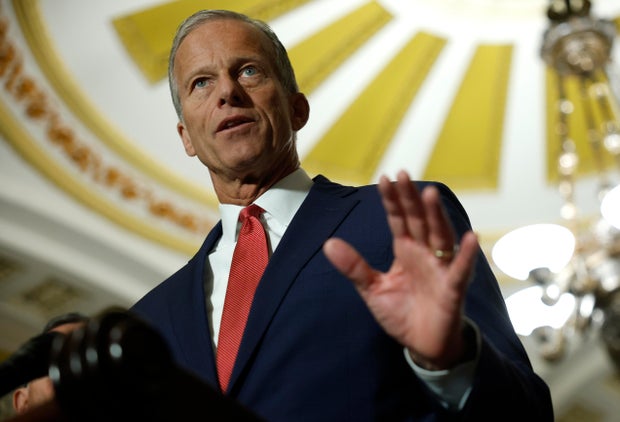
In Washington, D.C., a significant procedural development occurred as Senate Republicans, led by Senate Majority Leader John Thune, initiated a change to the Senate rules, aiming to streamline the confirmation process for President Trump’s nominees. This move came in response to what the Republicans labeled as a deliberate delay tactic by the Democrats, who have been stalling these confirmations as a form of protest against the President’s policies.
For several months, the GOP has been vocal about their discontent with the Democrats’ strategy to impede the confirmation process, which has recently escalated to unprecedented levels. In a bid to counteract these delays, discussions among Senate Republicans culminated in a formal proposal by Thune. This proposal suggested a new approach where non-cabinet executive branch nominees would be considered in groups, rather than individually.
“We’ve got a crisis,” Thune explained in a press conference. He emphasized the necessity to restore and codify what he described as standard practices in Senate operations—namely, acting swiftly on presidential nominations. This, he argued, was essential to ensure that the President could effectively establish his administrative team and allow the Senate to concentrate on its legislative responsibilities.
Thune highlighted that his proposal, although pioneering in its current context, was not without precedent or bipartisan foundations. He referred to a similar proposal from 2023, backed by Democratic Senator Amy Klobuchar and Independent Senator Angus King, which also advocated for the en bloc (grouped) confirmation of up to ten nominees. However, he noted that his current proposal was slightly less extensive since it focused only on subcabinet level nominees and explicitly excluded judicial nominees.
The strategy to adopt this new rule kicked into gear on Monday when Thune initiated a resolution to allow the simultaneous consideration of 48 nominees. By Thursday, the Senate was positioned to proceed with a procedural vote on this resolution. Although it was anticipated that the vote might not meet the 60-vote threshold typically required to advance most measures, the Republicans were prepared to challenge this by calling for a simple majority vote instead.
As the Senate session unfolded, there emerged a hint of a possible bipartisan compromise. Thune mentioned that the potential agreement with the Democrats closely resembled the earlier proposal by Klobuchar and King. “It’s in their court,” Thune remarked, indicating that if the Democrats declined the compromise, the Republicans would proceed with their initial plan.
Efforts to reach a consensus continued into the afternoon, but the Democrats requested more time to solidify support and further discuss the details. The Republicans, eager to advance their agenda, decided not to delay the vote further.
When the procedural vote failed to garner the required 60 votes, Thune challenged the outcome by making a point of order. Subsequently, the Senate, along party lines, voted 53 to 45 to overrule the chair, thereby lowering the vote threshold to a simple majority. This maneuver often described as the “nuclear option,” effectively changed the dynamics and longstanding precedents within the Senate, particularly regarding how nominees are confirmed.
The move drew criticism from Senate Minority Leader Chuck Schumer, who warned that adopting such a position might lead to regrettable consequences. He argued that the Republicans were undermining the Senate’s role as a carefully deliberative body by rushing confirmations and potentially allowing less qualified nominees to assume critical positions. Schumer also referred to a failed negotiation that took place before the August recess, where the White House retracted from a deal that would have expedited the confirmation of a group of nominees in exchange for the release of already appropriated funds.
The push to amend the confirmation process is not new and has been a topic of discourse under both Republican and Democratic administrations. According to the Center for Presidential Transition, the time required to confirm a nominee has substantially increased over recent administrations, highlighting the procedural inefficiencies that have gradually embedded themselves within the Senate’s operational norms.
Reflecting on the proposed changes, Senator Angus King noted that the intended application of his and Klobuchar’s legislation was for future administrations, to ensure the removal of politics from the immediate nominating process. He expressed concerns that the revival of this legislation under current political circumstances might compromise its intended impartiality.
The Senate’s decision to alter its confirmation procedures marks a notable shift in how the legislative body operates, underscoring the lengths to which parties are willing to go to assert their political agendas. This development not only impacts the immediate political landscape but also sets a precedent that could influence the functionality of the U.S. Senate for years to come.