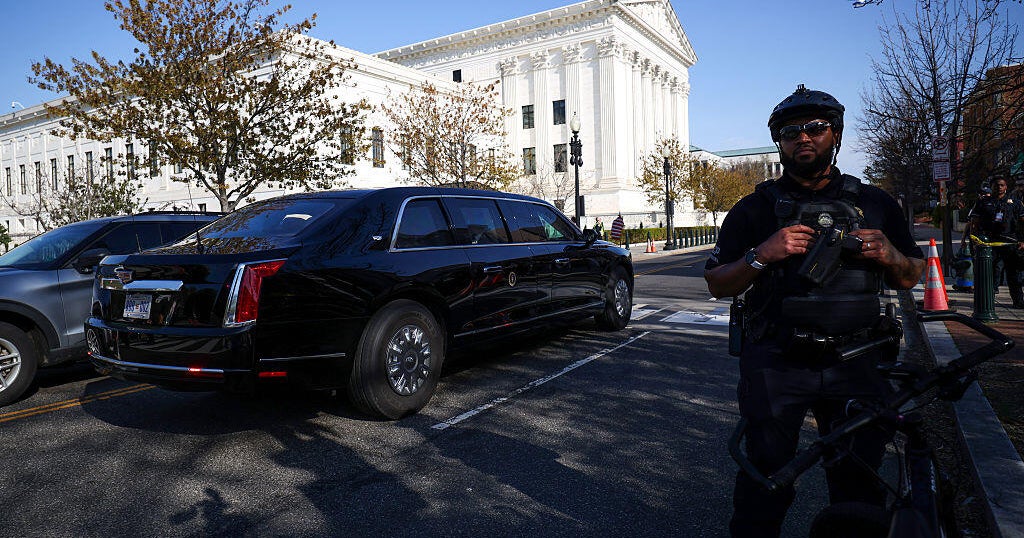
In an historic session, the Supreme Court of the United States heard arguments on Wednesday regarding President Trump’s controversial bid to terminate birthright citizenship. As one of the critical pillars of the President’s immigration policy, this high-stakes case drew significant attention, with the majority of the justices expressing skepticism towards Mr. Trump’s executive order.
The President was in attendance for the approximately 90-minute argument session, marking the first time a sitting president has attended Supreme Court oral arguments. Accompanying him were White House counsel David Warrington and Attorney General Pam Bondi.
In a post-argument statement on Truth Social, Mr. Trump wrote: “We are the only Country in the World STUPID enough to allow ‘Birthright’ Citizenship!”
Birthright citizenship, as it is currently understood, is based on the Citizenship Clause of the 14th Amendment, which has been in place for over a century. The clause states that “all persons born or naturalized in the United States and subject to the jurisdiction thereof, are citizens of the United States and of the state wherein they reside.” The interpretation of this clause has historically meant that nearly everyone born in the U.S. is automatically granted citizenship.
However, the President’s executive order, issued shortly after his inauguration, takes a narrower view, seeking to deny citizenship to children born in the U.S. to parents who are in the country illegally or temporarily. This order has been blocked by lower courts, which have deemed it likely to be illegal, and thus it has not yet taken effect.
The current case before the Supreme Court, known as Trump v. Barbara, is centered on whether the executive order complies with the 14th Amendment and an immigration law that dates back to 1952.
Solicitor General D. John Sauer represented the administration during the session, arguing that guaranteeing citizenship to the children of undocumented immigrants and temporary foreign nationals dilutes “the gift of American citizenship.” His argument was primarily based on the phrase “subject to the jurisdiction thereof” in the Citizenship Clause. According to Sauer, this phrase was understood in the 19th century to refer to individuals who are “domiciled” in the U.S., or those who are “lawfully present and have an intent to remain permanently.”
Sauer cited an 1898 Supreme Court case, Wong Kim Ark, to support his argument. In this case, the Supreme Court ruled that Wong, born to Chinese parents in the U.S., was indeed an American citizen. The court’s judgment referenced the parents’ “domicile” in the U.S. more than 20 times, a fact that Sauer asserts bolsters his argument that lawful permanent residence was seen as a prerequisite for citizenship.
Chief Justice John Roberts questioned Sauer’s interpretation of the amendment, finding it to be based on “very quirky” examples and taking issue with its broad application that would encompass millions of immigrants in the country illegally.
Justice Elena Kagan also found issue with Sauer’s argument, stating that “the text of the clause, I think, does not support you.” Justice Neil Gorsuch raised practical questions about defining “domicile,” and Justice Amy Coney Barrett questioned why the framers of the 14th Amendment didn’t explicitly mention that the clause applied only to those domiciled in the U.S., as Sauer suggested.
Justice Samuel Alito and Justice Ketanji Brown Jackson also raised concerns about the practical implications of Sauer’s arguments, particularly for undocumented immigrants who have established roots in the U.S. and for newborn children of parents without legal status.
The argument of the administration also touched on the issue of “birth tourism,” a practice where parents travel to the U.S. to give birth, thereby ensuring their child’s U.S. citizenship, which has been criticized by the Trump administration. Roberts, however, noted that this practice, regardless of its prevalence, did not affect the legal analysis of the case.
The argument against the President’s order was presented by Cecilia Wang, the legal director of the American Civil Liberties Union, on behalf of three parents whose children could be affected by the directive. Wang warned that a ruling in the administration’s favor would result in massive repercussions, rendering “swaths of American laws…senseless” and potentially placing the citizenship of millions of Americans at risk.
Wang argued that the justices’ focus on the concept of “domicile” in the Wong Kim Ark case was misplaced, asserting that the concept was not part of the court’s reasoning at the time.
Justice Brett Kavanaugh hinted that if the justices agreed with Wang’s interpretation of Wong Kim Ark, her side would prevail. A decision from the Supreme Court on this pivotal case is expected by late June or early July.