In a recent development that has caught public attention, President Donald Trump purchased over $1 million in stock of Dell Technologies earlier this year. The purchase is under scrutiny following the Pentagon’s announcement of a $9.7 billion contract with Dell, a leading computer company based in Texas.
This incident brings to the forefront the complexities that arise when a serving president continues to engage in buying and selling publicly traded stocks, such as Dell, even if it’s through financial advisors. This scenario gets further complicated given the fact that the president holds the power to make policy decisions which can directly or indirectly influence these same sectors.
In the initial three months of the current year, Mr. Trump’s investment portfolio executed more than 3,600 trades, as per a mandatory disclosure form. This involved buying and selling shares in large banks, manufacturers, and tech giants among other companies. The document revealed a Dell stock purchase ranging between $1 million to $5 million in February, and smaller amounts in the subsequent months. The document, in certain cases, provides ranges rather than specific amounts.
The Trump family has maintained that the president does not directly control the trading. The argument put forth is that these trades are automated and placed by external brokerage firms. “This structure was intentionally designed to maintain a clear separation between President Trump and the independent third-party investment managers overseeing the accounts, and to avoid even the semblance of any conflict of interest,” the Trump Organization stated earlier this month.
Anna Kelly, a White House spokesperson, echoed the same sentiment on Thursday, stating that Mr. Trump “only acts in the best interests of the American public.” She clarified that his assets are held in a trust managed by his children and added, “There are no conflicts of interest.”
However, the purchase of Dell stock brings new focus to the inherent issues arising from the Trump family’s extensive investments since Mr. Trump resumed his term in the White House. Their investments span across sectors like military drone manufacturing, cryptocurrency, mining, and the predictions market. These are the same sectors over which Mr. Trump exercises policy and government purchase decision-making power.
While it’s true that external advisors manage his financial accounts, these are not in a conventional “blind trust.” This implies that the president can still be cognizant of the moves made for his investments.
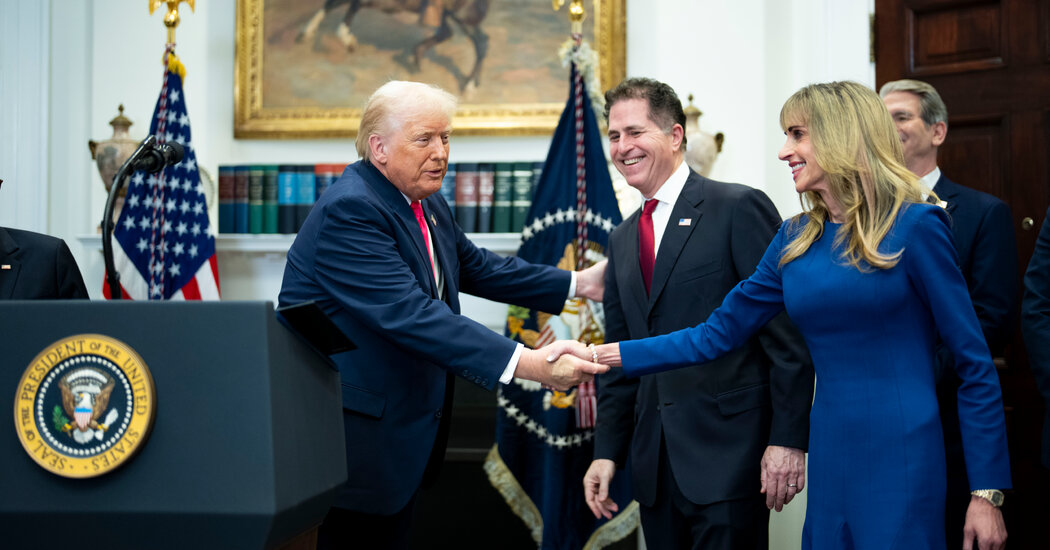
In addition to this, Mr. Trump took the initiative to publicly applaud Dell Technologies and its founder, Michael Dell, at an event in Georgia in February. This event took place nine days after Mr. Trump’s purchase of more than $1 million in Dell stock. The timing of this event has led to increased scrutiny of the President’s financial activities.
The event in Georgia was held post the pledge made by Mr. Dell and his wife in December to donate $6.25 billion to inaugurate the so-called Trump accounts program. This program creates special investment savings accounts with tax benefits for American children.
At the event, Mr. Trump lauded the Dell family’s donation and proceeded to endorse their computer products. “Go out and buy a Dell computer,” Mr. Trump urged the attendees.
The Pentagon contract, announced on Wednesday, grants Dell Federal Systems, a Dell subsidiary, the authority to supervise purchases across the Defense Department for Microsoft software, services, and licenses. This “blanket purchase agreement” is estimated to be worth $9.69 billion.
As the serving president, Mr. Trump is exempt from a conflict of interest law that prohibits federal employees from participating in actions in their official capacities that can benefit their own financial interest. Moreover, unlike other federal workers, he isn’t required to sell off financial holdings that could potentially result in a conflict of interest.
Robert Weissman, co-president of Public Citizen, a nonprofit group that has been vocal in criticizing the Trump family’s continued business activity, said the Dell stock purchase provides further evidence of the conflicts that have emerged in Mr. Trump’s second term.
“It is impossible to know where personal profit-making ends and policymaking starts with this president,” Mr. Weissman remarked.
This incident underlines the necessity for clearer boundaries and stricter regulations to prevent possible conflicts of interest. With the President holding the power to make policy decisions that can directly or indirectly influence the sectors he invests in, it’s essential to ensure that personal profit doesn’t supersede policymaking in any way.