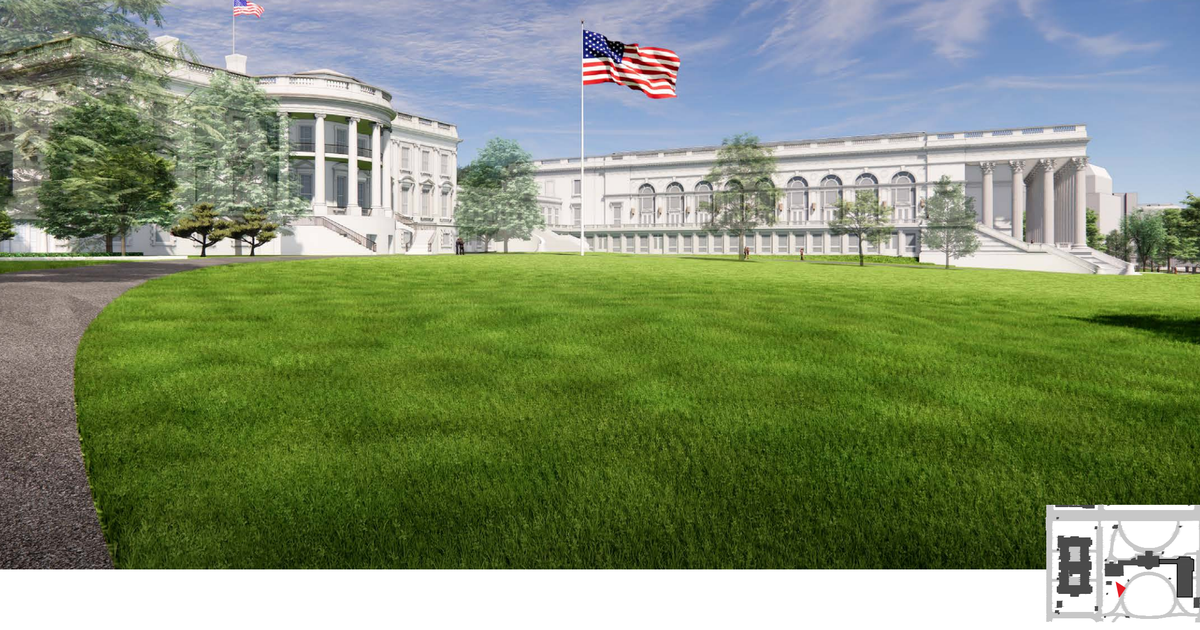
In a recent pivotal legal development, a federal judge has issued a temporary injunction against the Trump administration’s ambitious plan to construct a colossal 90,000-square-foot ballroom, aimed at replacing the White House’s East Wing. The decision, rendered by U.S. District Judge Richard Leon, emerges from a lawsuit initiated by the National Trust for Historic Preservation, which challenged the legal foundations of President Trump’s project on several grounds.
The lawsuit contends that the administration bypassed crucial federal guidelines and did not obtain necessary approvals before demolishing the East Wing to pave the way for the new ballroom—an assertion that led Judge Leon to conclude that the preservation group’s challenge would likely succeed based on legal merits. Central to Leon’s ruling is the judgment that the statutes the government relied upon do not confer the President the extensive authority he purported to possess for such architectural undertakings.
The essence of this controversy began when President Trump, harnessing the momentum of his administration, announced last summer the plans for the new ballroom. The announcement was quickly followed by the demolition of the East Wing by September, contrary to Trump’s earlier assurances that the existing structures of the White House would remain unaffected.
The project was expedited with approvals seemingly orchestrated with political convenience, as a panel from the U.S. Commission of Fine Arts, heavily composed of Trump’s allies, unanimously greenlit the proposal. Despite these rapid developments, fierce objections arose from various quarters, particularly congressional Democrats and preservation entities who censured the administration for the drastic changes being made to a historic edifice without sufficient public discourse.
In his scathing review of the arguments posed by the Justice Department, which defended the project’s financing mechanism largely funded through private donations, Judge Leon expressed concerns. He described the administration’s interpretation that allowed for the ballroom as an “alteration” under existing laws as a “brazen interpretation of the laws of vocabulary.” This sentiment underscores a broader implication of his ruling, emphasizing the symbolic stature of the White House as more than just a physical structure but a legacy held in trust for the nation.
Judge Leon explicitly noted in his decision, “The President of the United States is the steward of the White House for future generations of First Families. He is not, however, the owner!” This statement was part of his broader commentary underscoring the provisional nature of presidential authority over national monuments. He mandated that the construction project halt until an explicit authorization by Congress is secured.
The directive from Judge Leon comes as both a significant check on unilateral executive actions concerning national heritage properties and a reminder of the legislative powers held by Congress in matters of national property and spending oversight. He delineated that the executive might seek congressional endorsement at any time to resume construction using private funds.
Aside from the disputed ballroom, President Trump has embarked on several other significant architectural endeavors intended to imprint his vision on Washington’s landscape during his term. These include contentious plans to overhaul the Kennedy Center for the Performing Arts and erect a monumental triumphal arch in Virginia.
The funding arrangement for the ballroom has also raised eyebrows, described by Judge Leon as akin to a “Rube Goldberg” contraption for its convoluted process involving multiple stakeholders, including prominent corporations such as Lockheed Martin, Amazon, and Microsoft, which have considerable business dealings before the federal government.
Responding to the ruling, President Trump lambasted the decision, emphasizing a historical precedent of White House renovations that did not necessitate Congressional approvals, particularly when funded through donations. Meanwhile, Carol Quillen of the National Trust for Historic Preservation lauded the legal victory as a triumph for the American populace, significant in preserving the integrity of one of the nation’s most revered landmarks.
As the Trump administration signals its intent to appeal the decision, the case highlights the critical intersections of architecture, law, and heritage preservation. It represents a contentious chapter in the ongoing narrative of how modern necessities and historical preservation coexist within the framework of American governance and legal precedents.